
Disclosure: This page contains affiliate links. If you purchase through links to Amazon, AbeBooks, Bookshop.org, or Libro.fm, I may earn a commission at no additional cost to you. As an Amazon Associate I earn from qualifying purchases.
Which English translation of In Search of Lost Time should I read?
Lithub: “Really, Here’s Why You Should Read Proust” by William C. Carter
“I always tell anyone who might be intimidated by the many pages to be read that, although In Search of Lost Time is rich and complex and demands an attentive reader, the novel is never difficult…. Over the years, I have received unsolicited testimony from many such readers who say that Proust changed their lives by giving them a new and richer way of looking at the world…. In the closing pages, Proust urges each of us to comprehend, develop, and deploy our remarkable faculties. He intends his entire enterprise to persuade us that we are incredibly rich instruments, but that most often we let our gifts lie dormant or we squander them. The joy that so many readers feel at the conclusion of the book derives from the long-delayed triumph of the hero and the realization that we too can, by following his example, attempt to lead the true life. When the Narrator completes his quest, after many ups and downs and misunderstandings, the myriad themes—major and minor—beautifully orchestrated throughout, are gloriously resolved in the grand finale. This happy ending makes In Search of Lost Time a comedy of the highest order, one that amuses, delights, and frequently dazzles, as it instructs…. I urge anyone who loves books and who has not yet discovered Proust’s novel to pick up Swann’s Way and dive right in. I assure you that you will be richly rewarded.”
Here's a quick recommendation.
Read the 100-year-old classic!
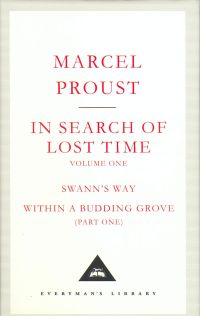
Get the Scott Moncrieff and Enright translation of In Search of Lost Time (published by Everyman's Library). Available as a hardcover (ISBN 9781841598963, 700 pages). Learn more about the Scott Moncrieff and Enright translation.
Want more choices? Keep reading for a comprehensive list of all translations and editions in English.
This page also provides more background on the work and a selection of related books and adaptations.
It also lists recommendations for different readers’ needs (e.g., affordability, scholarly apparatus, language style).
In Search of Lost Time: Translations in English
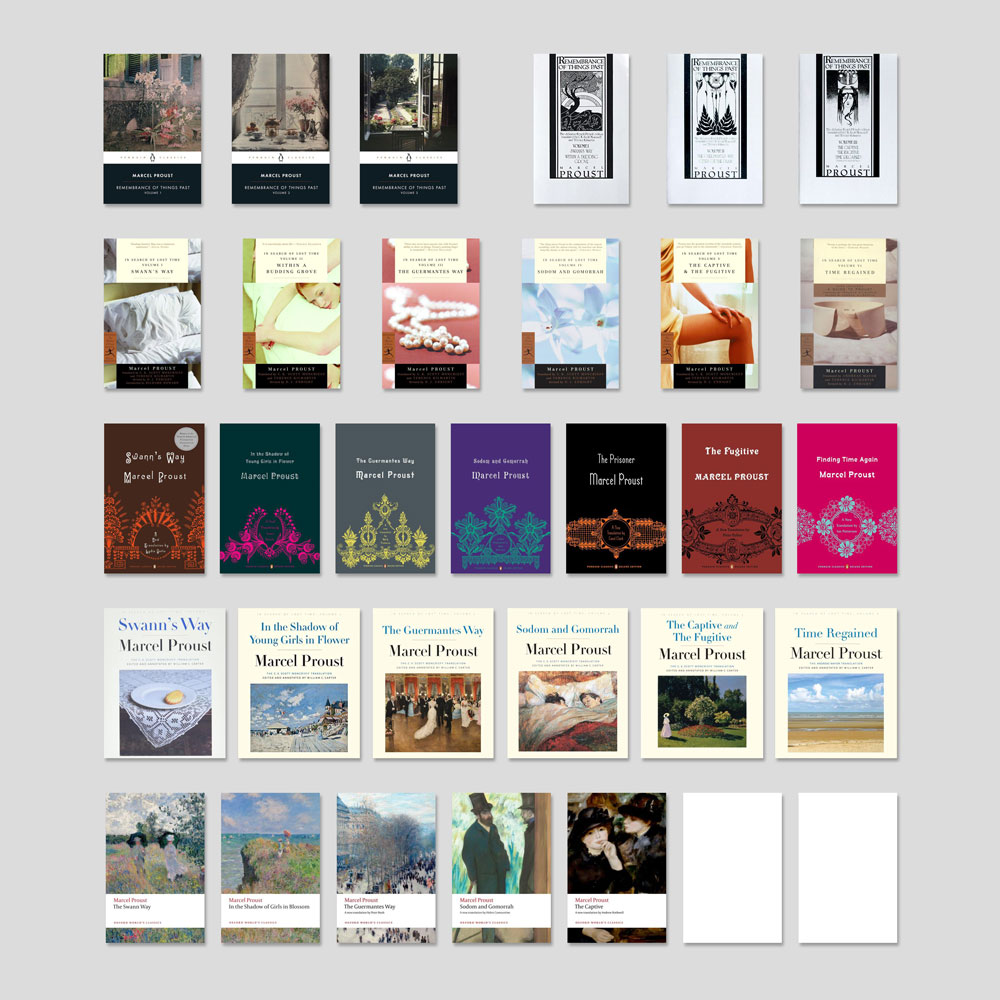
As of October 5, 2026, this list is (to the best of my knowledge) complete, and editions in bold are in print (or otherwise available).
- 1922-1930 — C.K. Scott Moncrieff
- 1981 — Scott Moncrieff revised by Terence Kilmartin
- 1992 — Scott Moncrieff revised by D.J. Enright
- 1995-2002 — Christopher Prendergast, editor
- 2013-2025 — Scott Moncrieff revised by William C. Carter (Yale)
- 2023-20?? — Brian Nelson and Adam Watt, editors (Oxford)
1922-1930 · C.K. Scott Moncrieff · Remembrance of Things Past
About C.K. Scott Moncrieff
Charles Kenneth Scott Moncrieff, surname “Scott Moncrieff”, was a Scottish writer, translator, and poet. He knew Scots, English, French, Italian, German, Latin, and ancient Greek (!!!). He died at age 40 without having finished his translation of Proust’s novel.
Jean Findlay, his great-great-niece, published a biography of him titled Chasing Lost Time: The Life of C. K. Scott Moncrieff: Soldier, Spy, and Translator and a volume of his writings titled ANT: Collected Short Stories, War Serials, and Selected Poems of C.K. Scott Moncrieff.
Sydney Schiff, who translated the final volume for publication in the UK in 1931, was a British novelist and translator who wrote under the pseudonym ‘Stephen Hudson.’ He was friends with Proust.
Wikipedia: “Stephen Hudson”
“Schiff’s novels are now almost entirely forgotten; but his and his wife’s significance as key figures of early Modernism, both as friends and facilitators to several major artists and writers, has recently been reassessed by Stephen Klaidman in a joint biography of the couple, Sydney and Violet: Their Life with T.S. Eliot, Proust, Joyce and the Excruciatingly Irascible Wyndham Lewis (2013).”
Frederick A. Blossom, who translated the final volume for publication in the US in 1932, was the American professor, editor, author, translator, and activist who was commissioned by Random House to translate volume 7. His translation is out of print.
» More about Frederick Blossom from the University of Wisconsin Digital Archive
» NYT Obituary of Frederick Blossom
About the Scott Moncrieff translation of In Search of Lost Time
Scott Moncrieff started his translation before Proust had finished writing all seven volumes.
Volume titles:
- Swann’s Way
- Within a Budding Grove
- The Guermantes Way
- Cities of the Plain
- The Captive
- The Sweet Cheat Gone
- Time Regained
Bookforum: “Review of Swann Songs: A new biography of translator C. K. Scott Moncrieff” by Eric Banks
“[Moncrieff] carried on with his own private translation without any commitment from a publishing house to back it up…. [Faults in his translation include] his sometimes purple prose (which Lydia Davis has called “dressy”), his reliance on faulty source materials, and the downright muddled passages in which he, perhaps out of sheer fatigue with the project, lost track of the narrative…. But as Jean Findlay reminds us in her new biography Chasing Lost Time, the fact that the second (and only other) English translation of Proust relied on seven translators (including Davis)—it being considered ‘beyond the capability of one single person to translate Proust’—only underscores how superhuman was the devotion and drive of Scott Moncrieff.”
Public Domain Review: “Lost in Translation: Proust and Scott Moncrieff” by William C. Carter
“Scott Moncrieff died in 1930, at age forty, leaving untranslated the final volume Le Temps Retrouvé. His task would be completed by Sydney Schiff, writing as Stephen Hudson. Schiff dedicated his translation: ‘To the memory of my friend CHARLES SCOTT MONCRIEFF, Marcel Proust’s incomparable translator.’”
FSG Work in Progress: “Soldier, Spy, Translator: The Life of C.K. Scott Moncrieff” by Jean Findlay
“So inspired was his translation that some critics felt he was improving on the original. Joseph Conrad wrote to him in 1922: ‘I was much more interested and fascinated by your rendering than by Proust’s creation. One has revealed to me something and there is no revelation in the other… [You have] a supreme faculty akin to genius…’ The Scott Moncrieff translation is widely seen as a literary masterpiece in its own right, and he is considered one of the great translators into English of the twentieth century….. Conscious of his task of selling Proust to the English-speaking world, he did not make an exact literal translation but a poetic one—one he knew would appeal to the post-Edwardian public—and one that has been the subject of appreciation and controversy ever since.”
New York Times: “Proust Re-Englished” by Richard Howard
“The Scott Moncrieff translation, based on the muddled and incomplete text which was all he had to work from, is embalmed among us as – well, semi-classical. (One recalls E.M. Forster’s praise of it in ”Aspects of the Novel.”) I disagree with this widespread but careless approval, and would seek out any excuse to dislodge the thing from such status. The text is frequently erroneous, almost always at odds with the temper of Proust’s prose: Where the original is infallibly immediate and alive, Scott Moncrieff sounds, to me, stale and dated.”
The Guardian: “The perfect Proust translation – but not for purists” by Jean Findlay
“The first volumes of A la Recherche du Temps Perdu were printed with quantities of typesetter errors; Proust’s elliptical sentences were hard to follow and his handwritten annotations on top of the typescript indecipherable in places. Scott Moncrieff not only understood Proust on a personal and cultural level, he had also worked in a newspaper office and knew how typesetter errors occurred. Despite having no access to the original manuscript, Scott Moncrieff had to be both the translator and, in many cases, the interpreter, using guesswork and intuition to find the right word or probable meaning. Nor did Scott Moncrieff have the time for slavish dedication to accuracy. He took on an enormous workload, including translations of Stendhal, Abelard and Heloise, and Pirandello, so as to feed “nine hungry nephews and nieces”. With one brother dead and the other improvident, he provided for their education and medicine…. [I]f you want to read the Proust that Proust saw published, that influenced Virginia Woolf and James Joyce, that is all of one piece and interpreted by someone as close to Proust’s sensibilities, education and experience as you can get, then you must read the Scott Moncrieff translation.”
Grand Street: “Translating Proust” by Terence Kilmartin
Kilmartin says Scott Moncrieff’s work was hampered by several disadvantages. For one thing, the first volume of his English translation was published before the last volume was published in France. “The complexities of the opening pages of the novel are especially difficult to decipher without the hindsight provided by the later volumes.” Another disadvantage was the “faultiness” of the French texts Scott Moncrieff had to work with. But also: “Scott Moncrieff’s knowledge of French was far from perfect. There is evidence of this throughout the novel—signs of haziness and uncertainty that in a less ingenious and resourceful translator would have been crippling. Time and again he fails to recognize quite ordinary set expressions. One finds him translating literally when English equivalents could and should have been found. We have, for instance, the Duc de Guermantes telling Swann that he is ‘as strong as the Pont Neuf’ instead of ‘as sound as a bell.’ … [C]areless or ignorant misreadings can sometimes distort the meaning of a whole passage or even make Proust say the opposite of what he intends…. When all this is said, however, it is extraordinary how successful Scott Moncrieff was…. [he] tried as a rule to stay as close as possible to the French text.”
Oxford University Press Blog: “Translating Proust Again” by Brian Nelson
“This translation was monumental in its scale and in many ways admirable in its realization. Moncrieff had a fine ear for the cadences of Proust’s prose, and a considerable talent for elegant phrasing. But his language dated over time, especially in dialogue, and from the beginning he was prone to tamper with the text, through embellishment or the heightening of language. The reservation most commonly voiced about his translation, indeed, is that it changed Proust’s tone. He tended to make Proust sound precious and flowery, whereas Proust’s style is not in the least affected or ornate. His prose is precise, rigorous, exact.”
Translation and Literature: “Scott Moncrieff s First Translation” by Peter France
“Charles Kenneth Scott Moncrieff (1889-1930) is one of the most visible of English-language translators. His virtually single-handed translation of Marcel Proust’s A la recherche du temps perdu, done in a mere eight years from 1921 to 1929, probably had almost as great an impact on English-speaking culture as Constance Garnetťs work on the Russian novel. It has been criticized (as inaccurate, too flowery, dated, etc.) and twice revised, but it survives to compete effectively with the more recent six-handed Penguin version.”
Boston Review: “Style over Substance: On Translating Proust” by Leland de la Durantaye
“There is always a tension in translation between the spirit and the letter, between conveying things we might call tone, mood, feel, or music, and being as literally faithful to the original as possible. Moncrieff excelled at both. He created a rich and recognizable style that became, for English readers, Proust. Because the translation was the only one in existence for so very long, it naturally became closely intertwined with the fate of the work in the English-speaking world…. Moncrieff gave the book’s opening section the heading ‘Overture.’ If we turn to the other translations we find no such heading…. This is not a sign that Moncrieff was a poor translator, but it is a sign that he was a very free one, ready and willing to depart from Proust’s text where he deemed it desirable.”
New York Times: “The Shape of Time” by Peter Brooks
“Scott Moncrieff may be pardoned for thinking of the early parts of the novel as a kind of series of tone poems, along with some purplish passages, which were his forte. What he couldn’t know was the rigorous architecture of the novel as a whole.”
The New York Review: “Kilmartin’s Way” by Roger Shattuck
“[T]he ‘old’ translation (unretouched Moncrieff followed by either Blossom or Mayor) works remarkably well. You need not throw away the edition in which you have read Proust, or still hope to read him, in the hope of obtaining the real thing that has been unavailable all these years. Moncrieff was a pro with staying power.”
The Common: “On Translation, Proust, and Advice for Young Poets: an Interview with Gregory Rabassa” by S. Tremaine Nelson
“SN: Did you read Proust in French originally? GR: Of course! SN: Which English translation do you recommend? GR: Moncrieff’s all right. He was criticized for the title. Moncrieff’s gesture was to throw ‘Remembrance of Things Past’ into the title. People who criticized him read too frivolously, people who hadn’t read Shakespeare’s 30th sonnet, ‘When to the sessions of sweet silent thought I summon up remembrance of things past.’ If you read the rest of the sonnet, it’s a pocket version of Proust’s novel, and Moncrieff saw that. Ramon and Proust. That was what switched me from being a chemistry and physics major to being a language major.”
From the Note on the Translation by Terence Kilmartin in the Scott Moncrieff / Kilmartin edition:
“A general criticism that might be levelled against Scott Moncrieff is that his prose tends to the purple and the precious—or that this is how he interpreted the tone of the original…. [I]n his efforts to reproduce the structure of those elaborate sentences with their spiralling subordinate clauses, not only does he sometimes lose the thread but he wrenches his syntax into oddly un-English shapes: a whiff of Gallicism clings to some of the longer periods, obscuring the sense and falsifying the tone. A corollary to this is a tendency to translate French idioms and turns of phrase literally, thus making them sound weirder, more outlandish, than they would to a French reader.”
From the Note by D. J. Enright on his revised translation:
“C. K. Scott Moncrieff excelled in description, notably of landscape and architecture, but he was less adroit in translating dialogue of an informal, idiomatic nature…. And some further intervention was prompted by Scott’ Moncrieff’s tendency to spell out things for the benefit of the English reader: an admirable intention (shared by Arthur Waley in his Tale of Genji), though the effect could be to clog Proust’s flow and make his drift harder to follow.”
From the General Editor’s Preface by Christopher Prendergast:
“There was indeed much to be corrected in Scott Moncrieff, on a scale from the trivial to the egregious.”
From the Translator’s Introduction by Lydia Davis to the Penguin translation:
“Much as one may argue with the specifics of Moncrieff’s decisions, however, his monumental work remains the standard by which all succeeding translations of Proust will be judged. Within the limitations of his approach, which was in part conditioned by his time and cultural milieu, Moncrieff’s ambition, to remain faithful to the shape of the Proustian sentence and the order in which it unfolded, and to create a rhythmic, coherent, eloquent text in English, was impressively fulfilled in Swann’s Way. His ear was for the most part sensitive, his handling of the language adroit, his mistakes in interpretation relatively few, given the sheer number of pages he translated.”
From the introduction by William C. Carter to his revision of the Scott Moncrieff translation:
“Part of the reason for the book’s success is Charles Kenneth Scott Moncrieff’s extraordinarily fine English translation of the first six parts, generally regarded as the best rendering of any foreign work into the English language…. Harold Bloom observes that Scott Moncrieff made it possible for In Search of Lost Time to become ‘widely recognized as the major novel of the twentieth century.’”
First sentence of the Scott Moncrieff translation of In Search of Lost Time
» See extracts to compare the translations of In Search of Lost TimeFor a long time I used to go to bed early. Sometimes, when I had put out my candle, my eyes would close so quickly that I had not even time to say 'I'm going to sleep'.

Get the Scott Moncrieff translation of Remembrance of Things Past (published by Penguin Classics)
Volume 1. Contains "Swann's Way" and "Within a Budding Grove". The translations are from 1922 and 1924, respectively.
Available as a paperback (ISBN 9780241610510, 1072 pages).

Get the Scott Moncrieff translation of Remembrance of Things Past (published by Penguin Classics)
Volume 2. Contains "The Guermantes Way" and "Cities of the Plain". The translations are from 1925 and 1927-9, respectively.
Available as a paperback (ISBN 9780241610527, 1200 pages).

Get the Scott Moncrieff translation of Remembrance of Things Past (published by Penguin Classics)
Volume 3. Contains "The Captive", "The Sweet Cheat Gone" and "Time Regained". The translations are from 1929, 1930, and 1931, respectively. "Time Regained" was translated by Stephen Hudson.
Available as a paperback (ISBN 9780241610534, 1072 pages).


Get the Scott Moncrieff translation of Remembrance of Things Past (published by Penguin Classics)
Volume 1. Contains "Swann's Way" and "Within a Budding Grove". The translations are from 1922 and 1924, respectively.
Available as an ebook (ISBN 9780241205938).
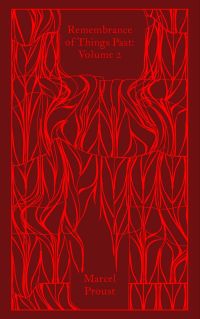
Get the Scott Moncrieff translation of Remembrance of Things Past (published by Penguin Classics)
Volume 2. Contains "The Guermantes Way" and "Cities of the Plain". The translations are from 1925 and 1927-9, respectively.
Available as an ebook (ISBN 9780241205952).
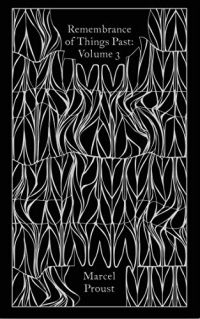
Get the Scott Moncrieff translation of Remembrance of Things Past (published by Penguin Classics)
Volume 3. Contains "The Captive", "The Sweet Cheat Gone" and "Time Regained". The translations are from 1929, 1930, and 1931, respectively. "Time Regained" was translated by Stephen Hudson.
Available as an ebook (ISBN 9780241205976).
1981 · Scott Moncrieff revised by Terence Kilmartin · Remembrance of Things Past
About Scott Moncrieff revised by Terence Kilmartin
Terrence ‘Terry’ Kevin Kilmartin was a translator and the literary editor of The Observer. He was born in Ireland and moved to England as a child. In addition to reworking Remembrance of Things Past, he compiled A Guide to Proust (originally published in 1983, now out of print but included in some versions of the novel—see below).
» An address read at the memorial service for Terence Kilmartin
About the Scott Moncrieff and Kilmartin translation of In Search of Lost Time
Kilmartin’s version is an edit of Scott Moncrieff’s existing English translation, except that Volume 7 was translated from French by Andreas Mayor in 1970.
Grand Street: “Translating Proust” by Terence Kilmartin
“Roger Shattuck…rebuked me very severely for failing to change the overall title…. I was indeed in favor of such a change, but allowed myself to be overruled by the publishers. I do not find it quite such a crucial issue as Shattuck and others do. Still, on balance I would have preferred to re-christen the novel In Search of Lost Time, even though the English phrase lacks the specific gravity of the French and misses the double meaning of temps perdu: time “wasted,” as well as “lost.”
This version includes a note on the translation, explanatory endnotes in each volume, addenda, and synopses.
Volume titles:
- Swann’s Way
- Within a Budding Grove
- The Guermantes Way
- Cities of the Plain
- The Captive
- The Fugitive
- Time Regained
From the “Note on the Translation” by Kilmartin:
He says that the French edition Scott Moncrieff was using was “notoriously imperfect” as a result of “Proust’s methods of composition,” which were chaotic and resulted in published books plagued by “errors, misreadings and omissions.” In 1954, the painstakingly revised and “virtually impeccable” Pleiade edition was published (in French). The differences are “sometimes considerable.” His version thus updates Moncrieff’s text to match the revised French source. He includes volume 7 as translated by Andreas Mayor, who was working with the revised French source. Kilmartin also corrects some mistakes in Scott Moncrieff’s translation, even making “extensive alterations”, but avoiding “officious tinkering.”
The Guardian: “The perfect Proust translation – but not for purists” by Jean Findlay
“After Proust died his brother Robert, a medical doctor, who himself died 13 years later, and Proust’s publishers, Gallimard, began work on a new version. It brought together all the notes they had found among the manuscripts. Proust would insert pieces of paper by way of revisions, and these gummed-on “paperoles” would often fall off. Gallimard and Robert Proust painstakingly reinserted these bits of sentences where they thought they ought to be. The result was an even longer novel: they added 300,000 words to the original 12 volumes. This “definitive version” was published by Gallimard in the 1950s, and reworked into Scott Moncrieff’s translation in the 1980s by Terence Kilmartin.”
From the General Editor’s Preface by Christopher Prendergast:
“Readers of Proust in English translation have been well served, above all by two truly heroic figures: first, C. K. Scott Moncrieff, and subsequently, Terrence Kilmartin. In relation to his own predecessor, Kilmartin… modestly billed his own effort as a ‘revision’ of Scott Moncrieff’s majestic, if in certain respects flawed, production…. [In terms of style,] Kilmartin’s description of his project as a ‘revision’ was excessively modest. It is in fact in very many ways a rewriting based on a quite different conception of the language and style of the novel as a whole.” Prendergast says Kilmartin’s goal was not to foreignize but to naturalize the language of the translation “to create for the reader the sense that he or she is reading a text as if it had been ‘originally’ written in the guest language.”
New York Times: “Proust Re-Englished” by Richard Howard
“Within the limits of his corrective enterprise, Mr. Kilmartin has done a conscientious and illuminating job. I can barely imagine the skills – beyond the dreams of dentistry – which such a labor of reconstruction must have demanded…. Major and minor, Mr. Kilmartin’s revisions occur almost sentence by sentence, always with great pertinacity…. He also offers at the end of each huge volume a valuable thematic synopsis, as well as a limited but extremely useful series of notes to explain literary and historical references -and inconsistencies – which occur throughout the text. Thirty notes for each thousand pages of a work published half a century ago is a modest enough apparatus, but an immediately helpful one, and I believe all new readers of Proust in English are in an inestimably advantageous position compared with their predecessors.”
The New York Review: “Kilmartin’s Way” by Roger Shattuck
“Definitive it is not. Vastly improved, yes. I take my hat off to Kilmartin for accepting the thankless task of cleaning up after a great translator, knowing that he would have to take the blame for all remaining weaknesses and would receive little credit for his contributions.”
Grand Street: “Translating Proust” by Terence Kilmartin
“[I]t was only the impending expiry of the Scott Moncrieff copyright that persuaded the publishers to initiate a revision of the entire text. I approached the task with some trepidation. On the one hand, I was warned that my tinkering would be regarded as lese-majeste if not sacrilege. On the other, I knew there were extremists who considered that nothing less than a complete re-translation could ever do proper justice to Proust…. As I worked my way through [Scott Moncrieff’s] text, I found myself alternating between delighted admiration of his elegant fluency and exasperation with his clumsy fallibility, his bowdlerising, archaising, prettifying.”
The New York Review: “Kilmartin’s Way” by Roger Shattuck
“Kilmartin’s ‘fix’ of Moncrieff has not caused deterioration or breakdown…. He was wise enough not to tinker idly and to keep repairs to a minimum. Kilmartin peered at or listened to every line of The Search. Small readjustments turn up everywhere, not just in sudden clusters.”
On the Translation of Volume 7 (Time Regained) by Andreas Mayor:
The Paris Review: “I have I Have Gone to Bed Early: Translating Proust” By Dan Piepenbring
Richard Howard said, regarding Mayor’s volume 7: “It was so good that there were plans to commission Mayor to do all the preceding parts, but then he died too.”
The New York Review: “Kilmartin’s Way” by Roger Shattuck
“Mayor, having displaced his rivals, also prepared notes for the revision of all Moncrieff’s version. He died before he could do the work. Using Mayor’s notes as well as comments garnered from critics who had discussed the translation, Kilmartin revised everything except Mayor’s version of the last volume…. Since its appearance a decade ago, Andreas Mayor’s translation of Time Regained has been judged the only one of the three to match Moncrieff’s sustained performance.
Reading Proust: Finding by Stephen Fall
“Random House commisioned [sic] a new version by Frederick Blossom under the title of The Past Recaptured. It was Prof. Blossom’s version that I read and reread many years ago, and I wouldn’t wish it upon anyone. Sydney Schiff’s translation apparently wasn’t highly regarded, either, for an entirely new translation by Andreas Mayor was commissioned and published in 1970. It is basically Mayor’s prose that appears in the Modern Library edition today, lightly edited by Kilmartin and Enright. There are wildly varying opinions of Mayor’s Time Regained, whether he restored Proust from Schiff’s depredations, or whether his work was a depredation in its own right.”
Bookforum: “Ruminations in an Emergency: A New Translation of Proust’s Late Masterpiece” by Rebecca Ariel Porte
To solve the conundrum of Time Regained, the Modern Library editors chose to use the work of Andreas Mayor, which was based on the 1954 Pléiade edition of the novel and often colored by Mayor’s heavy editorial hand, which tended to omit in places and, like Moncrieff’s translation, elaborate on or simplify Proust’s work according to its own standards.
First sentence of the Scott Moncrieff and Kilmartin translation of In Search of Lost Time
» See extracts to compare the translations of In Search of Lost TimeFor a long time I used to go to bed early. Sometimes, when I had put out my candle, my eyes would close so quickly that I had not even time to say to myself: “I'm falling asleep.”
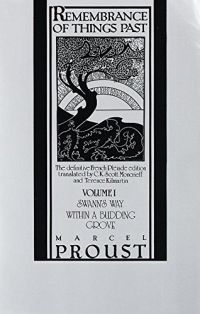
Get the Scott Moncrieff and Kilmartin translation of Remembrance of Things Past (published by Vintage)
Volume I: Contains "Swann's Way" and "Within a Budding Grove". Contains a note on the translation, notes, addenda, and a synopsis.
Available as a paperback (ISBN 9780394711829, 1056 pages).
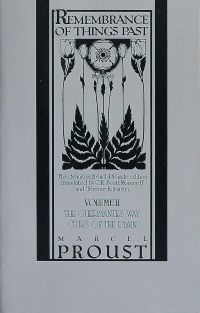
Get the Scott Moncrieff and Kilmartin translation of Remembrance of Things Past (published by Vintage)
Volume II: Contains "The Guermantes Way" and "Cities of the Plain". Includes notes, addenda, and a synopsis.
Available as a paperback (ISBN 9780394711836, 1216 pages).
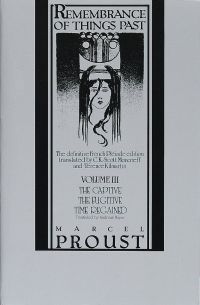
Get the Scott Moncrieff and Kilmartin translation of Remembrance of Things Past (published by Vintage)
Volume III: Contains "The Captive", "The Fugitive", and "Time Regained". Time regained translated by Andreas Mayor. Includes notes, addenda, and a synopsis.
Available as a paperback (ISBN 9780394711843, 1152 pages).
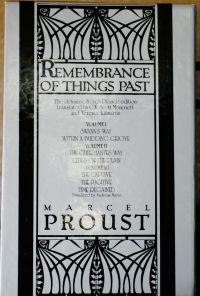
Get the Scott Moncrieff and Kilmartin translation of Remembrance of Things Past (published by Vintage)
Three-volume paperback box set. Out of print.
Available as a paperback box set (ISBN 9780394712437, 3365 pages).
1992 · Scott Moncrieff revised by D.J. Enright · In Search of Lost Time
About Scott Moncrieff revised by D.J. Enright
Dennis Joseph Enright was a British “Man of Letters.”
» More about DJ Enright at the British Council
About the Scott Moncrieff and Enright translation of In Search of Lost Time
Enright’s version is an edit of Kilmartin’s version of Scott Moncrieff’s existing English translation (not a new translation from French). The title page of the current Modern Library edition says “Translated by C.K. Scott Moncrieff and Terence Kilmartin, revised by D. J. Enright.”
The title was updated to In Search of Lost Time for the first time.
Volume titles:
- Swann’s Way
- Within a Budding Grove
- The Guermantes Way
- Sodom and Gomorrah
- The Captive and The Fugitive
- Time Regained + A Guide to Proust
The introduction by Richard Howard in volume 1 introduces new readers to Proust and Proust to his new readers, addressing both, in turn, as ‘you’. (I find this a bit strange.)
Volume 6 contains “A Guide to Proust” compiled by Terence Kilmartin and revised by Joanna Kilmartin. The guide contains a foreword and indexes of characters, persons, places, and themes. This guide was also previously published in 1983 as “A Reader’s Guide to the Remembrance of Things Past.”
Each volume contains a biographical note, notes on the translation, a synopsis, and endnotes. Sometimes there are textual addenda.
From the “Note on the Translation” by Terence Kilmartin:
He says that the French edition Scott Moncrieff was using was “notoriously imperfect” as a result of “Proust’s methods of composition,” which were chaotic and resulted in published books plagued by “errors, misreadings and omissions.” In 1954, the painstakingly revised and “virtually impeccable” Pleiade edition was published (in French). The differences are “sometimes considerable.” His version thus updates Moncrieff’s text to match the revised French source. He includes volume 7 as translated by Andreas Mayor, who was working with the revised French source. Kilmartin also corrects some mistakes in Scott Moncrieff’s translation, even making “extensive alterations”, but avoiding “officious tinkering.”
From the Note by D. J. Enright on the Revised Translation:
“The present revision or re-revision has taken into account the second Pleiade edition…. [which] clears up some long-standing misreadings.”
From the General Editor’s Preface by Christopher Prendergast to the Penguin translation:
“Kilmartin had the advantage of working from the far more reliable 1954 Pleiade edition…. [The] 1987 Pleiade edition… formed the basis of a further projected revision by Kilmartin, which, owing to ill-health, he passed on to D.J. Enright (Enright calls it a ‘re-revision’).”
Blurb by Richard Howard
“[T]his ultimate revision of the primary version affords the surest sled over the ice fields as well as the most sinuous surfboard over the breakers of Proustian prose, an invaluable and inescapable text.”
The Guardian: “Reviving the dread deity” by Paul Davis
“[T]he only previous translation of the novel into English, by CK Scott Moncrieff, showered Proust’s text in “cascades of Edwardian purple prose”, some but not all of them staunched by Terence Kilmartin and DJ Enright in the “fully revised” version now reissued by Vintage to compete with [the Penguin translation]…. For those without French considering setting out on the Proustian journey, the Moncrieff/ Kilmartin/Enright translation, remains, in my view, the best available reading text.”
Independent: “Forever in search of lost truth: Gabriel Josipovici on the problems of translating Proust, and the new revision by D J Enright”
“Enright’s hand has wisely been extremely light, for Kilmartin had, by and large, done an excellent job. He had corrected most of Moncrieff’s blunders… and had generally tried to make the tone as colloquial as that of the originals…. There are places, though, where Kilmartin has failed to spot a lapse by Scott Moncrieff and Enright has not acted either…. There are also places where Kilmartin seems to have gone more wrong than his predecessor, and where Enright has still let things stand…. It is of course easy for a reviewer to carp. Enright has had a go at the well-nigh impossible closing sentence of the novel and has not, to my mind, done any better with it than his predecessors; on the other hand, there are here and there many tiny touches where, like Kilmartin before him, he has helped make the translation more colloquial, flexible and in tune with the great original.”
The Yale Review: “Loaf or Hot-Water Bottle: Closely Translating Proust” by Lydia Davis
“[N]either Kilmartin nor Enright – as far as I can see from a number of close comparisons along the way – was as good a stylist as Moncrieff, so that although the latest version is undoubtedly more correct than Moncrieff’s, the newly rendered passages are not always up to the standard of the original translation. The text throughout could also be brought much closer to the French. There is still a great deal of “padding” in the revised versions. Not all the archaicisms have been eradicated – you will still come upon such expressions as “I bethought myself” – and not all the mistakes have been corrected.”
First sentence of the Scott Moncrieff and Enright translation of In Search of Lost Time
» See extracts to compare the translations of In Search of Lost TimeFor a long time I would go to bed early. Sometimes, the candle barely out, my eyes closed so quickly that I did not have time to tell myself: "I'm falling asleep."
Get the Scott Moncrieff and Enright translation of In Search of Lost Time (published by Everyman's Library)
Volume 1: Contains "Swann's Way" and "Within a Budding Grove (Part One)".
Available as a hardcover (ISBN 9781841598963, 700 pages).
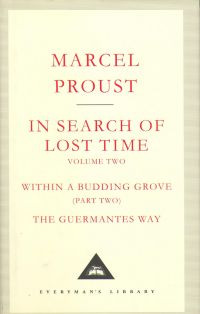
Get the Scott Moncrieff and Enright translation of In Search of Lost Time (published by Everyman's Library)
Volume 2: Contains "Within a Budding Grove (Part Two)" and "The Guermantes Way".
Available as a hardcover (ISBN 9781841598970, 900 pages).
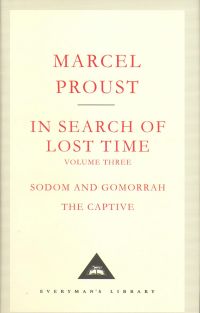
Get the Scott Moncrieff and Enright translation of In Search of Lost Time (published by Everyman's Library)
Volume 3: Contains" Sodom and Gomorrah" and "The Captive".
Available as a hardcover (ISBN 9781841598987, 900 pages).
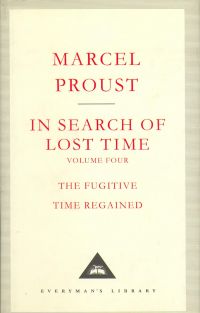
Get the Scott Moncrieff and Enright translation of In Search of Lost Time (published by Everyman's Library)
Volume 4: Contains "The Fugitive" and "Time Regained".
Available as a hardcover (ISBN 9781841598994, 700 pages).

Get the Scott Moncrieff and Enright translation of In Search of Lost Time (published by Everyman's Library)
Four-volume hardcover boxed set.
Available as a hardcover box set (ISBN 9781857152500, 3152 pages).

Get the Scott Moncrieff and Enright translation of In Search of Lost Time (published by Vintage Classics)
Volume 1: "Swann's Way". UK version. Includes a biographical note, a note by Terence Kilmartin on the translation, a note by D.J. Enright on the translation, endnotes, and a synopsis.
Available as a paperback (ebook also available) (ISBN 9780099362210, 544 pages).

Get the Scott Moncrieff and Enright translation of In Search of Lost Time (published by Vintage Classics)
Volume 2: "Within a Budding Grove". UK version. Includes endnotes, addenda, and a synopsis.
Available as a paperback (ebook also available) (ISBN 9780099362319, 656 pages).

Get the Scott Moncrieff and Enright translation of In Search of Lost Time (published by Vintage Classics)
Volume 3: "The Guermantes Way". UK version. Includes endnotes, addenda, and a synopsis.
Available as a paperback (ebook also available) (ISBN 9780099362418, 720 pages).

Get the Scott Moncrieff and Enright translation of In Search of Lost Time (published by Vintage Classics)
Volume 4: "Sodom and Gomorrah". UK version. Includes endnotes, addenda, and a synopsis.
Available as a paperback (ebook also available) (ISBN 9780099362517, 656 pages).

Get the Scott Moncrieff and Enright translation of In Search of Lost Time (published by Vintage Classics)
Volume 5: "The Captive" and "The Fugitive". UK version. Includes endnotes, addenda, and a synopsis.
Available as a paperback (ebook also available) (ISBN 9780099362616, 832 pages).

Get the Scott Moncrieff and Enright translation of In Search of Lost Time (published by Vintage Classics)
Volume 6: "Time Regained" and "A Guide to Proust". UK version. Includes endnotes and a synopsis.
Available as a paperback (ebook also available) (ISBN 9780099362715, 704 pages).

Get the Scott Moncrieff and Enright translation of In Search of Lost Time (published by Modern Library)
Volume I: "Swann's Way". Introduction by Richard Howard. Includes a biographical note, a note by Terence Kilmartin on the translation, a note by D.J. Enright on the translation, endnotes, and a synopsis.
Available as a paperback (ISBN 9780375751547, 656 pages).

Get the Scott Moncrieff and Enright translation of In Search of Lost Time (published by Modern Library)
Volume II: "Within a Budding Grove". Contains a biographical note, a note by Terence Kilmartin on the translation, a note by D.J. Enright on the translation, endnotes, addenda (maybe), and a synopsis.
Available as a paperback (ISBN 9780375752193, 784 pages).

Get the Scott Moncrieff and Enright translation of In Search of Lost Time (published by Modern Library)
Volume III: "The Guermantes Way". Contains a biographical note, a note by Terence Kilmartin on the translation, a note by D.J. Enright on the translation, endnotes, addenda, and a synopsis.
Available as a paperback (ISBN 9780375752339, 864 pages).

Get the Scott Moncrieff and Enright translation of In Search of Lost Time (published by Modern Library)
Volume IV: "Sodom and Gomorrah". Contains a biographical note, a note by Terence Kilmartin on the translation, a note by D.J. Enright on the translation, endnotes, addenda, and a synopsis.
Available as a paperback (ISBN 9780375753107, 784 pages).

Get the Scott Moncrieff and Enright translation of In Search of Lost Time (published by Modern Library)
Volume V: "The Captive" and "The Fugitive". Contains a biographical note, a note by Terence Kilmartin on the translation, a note by D.J. Enright on the translation, endnotes, addenda, and a synopsis.
Available as a paperback (ISBN 9780375753114, 992 pages).
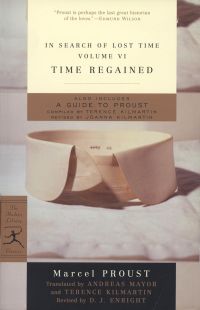
Get the Scott Moncrieff and Enright translation of In Search of Lost Time (published by Modern Library)
Volume VI: "Time Regained" and "A Guide to Proust". Contains a biographical note, a note by Terence Kilmartin on the translation, a note by D.J. Enright on the translation, endnotes, and a synopsis.
Available as a paperback (ISBN 9780375753121, 784 pages).

Get the Scott Moncrieff and Enright translation of In Search of Lost Time (published by Modern Library)
Six-volume paperback boxed set.
Available as a paperback box set (ISBN 9780812969641, 4864 pages).

Get the Scott Moncrieff and Enright translation of In Search of Lost Time (published by Modern Library)
Complete and unabridged ebook bundle.
Available as an ebook (ISBN 9780679645689).
1995-2002 · Christopher Prendergast, editor · In Search of Lost Time
About Christopher Prendergast, editor
Christopher A. Prendergast is a British professor emeritus specializing in French literature.
» More about Christopher Prendergast
The translators are Lydia Davis (American), James Grieve (Australian), Mark Treharne (English), John Sturrock (English), Carol Clark (English), Peter Collier (English), and Ian Patterson (English).
About the Prendergast translation of In Search of Lost Time
Each part was translated by a different translator with Prendergast as the editor of the project.
Volume titles and translators:
- The Way by Swann’s (UK), Swann’s Way (US), Lydia Davis
- In the Shadow of Young Girls in Flower, James Grieve
- The Guermantes Way, Mark Treharne
- Sodom and Gomorrah, John Sturrock
- The Prisoner, Carol Clark and The Fugitive, Peter Collier
- Finding Time Again, Ian Patterson
Quotations from French literary sources have been translated into English except in the case of poetry, which has been quoted in French with English provided in the notes.
Each volume includes an introductory essay, a detailed synopsis, and a few endnotes.
I’ve posted separately about Swann’s Way, translated by Lydia Davis.
Times Higher Education: “Whiff of the Madeleine” by Richard Parish
“[A] significant asset of the Penguin set is the quality and range of the introductory essays. Davis sets the ball rolling with a helpful overview of the novel and offers some crucial distinctions, notably in stressing the status of the novel as “fiction in the guise of autobiography”…; Grieve then considers foreshadowing, as well as looking at perception, character and caricature, and suggests that Proust “translates epistemology into poetry”; Treharne writes on death, society, comedy and sexuality; Sturrock, consonant with the evolution in the novel, focuses on homosexuality; and Clark on the Albertine motifs of jealousy and control in what is at once a “tragedy of possessive love” and a “dreadful comedy of misunderstanding”. Collier then looks at the unconscious, showing how “we negotiate with the memory of our emotions”, as well as providing the most sustained stylistic analysis, in the context of the narrator’s own developing vocation; and Patterson dwells on the destructive passage of time and the fulfilment of the novelistic project. All of these are fine pieces of criticism in their own right, and all, vitally, acknowledge the various difficulties a reader may encounter at different stages.”
The New York Review: “Far from Proust’s Way” by Andre Aciman
“[T]he much-touted team translation by Viking Penguin is the product of writers who are each translating a different Proust and whose practical operating principles and guidelines could not be more different or ill-defined. The voice of Davis, forever faithful to Proust’s word order, and the voice of Grieve, who doesn’t get it, could not possibly belong to the same novel. But if the intention of the Viking Penguin translation was to give us a Proust that would read well enough in English, then they have certainly succeeded.”
Times Higher Education: “Whiff of the Madeleine” by Richard Parish
“For all its subdivisions, A la Recherche du Temps Perdu , like Wagner’s Ring , is a single monumental work of art, which needs to be approached as such, and the broader rhetorical questions that arise in conclusion concern the degree to which this new translation is in any sense a truly collaborative project. Thus, did any of the translators read and revise any of the other parts of the series, or even one another’s endnotes? And, more obviously again, did the general editor read them all? And, if so, did he generally edit them?”
From the note by Lydia Davis on the translation:
“We agreed, often after lively debate, on certain practices that needed to be consistent from one volume to the next…. At the initial meeting of the Penguin Classics project, those present had acknowledged that a degree of heterogeneity across the volumes was inevitable and perhaps even desirable, and that philosophical differences would exist among the translators. As they proceeded, therefore, the translators worked fairly independently…. And Christopher Prendergast, as he reviewed all the translations, kept his editorial hand relatively light.”
World Press Review: “My Madeleine Is Rich” by Christophe Boltanski
“Clearly, this method [of using multiple translators] posed a number of problems. But at the same time, it presented advantages: Naturally, there is a continuity of tone in la Recherche, a Proustian voice, but at the same time there is also a wide variety of styles, an evolution from one volume to the next…. I felt that this changeable aspect of Proust’s style would come out more clearly in a translation by several people.”
From the General Editor’s Preface by Christopher Prendergast
On the organization of the project:
“The self and the world in Proust are not self-identical either through time or at any one moment in time; they are systematically disaggregated into a plurality of selves and worlds…. One of the benefits of the division of labour entailed by a collective translation is that it arguably heightens the changes of bringing into focus the stylistic variety we encounter as we move from one volume to the next. Multiple selves, multiple worlds, multiple styles: this, paradoxically, is the quintessence of Proust.”
On the style of translation (foreignizing or naturalizing):
“[Foreignizing] holds that we should never be allowed to forget that what we are reading is indeed a translation and that it is therefore both duty-bound and condemned to bear within it some trace of the foreignness in which it has taken up abode…. Conversely, [naturalizing] assumes that the prime task of the translator is to naturalize the host language as far as possible into the terms of the guest language in such a way as to create for the reader the sense that he or she is reading a text as if it had been ‘originally’ written in the guest language…. [In this translation] [f]or the most part, the foreignizing conception has prevailed.”
On Proust’s readership hitherto:
“For most of the twentieth century Proust was largely the preserve of the few, often as the cult-object of an elite coterie, for which reading A la recherche has been a kind of sacred rite…. The English reception of Proust has been especially plagued by this tendency to sport acquaintance (often slight) with his work as a badge of distinction, at once social and spiritual, by construing it as a storehouse of exquisite epiphanies laced with a strong dose of class-bound aestheticism.”
On the sparsity of notes and other materials:
“The view taken here is that part of the experience of reading Proust’s novel is co-extensive with the experience of his narrator-hero in the novel, namely the repeated pattern of forgetting and remembering, getting lost and refinding one’s way, and that detailed ‘guides’ sit uneasily with this important dimension of the work.”
First sentence of the Prendergast translation of In Search of Lost Time
» See extracts to compare the translations of In Search of Lost TimeFor a long time, I went to bed early. Sometimes, my candle scarcely out, my eyes would close so quickly that I did not have time to say to myself: ‘I'm falling asleep.’

Get the Prendergast translation of In Search of Lost Time (published by Penguin Modern Classics)
Volume 1: "The Way by Swann's". UK version. Translated and with an introduction by Lydia Davis. Contains a general editor's preface by Christopher Prendergast. Includes endnotes and a synopsis.
Available as a paperback (ebook also available) (ISBN 9780141180311, 496 pages).

Get the Prendergast translation of In Search of Lost Time (published by Penguin Modern Classics)
Volume 2: "In the Shadow of Young Girls in Flower". UK version. Translated and with an introduction by James Grieve. Includes endnotes and a synopsis.
Available as a paperback (ebook also available) (ISBN 9780141180328, 576 pages).

Get the Prendergast translation of In Search of Lost Time (published by Penguin Modern Classics)
Volume 3: "The Guermantes Way". UK version. Translated and with an introduction and notes by Mark Treharne. Includes endnotes and a synopsis.
Available as a paperback (ebook also available) (ISBN 9780141180335, 640 pages).

Get the Prendergast translation of In Search of Lost Time (published by Penguin Modern Classics)
Volume 4: "Sodom and Gomorrah". UK version. Translated and with an introduction by John Sturrock. Includes endnotes and a synopsis.
Available as a paperback (ebook also available) (ISBN 9780141180342).

Get the Prendergast translation of In Search of Lost Time (published by Penguin Modern Classics)
Volume 5: "The Prisoner" and "The Fugitive". UK version. Translated and with introductions and notes by Carol Clark and Peter Collier.
Available as a paperback (ebook also available) (ISBN 9780141180359, 720 pages).

Get the Prendergast translation of In Search of Lost Time (published by Penguin Modern Classics)
Volume 6: "Finding Time Again". UK version. Translated and with an introduction and notes by Ian Patterson. Includes endnotes and a synopsis.
Available as a paperback (ebook also available) (ISBN 9780141180366, 400 pages).
Get the Prendergast translation of In Search of Lost Time (published by Penguin Classics Deluxe)
Volume 1: "Swann's Way". US version. Translated and with an introduction and notes by Lydia Davis. Contains a note on the translation, suggestions for further reading, endnotes, and a snyopsis.
Available as a paperback (ebook also available) (ISBN 9780142437964, 496 pages).
Get the Prendergast translation of In Search of Lost Time (published by Penguin Classics Deluxe)
Volume 2: "In the Shadow of Young Girls in Flower". US version. Translated and with an introduction and notes by James Grieve. Contains a note by Lydia Davis (not James Grieve), endnotes, a synopsis, and suggestions for further reading.
Available as a paperback (ebook also available) (ISBN 9780143039075, 576 pages).

Get the Prendergast translation of In Search of Lost Time (published by Penguin Classics Deluxe)
Volume 3: "The Guermantes Way". US version. Translated and with an introduction and notes by Mark Treharne. Includes a note by Lydia Davis (not Mark Treharne) on the translation, endnotes, and a synopsis.
Available as a paperback (ebook also available) (ISBN 9780143039228, 640 pages).

Get the Prendergast translation of In Search of Lost Time (published by Penguin Classics Deluxe)
Volume 4: "Sodom and Gomorrah". US version. Translated and with an introduction and notes by John Sturrock. Includes a note by Lydia Davis (not John Sturrock) on the translation, endnotes, and a synopsis.
Available as a paperback (ebook also available) (ISBN 9780143039310, 576 pages).

Get the Prendergast translation of In Search of Lost Time (published by Penguin Classics Deluxe)
Volume 5: "The Prisoner". US version. Translated and with an introduction and notes by Carol Clark. Includes a note by Lydia Davis (not Carol Clark) on the translation, endnotes, and a synopsis.
Available as a paperback (ebook also available) (ISBN 9780143133599, 448 pages).

Get the Prendergast translation of In Search of Lost Time (published by Penguin Classics Deluxe)
Volume 6: "The Fugitive". US version. Translated and with an introduction and notes by Peter Collier. Includes a note by Lydia Davis (not Peter Collier) on the translation, endnotes and a synopsis.
Available as a paperback (ebook also available) (ISBN 9780143133704, 352 pages).

Get the Prendergast translation of In Search of Lost Time (published by Penguin Classics Deluxe)
Volume 7: "Finding Time Again". US version. Translated and with an introduction and notes by Ian Patterson. Includes a note by Lydia Davis (not Ian Patterson) on the translation, endnotes and a synopsis.
Available as a paperback (ebook also available) (ISBN 9780143133711, 432 pages).
2013-2025 · Scott Moncrieff revised by William C. Carter · In Search of Lost Time
About Scott Moncrieff revised by William C. Carter
William C. Carter is an American professor emeritus specializing in French and an esteemed Proust scholar. He is the author of a biography of Proust (see below).
About the Scott Moncrieff and Carter translation of In Search of Lost Time
This is a revision and annotation of the Scott Moncrieff translation, not a new translation (and not a revision of the Kilmartin or Enright revisions). It was published by Yale. Each volume includes an introduction, extensive marginal notes, and a synopsis. The notes are to the left or right of the text in the print versions of these large-format books (7.50 x 9.25 inches).
As of July 2025, all six volumes have been published:
- Swann’s Way
- In the Shadow of Young Girls in Flower
- The Guermantes Way
- Sodom and Gomorrah
- The Captive and The Fugitive
- Time Regained
From Carter’s introduction:
“The results of these revisions [by Kilmartin and Enright] were not always felicitous or accurate…. Scott Moncrieff seems to have been more sensitive than Kilmartin and Enright to the cadence of Proust’s sentences and to the importance of placing the key or strongest word at the end of a sentence or paragraph…. My sole intention in all the revisions that I have made was to bring Scott Moncrieff’s excellent translation closer than ever before to the sprit and style of Proust’s original text.”
Reading Proust: “The girls have flowered anew”
“There is scarcely a sentence that Mr. Carter hasn’t changed, always for the better and often getting closer to Proust’s phrasing…. Among Mr. Carter’s gifts to Americans, he has put the novel into our idiom…. As for Mr. Carter’s annotations, they appear on the same page as the text—hence the large format. This is often a convenience, compared to turning to the back of the book. But I sometimes found them distracting.”
Boston Review: “Style over Substance: On Translating Proust” by Leland de la Durantaye
“The Yale edition is the first extensively annotated edition of Proust’s novel in English: Davis’s translation has some annotations, but far fewer. Given the quality and extent of the French critical edition’s annotations, the reader might assume that Carter would draw from among them for his more modestly sized edition while adding entries on matters that need special highlighting for an English reader. But the lines he tends to follow are different than those traced by Tadié…. The vast majority of Carter’s annotations are straightforward, clear, and helpful. But a significant minority raise troubling questions.”
Leaves in the Wind: “Thoughts In and Out of Season 5” by David Bentley Hart
“Yale University Press occasionally produces handsome and impressive critical editions of certain great literary works… in which scrupulously edited and pristinely presented original texts appear on the page bounded in a box, with notes running down the margins rather like a layer of Talmudic commentary. Nowhere has the format been used to happier effect, it seems to me, than in the recent volumes of Yale’s new edition of Proust’s In Search of Lost Time…. William C. Carter, Professor Emeritus of French at the University of Alabama at Birmingham… certainly ranks high among the finest scholars of Proust in the English-speaking world today (I earnestly recommend both his Marcel Proust: A Life and his Proust in Love)…. Carter’s version is the one to get for those readers who want to understand every reference, every passing detail, every incidental feature of the text. The novel is an ocean, but no person, place, or thing—however obscure, minor, or seemingly extraneous—escapes the nets of his commentary. Clearly it is all a work of love for Carter, and a monument to a life of scholarly dedication to the French literary canon, and to Proust in particular.”
First sentence of the Scott Moncrieff and Carter translation of In Search of Lost Time
» See extracts to compare the translations of In Search of Lost TimeFor a long time I went to bed early. Sometimes, when I had put out my candle, my eyes would close so quickly that I had not even time to say "I'm going to sleep."
Get the Scott Moncrieff and Carter translation of In Search of Lost Time (published by Yale)
Volume 1: "Swann's Way". Includes an introduction, notes, and synopsis by William C. Carter.
Available as a paperback (ebook also available) (ISBN 9780300185430, 512 pages).
Get the Scott Moncrieff and Carter translation of In Search of Lost Time (published by Yale)
Volume 2: "In the Shadow of Young Girls in Flower". Includes an introduction, notes, and synopsis by William C. Carter.
Available as a paperback (ebook also available) (ISBN 9780300185423, 608 pages).
Get the Scott Moncrieff and Carter translation of In Search of Lost Time (published by Yale)
Volume 3: "The Guermantes Way". Includes an introduction, notes, and synopsis by William C. Carter.
Available as a paperback (ebook also available) (ISBN 9780300186192, 680 pages).
Get the Scott Moncrieff and Carter translation of In Search of Lost Time (published by Yale)
Volume 4: "Sodom and Gomorrah". Includes an introduction, notes, and synopsis by William C. Carter.
Available as a hardcover (ebook also available) (ISBN 9780300186208, 616 pages).
Get the Scott Moncrieff and Carter translation of In Search of Lost Time (published by Yale)
Volume 5: "The Captive and The Fugitive". Includes an introduction, notes, and synopses by William C. Carter.
Available as a hardcover (ebook also available) (ISBN 9780300186215, 784 pages).
2023-20?? · Brian Nelson and Adam Watt, editors · In Search of Lost Time
About Brian Nelson and Adam Watt, editors
Brian Nelson is a British translator and professor emeritus of French. He has translated many works by Emile Zola.
Adam Watt is a professor of French and comparative literature at Exeter. He wrote The Cambridge Introduction to Marcel Proust and a critical biography of Proust (see below). His publications on Proust have appeared in English, French, German, Chinese, Danish, and Persian.
About the Nelson and Watt translation of In Search of Lost Time
This is a new translation in the process of being published by Oxford.
My understanding is that Brian Nelson and Adam Watt are editors of the project. For Volume 1, Brian Nelson did the translation and Adam Watt is the editor and the author of the introduction and notes. I believe Brian Nelson will also translate the final volume. Other translators will handle other volumes (but I don’t know who).
The first volume was published in December 2023.
- The Swann Way (translated by Brian Nelson)
- In the Shadow of Girls in Blossom (translated by Charlotte Mandell)
- The Guermantes Way (translated by Peter Bush)
- Sodom and Gomorrah (translated by Helen Constantine)
- The Captive (translated by Andrew Rothwell)
- The Fugitive (to be translated by Brian Nelson, according to his university profile page)
- Time Regained (to be translated by Brian Nelson)
Volume 1 includes acknowledgments, a general editors’ preface, a translator’s note, an introduction, a note on the text, a select bibliography, a chronology of Marcel Proust, and endnotes. The introduction thoughtfully warns readers that it reveals plot details.
From the General Editors’ Preface:
“Publication will be in seven volumes. There will be a different translator for each volume (except the first and the last). We have chosen to standardize certain terms, recurrent phrases and expressions, modes of address, personal titles, use of elision and so forth across the translations, and, more generally, have attempted to facilitate unity of voice, a stylistic consonance, across the volumes (while bearing in mind shifts in Proust’s voice and tone as his work progressed)…. The notes seek not to offer any sort of critical commentary on Proust’s novel but rather to clarify dates and details that will enrich readers’ appreciation of its unique breadth of reference. The introductory essay to each volume outlines the key concerns and preoccupations of the volume in question, providing a broad frame of reference for readers tackling the novel for the first time and reflecting on the role of that volume in the wider structure of the novel as a whole.”
From the translator’s note by Brian Nelson:
“Successful translation of Proust is achieved (unsurprisingly, one might feel) by making him sound like Proust—by giving him an English voice, a voice that conveys his vision, his sensibility, and his unique qualities as a writer…. While recognizing the impossibility of exact equivalence, my aim has been to recreate the intricate harmonies of Proust’s sentences, and the whole pattern of effects embodied in his prose, in such a way that the translation creates the ‘illusion’ of which Anthea Bell speaks [that the translation will ‘read as easily and be as appealing to the reader as if it had been originally written in English].”
Oxford University Press Blog: “Translating Proust Again” by Brian Nelson
“Proust in English can be idiosyncratic while retaining an idiomatic quality. My goal has been to recreate Proust’s voice in such a way that the translation creates the illusion that the reader is reading not a translation but the original.”
The Sydney Morning Herald: “Why we just can’t forget Marcel Proust” by Yuri Cerqueira dos Anjos
“It is difficult to predict how this new translation will look as a whole. However, this first volume delivers a lot in terms of readability, which is definitely a good indication. Many translators in the past have associated Proust with an excessively elevated and ornate language…. Nelson retains Proust’s serpentine style without making it appear obscure…. Moreover, Nelson is able to seemingly transition between Proust’s wide range of voices…. His approach, supported by effective and precise explanatory endnotes, makes this version a compelling introduction to Proust’s masterpiece.”
First sentence of the Nelson and Watt translation of In Search of Lost Time
» See extracts to compare the translations of In Search of Lost TimeFor a long time, I went to bed early. Sometimes, my candle barely out, my eyes would close so quickly that I didn't even have time to think: 'I'm falling asleep.'

Get the Nelson and Watt translation of In Search of Lost Time (published by Oxford)
"The Swann Way." Translated by Brian Nelson. Includes a translator's note by Brian Nelson. Includes an introduction, note on the text, select bibliography, chronology, and endnotes by Adam Watt. Includes a general editors' preface by Nelson and Watt.
Available as a paperback (ebook also available) (ISBN 9780198871521, 480 pages).

Get the Nelson and Watt translation of In Search of Lost Time (published by Oxford)
"In the Shadow of Girls in Blossom". Translated by Charlotte Mandell with an introduction by Edward J. Hughes and explanatory endnotes by Adam Watt. Also contains a general editors' preface, translator's note, note on the text, bibliography, and chronology of Marcel Proust.
Available as a paperback (ebook also available) (ISBN 9780192845672, 576 pages).

Get the Nelson and Watt translation of In Search of Lost Time (published by Oxford)
"The Guermantes Way." Translated by Peter Bush. Introduction by Peter Brooks.
Available as a paperback (ebook also available) (ISBN 9780192849762, 640 pages).
Get the Nelson and Watt translation of In Search of Lost Time (published by Oxford)
"Sodom and Gomorrah." Translated by Helen Constantine. Introduction by Michael Lucey. Notes by Adam Watt.
Available as a paperback (ebook also available) (ISBN 9780192846181, 608 pages).

Get the Nelson and Watt translation of In Search of Lost Time (published by Oxford)
(Shipping in January 2027) "The Captive." Translated by Andrew Rothwell. Introduction by Elisabeth Ladenson, probably (product page is unclear). Notes by Adam Watt and Brian Nelson, possibly (product page is unclear).
Available as a paperback (ebook also available) (ISBN 9780192869319, 464 pages).
Notes on the work and its translation
The world’s longest novel!
No matter which English translation of Proust’s massive work you choose, reading the whole thing will be a challenge, simply in terms of length. It was published in French from 1913 to 1927 in seven volumes totaling over four thousand pages.
You could just read the first volume only, if you want, and then see whether you feel like reading the rest of it.
» What’s the best translation of Swann’s Way?
Clocking in at over 1.2 million words, A la recherche du temps perdu, originally translated into English as Remembrance of Things Past, holds the Guinness Book World Record for longest novel. Other long novels include The Dream of the Red Chamber, which is estimated to be almost 1 million words, The Tale of Genji, which is about 750,000 words; War and Peace and Journey to the West, both about 600,000 words; and the notoriously long and often abridged Les Misérables, at “only” 500,000 words.
New York Times: “Marcel Proust at 100” by William H. Gass
“When reading, one wonders first if the book will ever end, and then, in despair, if it will ever begin. In comparison, the Russian steppes, were they so vast? Or winters in upper Michigan prolonged?”
From the introduction by Adam Watt to the Nelson translation:
“A la recherche du temps perdu is a massive novel that invites its readers to take a big gamble: read me, it says, page after page, volume after volume, and see what return you might get on your investment. Will it be time well spent or time wasted?”
Bookforum: “Ruminations in an Emergency: A New Translation of Proust’s Late Masterpiece” by Rebecca Ariel Porte
“[It’s] a fictional reconstruction of a life and a world that moves from the idyll of Belle Époque France to the aftermath of World War I, touching on the Dreyfus affair, anti-Semitism, and French nationalism; winding through the salons and bedrooms of Parisian high society; and exploring arcane permutations of anxiety, jealousy, aggression, attachment, solipsism, possessiveness, loneliness, boredom, coercion, luxury, art, love, class, time, memory, madeleines with lime-blossom tisanes, and queer desire.”
Why does the novel have two titles?
Scott Moncrieff chose the title “Remembrance of Things Past.” The English title adopted in 1992, which is now generally considered more accurate and thus more appropriate, is “In Search of Lost Time.”
Bookforum: “Review of Swann Songs: A new biography of translator C. K. Scott Moncrieff” by Eric Banks
“That phrase from Shakespeare’s ‘Sonnet 30,’ while lovely, ‘cannot possibly mean what you say,’ Proust wrote, registering a complaint that would dog Scott Moncrieff’s translation in both letter and spirit for times to come.”
The titles he chose for the individual volumes are also controversial. In particular, the title of Volume 1 was supposed to match up with the title of Volume 7. Instead, Scott Moncrieff chose titles that would be familiar to English readers from poems.
Grand Street: “Translating Proust” by Terence Kilmartin
“Scott Moncrieff’s strengths and weaknesses are neatly epitomized in the titles he chose for the novel as a whole and for the individual sections. They are stylish and ingenious, and at the same time slightly out of key.“
Proustonomics: “C.K. Scott Moncrieff, poet, spy & Proust’s translator: interview with Jean Findlay” by Nicolas Ragonneau
“Each title had to entice an English speaking audience as its first priority, and that audience would be a literary one, so a line from Shakespeare’s sonnet no 30 would be known as such ‘When to the sessions of sweet silent thought, I summon up remembrance of things past’. Charles’s translation was a work of art in itself, bearing in mind the audience of his day and how to sell to that audience. He was also a successful critic and literary figure and knew as Noel Coward advised ‘never bore your audience to death’. A faithful and clunking translation would alienate the readership.”
Public Domain Review: “Lost in Translation: Proust and Scott Moncrieff” by William C. Carter
On the meaning of Proust’s title: “Proust’s theory of memory rejects the notion that we can simply sit and quietly resurrect the past in its true vividness through what he called voluntary memory. When we attempt to do this, we find that it doesn’t work very well. We remember very little and often only in a haphazard and rather bland way. On the other hand, Proust’s title should be taken to suggest [that] the Narrator’s search… is an active, arduous quest in which the past must be rediscovered—largely through what Proust called involuntary memory, as demonstrated in the famous madeleine scene—then analyzed and understood, and finally, if your ambition is to preserve it in writing, transposed and recreated in a book.”
From the General Editor’s Preface by Christopher Prendergast to the Penguin translation:
“There will always be fans of Scott Moncrieff’s prettily Shakespearean Remembrance of Things Past. But we also know that Proust took vigorous exception to Scott Moncrieff’s title, and for good reason. It removes virtually everything expressed or implied by the original.”
How many volumes does In Search of Lost Time have?
Well, that depends.
The complete novel is three volumes if you get the Scott Moncrieff and Kilmartin version from Vintage or the Scott Moncrieff version from Penguin Classics.
The complete novel is four volumes if you get the Scott Moncrieff and Enright hardcover boxed set from Everyman’s Library.
The complete novel is six volumes if you get the Scott Moncrieff and Enright set from Vintage Classics or Modern Library, or if you get the Penguin Modern Classics set, or the Yale set.
The complete novel is seven volumes if you get the Penguin Classics Deluxe set, or the ongoing Oxford translation.
Originally, the novel was printed in even more volumes, like twelve.
What are the titles of the volumes of In Search of Lost Time?
| French | English |
| 1. Du côté de chez Swann | 1. Swann’s Way -or- The Way by Swann’s -or- The Swann Way |
| 2. À l’ombre des jeunes filles en fleurs | 2. Within a Budding Grove -or- In the Shadow of Young Girls in Flower -or- In the Shadow of Girls in Blossom |
| 3. Le Côté de Guermantes | 3. The Guermantes Way |
| 4. Sodome et Gomorrhe | 4. Cities of the Plain -or- Sodom and Gomorrah |
| 5. La Prisonnière | 5. The Captive -or- The Prisoner |
| 6. Albertine disparue | 6. The Sweet Cheat Gone -or- The Fugitive |
| 7. Le Temps retrouvé | 7. Time Regained -or- The Past Recaptured -or- Finding Time Again |
Is there an English version of In Search of Lost Time in the public domain? (Can I get it for free?)
The complete original French text is in the public domain as of January 1, 2023. New translations can be published without any need to ask for permission or pay a fee for translation rights.
» Download original French text from Wikisource
Each English translation has its own copyright.
The volumes of Scott Moncrieff’s English translation were published in 1922, 1924, 1925, 1927, 1929, 1930, and 1931. The six volumes published before 1931 are already in the public domain. The last volume (translated by Sydney Schiff) will enter the public domain in the US on January 1, 2027. The other versions are too recent to be in the public domain.
Are the writers who work on this novel “cursed”?
No. But many of them, including Proust himself, have left their work unfinished.
- When he died, Proust had not finished editing the last three volumes.
- Scott Moncrieff was unable to complete his translation of volume 7.
- Andreas Mayor (translator of volume 7) was to translate the other volumes as well.
- Terence Kilmartin developed a brain tumor (which he survived).
- Richard Howard began and abandoned a complete translation (he only shared a few pages).
- James Grieve only produced translations of volumes 1 and 2 before he died.
Letters Republic: “In Search of Penguin’s Proust” by Kevin Donovan
Proust and popular fantasy novelist Robert Jordan (and, someday, with increasing likelihood, George Martin) suffered from the so-called magnum opus death curse. “Like ascending the slopes of Everest, tackling Proust meant passing a number of the failed and dead along the way…. The book, it seemed, was too much for any one person to labor on alone and survive.”
World Press Review: “My Madeleine Is Rich” by Christophe Boltanski
“It seems to me [Prendergast] that the heroic era of literary translation by a single person is over…. So we felt we had to undertake it as a team.”
Further exploration
Useful Websites
- The Proust Project: 182 Days of Marcel Proust (Penguin translation)
https://proustproject.blogspot.com/ - Reading Proust
https://readingproust.com/ - The University at Buffalo: Collection of related books
https://research.lib.buffalo.edu/proust/crit-in-eng - Brothers Judd: Collection of related links
https://brothersjudd.com/index.cfm/fuseaction/reviews.detail/book_id/333/Swann%27s%20Way.htm - Study Guide by Michael J. Cummings
https://cummingsstudyguides.net/Guides6/Remembrance.html - Website of Chris Taylor (English translations of miscellaneous writings)
http://www.yorktaylors.free-online.co.uk/ - Proust Ink (created by William C. Carter and Nicolas Drogoul to celebrate the life and works of Proust)
https://www.proust-ink.com/
Yet More Translations?!
Volume 1 (Swann’s Way) has been translated separately.
Other volumes also have also been translated separately:
Albertine Gone translated by Terence Kilmartin (Chatto & Windus, 1989)
“After the death in 1986 of Proust’s niece, Suzy Mante-Proust, her son-in-law discovered among her papers a typescript that had been corrected and annotated by Proust. The late changes Proust made include a small crucial detail and the deletion of approximately 150 pages. This version was published in French (Paris: Grasset, 1987) and translated as Albertine Gone by Terence Kilmartin (London: Chatto & Windus, 1989); the translation is now out of print.”
Time Regained translated by David Whiting (Naxos AudioBooks, 2012)
The unabridged audiobook published by Naxos (read by Neville Jason) is based on the original Scott Moncrieff translation, except for the last volume, which is based on a translation by David Whiting that was commissioned by Naxos and has not been published in print.
For more on In Search of Lost Time, its author, its historical and literary context, and/or its adaptations, consider the resources below.

Get Marcel Proust: A Life by William C. Carter
A biography.
Available as a paperback (ebook also available) (ISBN 9780300191790, 1000 pages).
Get Proust in Love by William C. Carter
A biography.
Available as a paperback (ebook also available) (ISBN 9780300211078, 280 pages).

Get The Cambridge Introduction to Marcel Proust by Adam Watt
A biography.
Available as a paperback (ebook also available) (ISBN 9780521734325, 154 pages).

Get Marcel Proust's Search for Lost Time: A Reader's Guide to the Remembrance of Things Past by Patrick Alexander
Includes "detailed plot summaries, historical and cultural background, a guide to the fifty most important characters, maps, family trees, illustrations, and a brief biography of Proust."
Available as a paperback (ebook also available) (ISBN 9780307472328, 400 pages).

Get How Proust Can Change Your Life by Alain de Botton
"Alain de Botton combines two unlikely genres—literary biography and self-help manual—in the hilarious and unexpectedly practical How Proust Can Change Your Life."
Available as a paperback (ebook also available) (ISBN 9780679779155, 208 pages).

Get Living and Dying with Marcel Proust by Christopher Prendergast
"Entertaining and erudite, Prendergast’s book will surely become the companion for all readers either about to reembark on Proust’s three-million-word journey or setting out for the first time."
Available as a paperback (ebook also available) (ISBN 9781609457600, 256 pages).

Get Proust's Way: A Field Guide to In Search of Lost Time by Roger Shattuck
"Proust's Way, the culmination of a lifetime of scholarship, will serve as the next generation's guide to one of the world's finest writers of fiction."
Available as a paperback (ebook also available) (ISBN 9780393321807, 318 pages).

Get A Reader's Guide to Proust's In Search of Lost Time by David Ellison
"David Ellison leads the reader through the work, clarifying but not oversimplifying the intricate beauty of Proust's imaginary universe."
Available as a paperback (ebook also available) (ISBN 9780521720069, 230 pages).

Get Proust for Beginners by Steve Bachmann
Illustrated by Van Howell. Introduction by Harold Augenbraum. "Proust For Beginners is a compelling biography of French novelist Marcel Proust and a vivid portrait of his times. It also serves as a concise guide and critical review of In Search of Lost Time."
Available as a paperback (ebook also available) (ISBN 9781939994448, 170 pages).

Get The World According to Proust by Joshua Landy
"Joshua Landy invites the reader to view the novel as a single quest-a quest for purpose, enchantment, identity, connection, and belonging- through the novel's fascinating treatments of memory, society, art, same-sex desire, knowledge, self-understanding, self-fashioning, and the unconscious mind. "
Available as a hardcover (ebook also available) (ISBN 9780197648681, 152 pages).
Get Marcel Proust: A Very Short Introduction by Joshua Landy
A concise, accessible introduction.
Available as a paperback (ISBN 9780197586556, 168 pages).
In Search of Lost Time: Translation recommendations
What’s the best In Search of Lost Time translation?
How can there be a best when it’s not even clear what would make a translation perfect?
From the General Editors’ Preface to Nelson and Watt’s The Swann Way:
“There is no ideal, ultimate translation of a given original. There cannot be, given that nothing is exactly the same in one language as in another.”
Independent: “Forever in search of lost truth: Gabriel Josipovici on the problems of translating Proust, and the new revision by D J Enright”
“What all this [repeated revision] teaches us is that Valery was literally correct when he said that works of art are never finished, only abandoned. Our romantic hackles rise at this; we want to believe in well-wrought urns and the unearthly perfection of masterpieces. But these are myths; most works remain, like Calder’s mobiles, floating in a breeze of possibilities. Scholars may advance our knowledge, money may buy a better text and a better translation, but the ‘true’ text and the perfect translation will, of course, always remain tantalisingly out of reach, and we had better learn to live with this when we read Shakespeare, or Joyce, or Proust.”
From the General Editor’s Preface by Christopher Prendergast to the Penguin translation:
“Henry James described the house of fiction as a house with many windows, and there is no reason why the figure of speech should not be carried over to the translation of fiction.”
Nevertheless, my recommendations
If you’re a traditionalist, then I’d recommend the Enright translation.
If you’re a bit iconoclastic, then get the Prendergast translation.
If you’re not sure you want to read the whole thing, check out the separate page for Swann’s Way.
To sum up, here's what I recommend.
Modernized version of an old favorite:
Get the Scott Moncrieff and Enright translation of In Search of Lost Time (published by Everyman's Library). Available as a hardcover (ISBN 9781841598963, 700 pages). Learn more about the Scott Moncrieff and Enright translation.
Iconoclastic modern translation:
Get the Prendergast translation of In Search of Lost Time (published by Penguin Modern Classics). Available as a paperback (ebook also available) (ISBN 9780141180311, 496 pages). Learn more about the Prendergast translation.
Scholarly translation with explanatory notes:
Get the Scott Moncrieff and Carter translation of In Search of Lost Time (published by Yale). Available as a paperback (ebook also available) (ISBN 9780300185430, 512 pages). Learn more about the Scott Moncrieff and Carter translation.
Can't decide? Compare extracts from the different versions of In Search of Lost Time.
I hope you find the reading worthwhile.
Help improve and support this site
Spotted an error or missing edition? Email me. I am grateful for corrections and additions, and I update pages whenever I can verify new information.
Have a question or recommendation? Leave a comment. Genuine comments are always welcome.
Want to hear about new posts? Subscribe to the mailing list. I send occasional emails when I publish substantial new material.
Found this guide useful? If you would like to support the research behind We Love Translations, you can buy me a coffee. Thank you.



Thank you for these two posts. I’m reading the first volume translated by Scott Moncrieff because it’s in the public domain, but at some point I do want to own a physical copy and might go for a different translation. Your blog helped me a lot with understanding the contexts of these different translations! The extensiveness of information is truly impressive.