
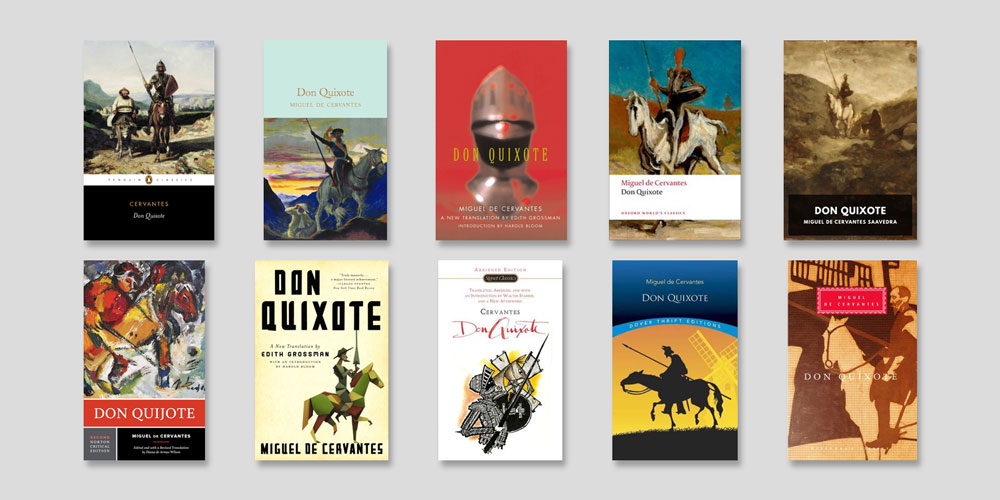
Disclosure: This page contains affiliate links. If you purchase through links to Amazon, AbeBooks, Bookshop.org, or Libro.fm, I may earn a commission at no additional cost to you. As an Amazon Associate I earn from qualifying purchases.
Which English translation of Don Quixote should I read?
So you want to read the world’s first novel? Or at any rate, the first modern novel, or perhaps the first modern European novel? So have countless other English speakers since the 1600s.
El Ingenioso Hidalgo Don Quixote de la Mancha was published in two volumes, the first in 1605, and the second in 1615. It is the second most-translated book in the world (after the Bible) if you add up the different translations in all the different languages. (The Little Prince is the most-translated secular book in the world if you count each language once.) In his novel, Quixote: The Novel and the World, Professor Ilan Stavans claims that “Cervantes’s is the novel most translated into English because English speakers have identified it as a cornerstone of Western civilization.” (page 200)
Not sure whether you even want to read Don Quixote? Neither was I, and I was pleasantly surprised. But you don’t have to take my word for it. Ilan Stavans narrates this TedEd episode on the importance of Don Quixote.
Here's a quick recommendation.
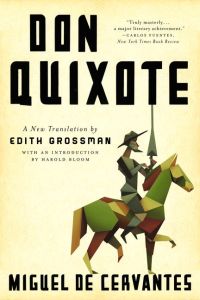
Get the translation everyone's talking about!
Get the Grossman translation of Don Quixote (published by Art of the Story Deluxe Edition). Available as a paperback (ISBN 9780062391667, 992 pages). Learn more about the Grossman translation.
Want more choices? Keep reading for a comprehensive list of all translations and editions in English.
This page also provides more background on the work and a selection of related books and adaptations.
It also lists recommendations for different readers’ needs (e.g., affordability, scholarly apparatus, language style).
Don Quixote: Translations in English
As of October 3, 2026, this list is (to the best of my knowledge) complete, and editions in bold are in print.
- 1620 — Thomas Shelton
- 1687 — John Phillips
- 1700 — Pierre Antoine Motteux
- 1742 — Charles Jervas
- 1755 — Jervas revised by Tobias Smollett
- 1881 — Alexander James Duffield
- 1885 — John Ormsby
- 1888 — Henry Edward Watts
- 1910 — Robinson Smith
- 1949 — Samuel Putnam
- 1950 — J. M. Cohen
- 1957 — Walter Starkie (Signet)
- 1981 — Ormsby revised by Joseph Ramon Jones and Kenneth Douglas (Norton)
- 1995 — Burton Raffel (Norton)
- 2000 — John Rutherford (Penguin)
- 2003 — Smollett revised by O.M. Brack, Jr. (University of Georgia)
- 2003 — Edith Grossman (Vintage)
- 2005 — Tom Lathrop (Signet/Alma)
- 2006 — James H. Montgomery (Hackett)
- 2008 — Jarvis revised by E.C. Riley (Oxford)
- 2020 — Raffel revised by Diana de Armas Wilson (Norton)
1620 · Thomas Shelton · The history of the valerous and wittie knight-errant, Don Quixote of the Mancha
About Thomas Shelton
He remains a mystery. “Thomas Shelton” is known for being the first translator of Don Quixote into any language, but there is speculation about whether that was his name, whether he is the same as other people named “Thomas Shelton” or “Thomas Sheldon”, and whether he translated Part 1 and Part 2 or just Part 1. We do know he dedicated Part 1 to “Lord Walden”, easily identified as Theophilus Howard, 2nd Earl of Suffolk.
About the Shelton translation of Don Quixote
Shelton’s Tudor English translation of Part 1, published in 1612, was based on an edition published in Brussels in the Spanish Netherlands in 1607 rather than on the original 1605 edition. In the dedication, Shelton claims to have translated Part 1 in forty days for the sake of “a very dear friend that was desirous to understand the subject”.
A translation of Part 2, and a revised version of Shelton’s translation of Part 1, were published in 1620. Shelton’s name does not appear on the translation, but it is nonetheless attributed to him. This edition was titled The History of Don Quichote.
Ilan Stavans, in Quixote: The Novel and the World, says Shelton’s translation is “seldom read now” but was “quite popular for at least 150 years” (page 180).
The Oxford Guide to Literature in English Translation edited by Peter France
“Shelton… manages to convey a good deal of cervantes’ tone. Unfortunately, there are passages which he has clearly not understood…. and elsewhere there are signs of haste.” (page 418)
See the copies of the Shelton translation available from antiquarian booksellers: Search AbeBooks
Shelton’s complete translation was published in three volumes in Macmillan’s Library of English Classics series in 1900. Browse the scans online free at Archive.org: Volume 1 · Volume 2 · Volume 3
Or read the text of the Shelton translation online free at Gavilan College.
First sentence of the Shelton translation of Don Quixote
» See extracts to compare the translations of Don QuixoteThere lived, not long since, in a certain village of the Mancha, the name whereof I purposely omit, a gentleman of their calling that used to pile up in their halls old lances, halberts, morions and such other armours and weapons.
1687 · John Phillips · The History of the most Renowned Don Quixote of Mancha
About John Phillips
He was a nephew, pupil, and collaborator of John Milton.
About the Phillips translation of Don Quixote
“(In)Decorous Mirth: Phillips’s 1687 Translation of Don Quijote and the Social Function of Humor” by Eli Cohen
“John Phillips’s translation of Don Quijote (1687) has been considered one of the worst translations of all time, certainly the worst of Cervantes’s work. However, an analysis of the Phillips translation in the context of late seventeenth-century English culture reveals in Phillips’s work an insightful reading both of the original text and of his own context.”
National Endowment for the Humanities: “One Master, Many Cervantes” by Ilan Stavans
“His critics, and they are plentiful, contend his work is barely an approximation. Phillips didn’t use the Spanish original. He based it, as was his custom in general, on a French translation by Filleau de Saint-Martin.”
Introduction to Don Quixote by Henry Edward Watts, 1888
“The next after Shelton to turn Don Quixote into English was John Phillips, the nephew of Milton, who may be dismissed in a very few words. In an evil hour he conceived the notion of adapting Don Quixote to ‘the humour of the age.’ He fell into oblivion speedily, helped thereto by a shaft out of the quiver of Swift.”
Huntington Library Quarterly: “Tobias Smollett and the Translators of the Quixote” by Julie Candler Hayes
“Milton’s nephew John Phillips produced a broadly comic, very free translation in 1687…. Phillips’s translation has generally been dismissed by critics…. we may suspect that the entire production is intended less as a translation than as a parody for readers already familiar with either the original or Shelton’s version.”
See the copies of the Phillips translation available from antiquarian booksellers: Search AbeBooks
Read the text of the Phillips translation online free at Early English Books Online at the University of Michigan.
First sentence of the Phillips translation of Don Quixote
» See extracts to compare the translations of Don QuixoteIn some part of Mancha, of which the Name is at present slipt out of my Memory, not many years ago, there liv’d a certain Country Squire, of the Race of King Arthur’s Tilters, that formerly wander’d from Town to Town, Cas’d up in Rusty old Iron, with Lance in Rest, and a Knight-Templers Target; bestriding a forlorn Pegasus, as Lean as a Dover Post-Horse, and a confounded Founder’d Jade to boot.
1700 · Pierre Antoine Motteux · The history of the renown'd Don Quixote de la Mancha
About Pierre Antoine Motteux
Peter Anthony (aka Pierre Antoine) Motteux was a French-born English writer. French was his first language. He worked on a translation of Gargantua and Pantagruel.
Ilan Stavans, in Quixote: The Novel and the World says, “biographical information on Motteux is scarce” (184).
About the Motteux translation of Don Quixote
The Oxford Guide to Literature in English Translation edited by Peter France
“[T]here are fewer errors [than in Shelton’s translation, but] Motteux tends to paraphrase difficult passages…. Motteux’s version… has many merits, and thoroughly deserves the popularity which has kept it in print to the present day.” (page 418)
Motteux’s edition of Don Quixote says “translated from the original by several hands.” It’s not clear what this means. Maybe he was crediting the previous English, French and Italian translators whose work he referred to, or maybe he was crediting paid collaborators.
Ormsby says: Motteux’s translation is “distinctly Franco-cockney” and that “Anyone who compares it carefully with the original will have little doubt that it is a concoction from Shelton and the French of Filleau de Saint Martin, eked out by borrowings from Phillips…. To attempt to improve the humour of ‘Don Quixote’ by an infusion of cockney flippancy and facetiousness… is a proof of the uncritical way in which ‘Don Quixote’ is generally read that this worse than worthless translation—worthless as failing to represent, worse than worthless as misrepresenting—should have been favoured as it has been.”
Motteux is the translation that I read, because I bought the cheap Wordsworth edition. I wasn’t paying any attention to the name of the translator.
See the copies of the Motteux translation available from antiquarian booksellers: Search AbeBooks
The Motteux translation was published in four volumes by John Grant in 1908. Browse the scans online free at Archive.org: Volume 1 · Volume 2 · Volume 3 · Volume 4
There are some modern, edited reprints of the Motteux translation. See below.
First sentence of the Motteux translation of Don Quixote
» See extracts to compare the translations of Don QuixoteAt a certain village in La Mancha, of which I cannot remember the name, there lived not long ago one of those old-fashioned gentlemen who are never without a lance upon a rack, an old target, a lean horse, and a greyhound.
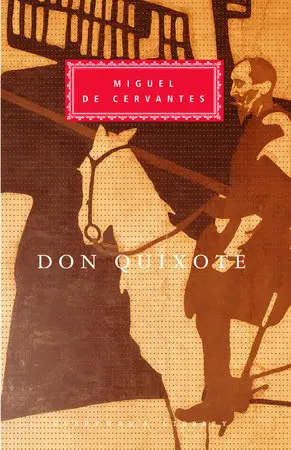
Get the Motteux translation of The history of the renown'd Don Quixote de la Mancha (published by Everyman's Library Classics Series)
Includes an introduction by A.J. Close. Unfortunately, the publisher's preview of the interior is showing the Everyman's CHILDREN'S edition, not the Everyman's Library edition.
Available as a hardcover (ISBN 9780679407584, 1112 pages).
Get the Motteux translation of The history of the renown'd Don Quixote de la Mancha (published by Everyman's Library)
Includes an introduction by A.J. Close. Unfortunately, the publisher's preview of the interior is showing the Everyman's CHILDREN'S edition, not the Everyman's Library edition.
Available as a hardcover (ISBN 9781857150032, 1048 pages).
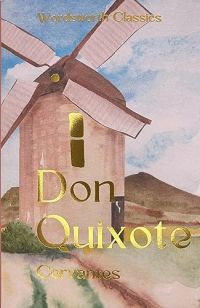
Get the Motteux translation of The history of the renown'd Don Quixote de la Mancha (published by Wordsworth Classics)
Includes introduction and footnotes by Stephen Boyd.
Available as a paperback (ISBN 9781853260360, 800 pages).
1742 · Charles Jervas · The life and exploits of the ingenious gentleman Don Quixote de la Mancha
About Charles Jervas
Charles Jervas (aka Charles Jarvis) was an Irish portrait painter. His translation of Don Quixote was published posthumously. The printer mistakenly spelled his name “Jarvis”, so his popular translation became known as the Jarvis translation. Wikidata lists a variety of spellings of his name.
About the Jervas translation of Don Quixote
The Oxford Guide to Literature in English Translation edited by Peter France
“His knowledge of Spanish… seems to have been more than competent, and his version, unlike those of Shelton and Motteux, is remarkably free from mistranslations…. Jarvis’s is the best of the older English versions of Don Quixote.” (page 418)
Ormsby says: “Charles Jervas, the portrait painter, and friend of Pope, Swift, Arbuthnot, and Gay. Jervas has been allowed little credit for his work, indeed it may be said none, for it is known to the world in general as Jarvis’s. It was not published until after his death, and the printers gave the name according to the current pronunciation of the day. It has been the most freely used and the most freely abused of all the translations. It has seen far more editions than any other, it is admitted on all hands to be by far the most faithful, and yet nobody seems to have a good word to say for it or for its author.”
Putnam (in his 19XX text) says “This translation has been about the most popular of all—in England if not in America—having run through close to a hundred printings.”
See the copies of the “Jarvis” translation available from antiquarian booksellers: Search AbeBooks
The Jarvis translation was published in 3 volumes by Dubochet in 1837 with a lot of illustrations by Tony Johannot. Browse the scans online free at Archive.org: Volume 1 · Volume 2 · Volume 3
The Jarvis translation lives on, as it was likely the unacknowledged basis for the Smollet translation. As of 2008, there is an edited version of the Jarvis translation available from Oxford.
First sentence of the Jervas translation of Don Quixote
» See extracts to compare the translations of Don QuixoteDown in a village of La Mancha, the name of which I have no desire to recollect, there lived, not long ago, one of those gentlemen who usually keep a lance upon a rack, an old buckler, a lean horse, and a coursing grayhound.
1755 · Jervas revised by Tobias Smollett · The history and adventures of the renowned Don Quixote
About Jervas revised by Tobias Smollett
He was a Scottish writer.
About the Jervas/Smollett translation of Don Quixote
Smollet’s version has been sometimes considered a revision of the Jarvis translation. Nevertheless, it remains a historically important edition, and alongside the Motteux and Ormsby public domain translations, remains in print.
Carmine Rocco Linsalata, assistant professor of Romance languages at Stanford University, studied the question of Smollett’s originality. In 1956, Standford University Press published his findings as: Smollett’s Hoax: Don Quixote in English. It is 119 pages, consisting mostly of data. The conclusion is that Smollett’s version is NOT a new translation. Linsalata says, “[I]t is hoped that the textual evidence presented will satisfy the die-hards that Smollett’s translation is a gem in the realm of fraudulent acts.” (page vii)
However, the Smollett translation has been rehabilitated and given a thorough scholarly treatment and reprinted by the University of Georgia Press in an edition revised by O.M. Brack, Jr.
Ilan Stavans, in Quixote: The Novel and the World, says: “My aim became to determine whether Smollett’s name rightly belongs among those who have performed the demanding task of translating Cervantes’ accounts of the Spanish Don in armor…. That Smollett plagiarized from Jarvis may be stated with neither hesitation nor doubt.… I am left to conclude that Tobias Smollett did not know Spanish, and that he relegated the task of translating the Quixote to his hack school.” (pages 22-23)
National Endowment for the Humanities: “One Master, Many Cervantes” by Ilan Stavans
“Smollett’s translation is an abomination.”
The Cervantes Society of America: Review by Thomas R. Hart of the 1986 FSG edition of the Smollett translation
“Smollett’s conviction that he was engaged in translating an essentially comic text would be hard to infer from his translation, though one gets an occasional glimpse of it in his notes… Linsalata’s book [Smollett’s Hoax] is unconvincing, as A. A. Parker pointed out in a brief but incisive review in Modern Language Review (1959)…. Like other English versions of Cervantes’s masterpiece, Smollett’s falls short on two main counts. One is that it fails to render the wide range of stylistic levels in the original…. The second deficiency of Smollett’s translation, again one it shares with other versions, is that it fails to capture the sense of fun in playing with the possibilities of language…. Smollett’s translation is on the whole readable and reasonably accurate. His errors are neither so numerous nor so grave as to lead the reader seriously astray. Some apparent errors must be attributed not to Smollett’s lack of linguistic competence but to the deficiencies of the editions available to him.”
See the copies of the Jarvis/Smollett translation available from antiquarian booksellers: Search AbeBooks
The Jarvis/Smollett translation was published in 1 volume by Harrison and Company in 1792. Browse the scans online free at Archive.org.
The Jarvis/Smollett translation was published in 4 volumes by Conrad and Company in 1803. Browse the scans online free at Hathi Trust.
There are many modern, edited reprints of the Jarvis/Smollett translation. In particular, the University of Georgia Press released an edited edition in 2003, fortunately or unfortunately coinciding with the publication of Edith Grossman’s popular new translation.
First sentence of the Jervas/Smollett translation of Don Quixote
» See extracts to compare the translations of Don QuixoteIn a certain corner of la Mancha, the name of which I do not choose to remember, there lately lived one of those country gentlemen, who adorn their halls with a rusty lance and worm-eaten target, and ride forth on the skeleton of a horse, to course with a sort of a starved greyhound.


Get the Jervas/Smollett translation of The history and adventures of the renowned Don Quixote (published by Enriched Classics)
Translated from the Spanish by Tobias Smollett with revisions by Dr. Cory Reed. Supplementary materials written by Professor Cory Reed. Includes an introduction, a chronology of the author's life and work, some historical context, a note on the translation, endnotes, interpretive notes, critical exceprts, questions for discussion, and suggestions for the interested reader.
Available as an ebook (ISBN 9781501137341, 1360 pages).

Get the Jervas/Smollett translation of The history and adventures of the renowned Don Quixote (published by Dover Thrift)
Includes translation by Tobias Smollet, an author bio, a translator's note, and the text of Don Quixote.
Available as a paperback (ISBN 9780486821955, 992 pages).

Get the Jervas/Smollett translation of The history and adventures of the renowned Don Quixote (published by Dover Thrift)
Includes translation by Tobias Smollet.
Available as an ebook (ISBN 9780486829692, 992 pages).
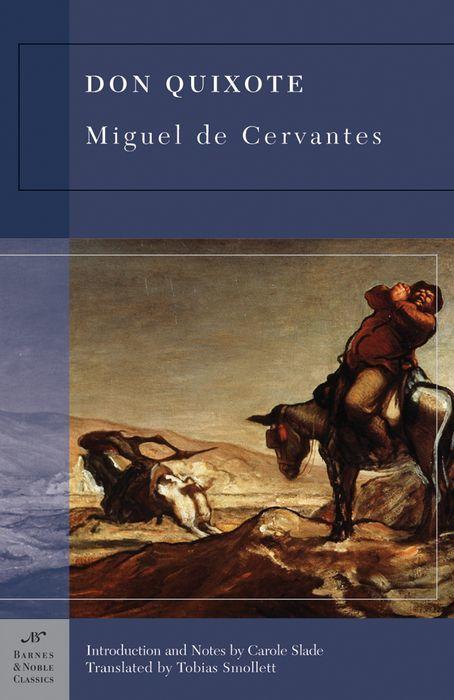
Get the Jervas/Smollett translation of The history and adventures of the renowned Don Quixote (published by Barnes & Noble Classics Series)
Includes an introduction and notes by Carole Slade and illustrations by Gustave Dore. B&N Classics include extras such as an author bio, chronology, notes, bibliography, etc.
Available as a paperback (ISBN 9781593080464, 928 pages).
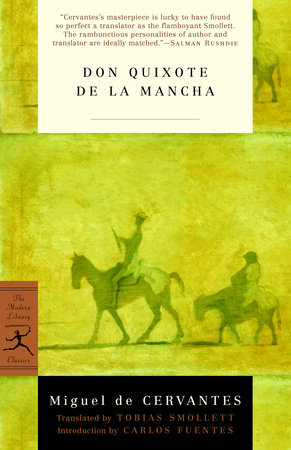
Get the Jervas/Smollett translation of The history and adventures of the renowned Don Quixote (published by Modern Library)
Includes an introduction by Carlos Fuentes, endnotes by Stephanie Kirk, a glossary, and a reading group guide. This Modern Library edition is out of print, but you may be able to locate a used copy. There is a in-print Modern Library edition containing the Putnam translation.
Available as a paperback (ISBN 9780812972108, 1185 pages).
1881 · Alexander James Duffield · The ingenious knight, Don Quixote de la Mancha
About Alexander James Duffield
According to Wikipedia, he was an English mining engineer, Hispanist, and writer. In 1881 he also published Don Quixote, his Critics and Commentators, with a brief Account of the Minor Works of Cervantes and a Statement of the Aim of the greatest of them all.
About the Duffield translation of Don Quixote
Duffield began his translation with Henry Edward Watts, who later published his own version. It would be interesting to know what exactly became of their effort to collaborate.
Ilan Stavans in Quixote: The Novel and the World says Duffield’s 1881 translation is “largely forgotten” (page 180).
The Oxford Guide to Literature in English Translation edited by Peter France
The guide says this is one of several translations that have “sunk without a trace” (page 418).
Before the start of the novel itself, volume 1 contains over 120 pages of introductory material on: Cervantes, “this translation and others”, notes and comments, women of Cervantes, books of chivalry, proper names, the author’s dedication, the author’s prologue, the title, the notes on the prologue, the roll of customary sonnets and notes on the sonnets.
See the copies of the Duffield translation available from antiquarian booksellers: Search AbeBooks
The Duffield translation was published in 3 volumes by C. Kegan Paul and Company in 1881. Browse the scans online free at Archive.org: Volume 1 · Volume 2 · Volume 3
Or browse the scans at Hathi Trust online free.
First sentence of the Duffield translation of Don Quixote
» See extracts to compare the translations of Don QuixoteIn a village of La Mancha, the name of which I do not care to recollect, there lived not long ago a knight, one of those who kept lance in rack, an ancient targe, a lank stallion, and a swift greyhound.
1885 · John Ormsby · The ingenious gentleman Don Quixote of La Mancha
About John Ormsby
He was an Anglo-Irish translator, known for his popular translation of Don Quixote.
About the Ormsby translation of Don Quixote
Ormsby includes an introduction describing most of the previous translations, a biography of Cervantes, and footnotes. It was published by Norton in a revised edition edited by Kenneth Douglas and Joseph Jones.
Ilan Stavans, in Quixote: The Novel and the World, says the Ormsby translation was the most scholarly so far. It was also the first to become available online.
Lit Hub: “Don Quixote: Sloppy, Inconsistent, Baffling, Perfect” by Ilan Stavans
“[The Restless Classics edition, in which this article is included as an introduction,] uses the rendition by John Ormsby (1829–1895), first published in London in 1885. I find his version the most genuine, the closest to the original, and with the most rhythm and sharpness…. I like this version because it avoids affectation.”
The Oxford Guide to Literature in English Translation edited by Peter France
The guide calls it “remarkable” but “not always easy” for readers today to follow. “In his quest for accuracy, he often introduces obscure Elizabethan words; more seriously, in attempting to reflect the syntax of the original, he frequently writes what amount to pseudo-Spanish sentences which bear little relation to natural English. Yet… many of his specific translations would be difficult to improve on.” (page 418)
See the copies of the Ormsby translation available from antiquarian booksellers: Search AbeBooks
The Ormsby translation was published in 4 volumes by Smith, Elder and Company in 1885. Browse the scans online free at Archive.org: Volume 1 · Volume 2 · Volume 3 · Volume 4
Or read the text of the Ormsby translation at TeleLib online for free.
There are many modern, edited reprints of the Ormsby translation, including free ebooks. See below.
First sentence of the Ormsby translation of Don Quixote
» See extracts to compare the translations of Don QuixoteIn a village of La Mancha, the name of which I have no desire to call to mind, there lived not long since one of those gentlemen that keep a lance in the lance rack, an old buckler, a lean hack, and a greyhound for coursing.
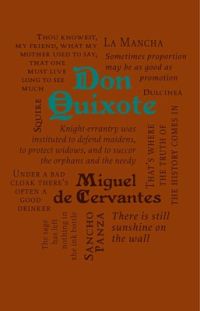
Get the Ormsby translation of The ingenious gentleman Don Quixote of La Mancha (published by Word Cloud Classics)
Features: clean, modern aesthetic, flexible vinyl covers, specially-designed endpapers, foil-stamping, cute size (5.25″ x 7.75″).
Available as a flexibound book (ISBN 9781607107330, 1056 pages).
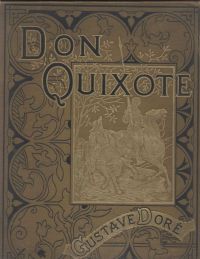
Get the Ormsby translation of The ingenious gentleman Don Quixote of La Mancha (published by Project Gutenberg)
Includes a translator's preface and illustrations by Gustave Dore (taken from the 1880 Jarvis/Motteaux edition published by JW Clark).
Available as an ebook.
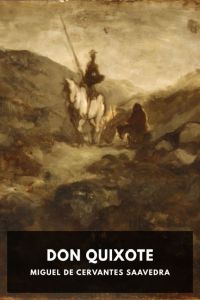
Get the Ormsby translation of The ingenious gentleman Don Quixote of La Mancha (published by Standard Ebooks)
Includes a translator's preface.
Available as an ebook.
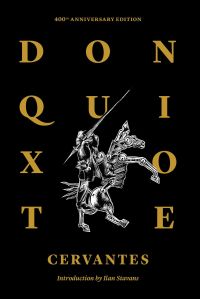
Get the Ormsby translation of The ingenious gentleman Don Quixote of La Mancha (published by Restless Classics)
400th Anniversary edition. Includes an introduction by Ilan Stavans and illustrations by Eko. Online video series made to accompany this edition.
Available as a paperback (ISBN 9781632060754, 960 pages).
Get the Ormsby translation of The ingenious gentleman Don Quixote of La Mancha (published by Restless Classics)
400th Anniversary edition. Includes an introduction by Ilan Stavans and illustrations by Eko. Online video series made to accompany this edition.
Available as an ebook (ISBN 9781632060808).
1888 · Henry Edward Watts · The ingenious gentleman Don Quixote of La Mancha
About Henry Edward Watts
Wikipedia says he was “a British journalist and author on Spanish topics.” He lived in India, England, and Australia.
About the Watts translation of Don Quixote
Watts began his translation with Alexander James Duffield, who later published his own version. It would be interesting to know what exactly became of their effort to collaborate.
In his introduction, in talking of previous translations, he says: “[H]owever badly it may be rendered, however roughly treated, in the baldest and driest version it never ceases to be readable.”
The 1888 edition included a biography of Cervantes which was reissued separately from the 1895 reprint of Don Quixote.
See the copies of the Watts translation available from antiquarian booksellers: Search AbeBooks
The Watts translation, in a revised edition, was published in 4 volumes by Adam and Charles Black in 1895. Browse the scans online free at Archive.org: Volume 1 · Volume 2 · Volume 3 · Volume 4
First sentence of the Watts translation of Don Quixote
» See extracts to compare the translations of Don QuixoteIn a certain village of La Mancha, whose name I will not recall, there lived not long ago: a gentleman, one of those who keep a lance in the rack, an ancient target, a lean hackney, and a greyhound for coursing.
1910 · Robinson Smith · That imaginative gentleman Don Quijote de la Mancha
About Robinson Smith
Hard to say. He gets a passing mention, if any, in lists of Cervantes’ translators.
About the Smith translation of Don Quixote
AKA The Visionary Gentleman Don Quijote de la Mancha
Book Review in The Modern Language Review, 1914
In this review, Smith was criticized for bad research on the origins of the novel and for adding too many unhelpful notes.
The Westminster Review, 1911
This review says Smith translated from “the Spanish Academy text of 1810”. He referred to the Shelton, Ormsby and Watts English translations. He omitted the poems and the “interpolated stories” to create a “popular edition”. He added an index.
See the copies of the Smith translation available from antiquarian booksellers: Search AbeBooks
The Smith translation was published by Routledge in 1914. Browse the scans at Hathi Trust (US only).
First sentence of the Smith translation of Don Quixote
» See extracts to compare the translations of Don QuixoteIn a village of La Mancha, whose name l do not care to recall, there lately lived one of those gentlemen that keep a lance in the rack, an ancient shield, a rake of a horse and one lone harrier-bound.
1949 · Samuel Putnam · Don Quixote de la Mancha
About Samuel Putnam
He was an American writer and translator best known for his translation of Don Quixote.
About the Putnam translation of Don Quixote
Putnam worked from a critical text based on the first editions of 1605 and 1615.
Putnam’s translation is still under copyright and still in print. See below.
The Oxford Guide to Literature in English Translation edited by Peter France
“This is in many ways an exemplary piece of work, done in full awareness of earlier translators—especially Ormsby—and backed by a series of very helpful notes. However, it does have its faults: [too much stress on the colloquial, wordiness, some convoluted sentences].” (page 419)
Translation and Literature: Review by Arthur Terry of the Raffel translation
“It is hard to imagine anyone, in however elevated a tone, actually speaking Putnam’s version: the sentences are often convoluted and the vocabulary is at times faintly archaic…. Putnam seems pedantic and, at times, almost incomprehensible.”
First sentence of the Putnam translation of Don Quixote
» See extracts to compare the translations of Don QuixoteIn a village of La Mancha the name of which I have no desire to recall, there lived not so long ago one of those gentlemen who always have a lance in the rack
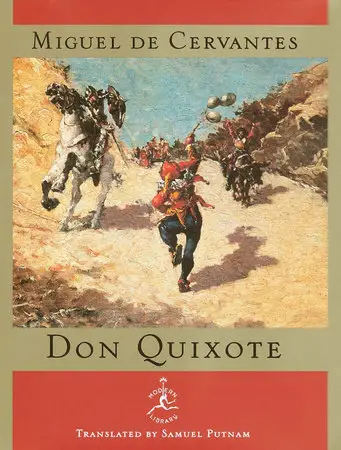
Get the Putnam translation of Don Quixote de la Mancha (published by Modern Library)
Includes an introduction by Samuel Putnam, a note on the author, endnotes for each part, and a bibliography that includes detailed information on the publication history of the English translations.
Available as a hardcover (ISBN 9780679602866, 1280 pages).
Get the Putnam translation of Don Quixote de la Mancha (published by Modern Library)
Includes an introduction by Samuel Putnam, a note on the author, endnotes for each part, and a bibliography that includes detailed information on the publication history of the English translations.
Available as an ebook (ISBN 9780679641223, 1056 pages).
1950 · J. M. Cohen · The adventures of Don Quixote
About J. M. Cohen
He was an English writer and translator of Russian, Spanish, and French works, including books by Rousseau, Rabelais, and Montaigne.
About the Cohen translation of Don Quixote
The Cohen translation is still under copyright and still in print.
The Oxford Guide to Literature in English Translation edited by Peter France
This translation relies on Jarvis. It is “accurate enough” but “decidedly flat” with “fairly lifeless” prose. (page 419)
National Endowment for the Humanities: “One Master, Many Cervantes” by Ilan Stavans
Stavans says the Cohen translation strikes him as “lacking ambiguity” and equates ambiguity with richness.
First sentence of the Cohen translation of Don Quixote
» See extracts to compare the translations of Don QuixoteIn a certain village in La Mancha, which I do not wish to name, there lived not long ago a gentleman – one of those who have always a lance in the rack, an ancient shield, a lean hack and a greyhound for coursing.
Get the Cohen translation of The adventures of Don Quixote (published by Macmillan Collector's Library)
Includes an introduction by Ned Halley.
Available as a hardcover (ISBN 9781509844760, 1032 pages).
1957 · Walter Starkie · Don Quixote of La Mancha
About Walter Starkie
Walter Fitzwilliam Starkie was an Irish writer, musician, translator, and Hispanist known for his travel writing.
About the Starkie translation of Don Quixote
1954 – Macmillan published an abridged translation by Starkie, subtitled “An abridged version designed to relate without digressions to the principle adventures of the Knight and his Squire”. It includes a long author bio and decorative illustrations by Gustave Dore. Published in London.
1957 – Mentor/New American Library published the abridged translation by Starkie, but with the bio shortened.
1964 – New American Library/Signet published the unabridged translation by Starkie.
The Starkie translation is still under copyright. The abridged version is still in print; the unabridged version is out of print. See below.
First sentence of the Starkie translation of Don Quixote
» See extracts to compare the translations of Don QuixoteAt a village of La Mancha, whose name I do not wish to remember, there lived a little while ago one of those gentlemen who are wont to keep a lance in the rack, an old buckler, a lean horse, and a swift greyhound.
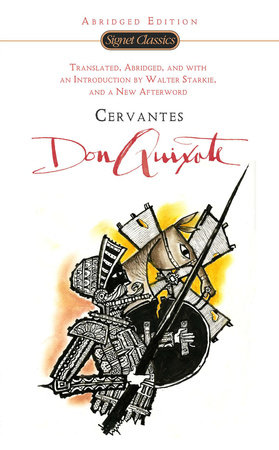
Get the Starkie translation of Don Quixote of La Mancha (published by Signet Classics)
ABRIDGED. Includes an introduction by Walter Starkie, an afterword by Roberto Gonzalez Echevarria, and footnotes.
Available as a paperback (ISBN 9780451532299, 560 pages).
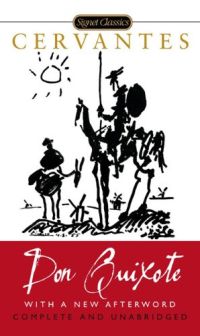
Get the Starkie translation of Don Quixote of La Mancha (published by Signet Classics)
UNABRIDGED. Inclueds an introduction by Edward H. Friedman, a selected bibliography, both parts of Don Quixote (including the prefatory verses), and a few footnotes. This Signet edition is out of print, but you may be able to find a second-hand copy.
Available as a paperback (ISBN 9780451531285, 1056 pages).
1981 · Ormsby revised by Joseph Ramon Jones and Kenneth Douglas · Don Quixote
About Ormsby revised by Joseph Ramon Jones and Kenneth Douglas
Jones was, with his wife, a longtime professor of Spanish at the University of Kentucky until his retirement in 2001. The pair were inducted into the University of Kentucky Arts & Sciences Hall of Fame in 2011. Kenneth Douglas was a writer, editor, and translator. He taught French literature at Yale for 20 years.
» New York Times obituary of Kenneth Douglas
About the Ormsby/Jones & Douglas translation of Don Quixote
The Jones/Douglas version of the Ormsby translation is still under copyright but out of print. See below.
The Oxford Guide to Literature in English Translation edited by Peter France
“[E]ven though [Ormsby] takes accuracy to extreme lengths—an unusual fault among translators of Don Quixote—it is this very accuracy which has encouraged Jones and Douglas to revise his version, a task which has resulted in one of the most convincing of modern translations.” (page 418-9)
First sentence of the Ormsby/Jones & Douglas translation of Don Quixote
» See extracts to compare the translations of Don QuixoteIn a village of La Mancha, which I prefer to leave un-named, there lived not long ago one of those gentlemen that keep a lance in the lance-rack, an old shield, a lean hack, and a greyhound for hunting.
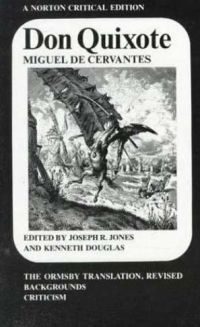
Get the Ormsby/Jones & Douglas translation of Don Quixote (published by Norton)
Contains a preface, a guide to pronuncaition of Spanish names, both parts of Don Quixote (including the poetry at the beginning), footnotes in the text, six "Backgrounds and Sources", 10 critical essays, a selected bibliography. This Norton Critical Edition is out of print, but you may be able to find a second-hand copy. (If the stock image is yellow, ignore it. That’s the wrong cover but the correct ISBN. The Norton covers have a red or black border and a Dore illustration of tilting at windmills. The red one is the 1981 first edition.)
Available as a paperback (ISBN 9780393090185, 1022 pages).
1995 · Burton Raffel · The history of that ingenious gentleman, Don Quijote de la Mancha
About Burton Raffel
He was an American writer, translator, and professor, known for his translation of Beowulf. He also translated Gargantua and Pantagruel and Dante’s Divine Comedy. He is the author of a book titled The Art of Translating Prose.
About the Raffel translation of Don Quixote
This version is distinguished from others in that Raffel chose to use a J in place of an X in the title.
The Raffel translation is still under copyright. The version originally published by Norton is out of print, but as of 2020, Norton is selling a version of the Raffel translation revised by Diana de Armas Wilson.
The Oxford Guide to Literature in English Translation edited by Peter France
This is an “excellent”, “natural” and rhythmic translation that “[tries] to follow the syntax of the original without falling into any of Ormsby’s excesses” and is “immensely successful” in handling Sancho Panza’s proverbs. (page 418)
Philosophy and Literature: “Don Quixote: Translation and Interpretation” by James A. Parr
“Burton Raffel resorts to what he calls syntactic tracking, in addition to the customary attention to lexical equivalencies, and produces a text that is also close to the original, not in its archaism, but in rhythm and rhetoric, in length of sentences, patterning, and colloquial dialogue. Raffel is also able to capture certain subtleties better than some of his predecessors, although at times this becomes a quest for innuendo, leading him astray. His Americanized version may nevertheless appeal to some readers in the United States.”
Translation and Literature: Review by Arthur Terry of the Raffel translation
“One of the virtues of Raffel’s translation is that it attempts, as far as possible, to follow the syntax of the original…. Raffel’s translation… is natural from beginning to end…. Overall, then, this is an excellent version…. [T]his is one of the best examples of book production I have seen for some time, and both publishers and translator are to be congratulated on a superb piece of work.”
Review by Alan Burch of the Raffel translation
“One of the most striking—and recommendable—features of Burton Raffel’s new translation of Don Quijote is his use of colloquial modern American English, which is not only refreshing, but perhaps will attract more (and younger) readers to the text. This approach works particularly well in the dialogue of Sancho Panza…. Raffel’s work is somewhat abridged, given the absence of translations of the original title pages, tables of contents, and other prefatory materials, especially the verses to Part I, which the Ormsby translation, among others, includes…. I will continue to use the Ormsby translation as my principal English language edition of the Quijote.”
First sentence of the Raffel translation of Don Quixote
» See extracts to compare the translations of Don QuixoteIn a village in La Mancha (I don’t want to bother you with its name) there lived, not very long ago, one of those gentlemen who keep a lance in the lance-rack, an ancient shield, a skinny old horse, and a fast greyhound.
Get the Raffel translation of The history of that ingenious gentleman, Don Quijote de la Mancha (published by Norton)
Includes an introduction by Diana de Armas Wilson, a translator's note, and the text of both parts of Don Quixote with footnotes. This Norton edition is out of print, but you may be able to find a second-hand copy. There is a Norton edition revised by Diana de Armas Wilson in print.
Available as a hardcover (ISBN 9780393037197, 733 pages).
2000 · John Rutherford · The ingenious hidalgo Don Quixote de la Mancha
About John Rutherford
John David Rutherford is a British writer, professor, Hispanist, and translator of works in Spanish.
About the Rutherford translation of Don Quixote
Although he preserves the author’s long sentences, Rutherford chose to use modern language rather than archaic or literary language, as he explains in his introduction, because Cervantes was using the language of his own time.
Translation and Literature: “Review of Cervantes: Don Quixote, translated by John Rutherford” by Arthur Terry
Rutherford’s introduction claims that “translators have failed to emphasize the comic aspects of the novel…. Rutherford divides [translators] into the ‘cavalier’ (Shelton, Motteux, Philips, Smollett) who are vigorous but inaccurate, and the ‘puritanical’ (Jervas to the present day), who take an over-serious view of the text. His own approach is to adopt the strengths of either tendency while avoiding its defects.” And the result? “Rutherford succeeds in bringing out the humour of the original more consistently than any previous translator since the eighteenth century.”
Independent: “When translators play safe we get mediocrity” by John Rutherford
“We can regard the translator not as a passive reproducer of meanings but as an active reader first, and then a creative rewriter of what he has read…. Any translation of this novel is the translator’s account of his reading of it…. [Since] some readings are more appropriate than others, … some translations are better than others.”
The New Yorker: “Knight’s Gambit” by James Wood
“John Rutherford’s recent version for Penguin Classics… takes more liberties with Sancho Panza’s demotic Spanish than Grossman’s does.”
The Miscellany News of Vassar College: “Translations of ‘Don Quixote’ prove accessible, unique’” by Jimmy Christon
Rutherford’s strengths are his humor and verse translations that “felt poetic rather than just rendering the verse from Spanish into English with no regard for meter…. [However,] there’s a sort of stiffness to the language spoken by the characters… [and] there isn’t a clear distinction between the voice of the narrator and the voice of the characters.”
Cervantes Society of America: Review of the Rutherford translation by Tom Lathrop
“I like it that certain Spanish items are translated or explained for English-speaking readers, seemingly as part of the work: ‘His surname’s said to have been Quixada, or Quesada (as if he were a jawbone, or a cheesecake)’.” However: “The translation has a decidedly British slant. The language is very colloquial—the more colloquial the language is, the more region-specific it is. There is nothing the matter with this in principle, let me emphasize, but I wonder how an audience of American students will react to the text, or understand it properly, for that matter.”
Frankly Curious: “Don Quixote in English Langauge Translation” by Frank Moraes
“When people ask me which translation of Don Quixote they should read, I always tell them the same thing, ‘You should read whichever translation you happen to have.’ While it is true that the translations are quite different, they aren’t so different that you should wait to read it. Just grab a copy and start reading it. Just the same, if you are going to buy a new copy, I recommend John Rutherford’s translation from Penguin Classics. It is laugh-out-loud funny — most likely providing the closest experience that early 17th century Spanish readers got from the original.” Visit the link for samples of 12 English versions of the first sentence of the author’s prologue, and for a comparison of the translation of what Rutherford renders as “sorry face”, and for links to more articles about DQ.
First sentence of the Rutherford translation of Don Quixote
» See extracts to compare the translations of Don QuixoteIn a village in La Mancha, the name of which I cannot quite recall, there lived not long ago one of those country gentlemen or hidalgos who keep a lance in a rack, an ancient leather shield, a scrawny hack and a greyhound for coursing.
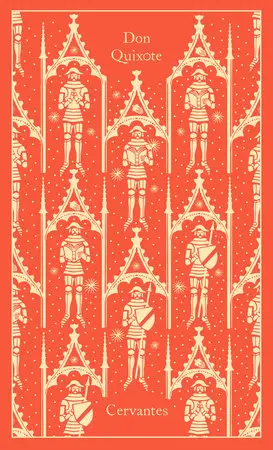
Get the Rutherford translation of The ingenious hidalgo Don Quixote de la Mancha (published by Penguin Clothbound Classics)
Includes an introduction and notes by John Rutherford. Cover designed by Coralie Bickford-Smith.
Available as a hardcover (ISBN 9780241347768, 1056 pages).
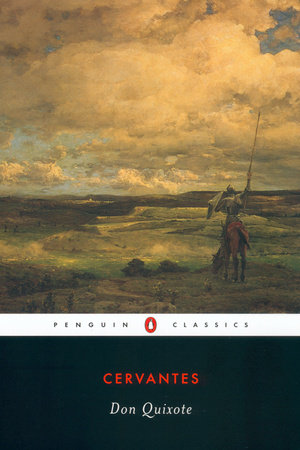
Get the Rutherford translation of The ingenious hidalgo Don Quixote de la Mancha (published by Penguin Classics)
Includes an introduction by Roberto Gonzalez Echevarria and notes by John Rutherford.
Available as a paperback (ISBN 9780142437230, 1072 pages).
Get the Rutherford translation of The ingenious hidalgo Don Quixote de la Mancha (published by Penguin Classics)
Includes an introduction and notes by John Rutherford.
Available as a paperback (ISBN 9780140449099, 1056 pages).
Get the Rutherford translation of The ingenious hidalgo Don Quixote de la Mancha (published by Penguin)
Includes an introduction and notes by John Rutherford.
Available as an ebook (ISBN 9780141908335, 1056 pages).
2003 · Smollett revised by O.M. Brack, Jr. · The History and Adventures of the Renowned Don Quixote
About Smollett revised by O.M. Brack, Jr.
O.M. “Skip” Brack, Jr. was an emeritus professor of literature, editor of a series of works by Tobias Smollett, bibliographer, and expert on Samuel Johnson.
About the Smollett/Brack translation of Don Quixote
See above for information on the Smollett translation.
From the publisher, University of Georgia Press:
This authoritative textual edition presents Tobias Smollett’s translation of Cervantes’s Don Quixote in the form most faithful to Smollett’s own intentions. It includes Francis Hayman’s twenty-eight illustrations engraved for the original edition, Smollett’s explanatory notes, and his prefatory “Life of Cervantes.”
Smollett’s Don Quixote first appeared in 1755 and was for many years the most popular English-language version of Cervantes’s masterpiece. However, soon after the start of the nineteenth century, its reputation began to suffer. Rival translators, literary hucksters, and careless scholars initiated or fed a variety of charges against Smollett-even plagiarism. For almost 130 years no publisher risked reprinting it.
Redemption began in 1986, when the distinguished Mexican novelist Carlos Fuentes, in his foreword to a new (albeit flawed) edition of Smollett’s translation, declared it to be “the authentic vernacular version” of Don Quixote in English. Fuentes’s opinion was in accord with that of the preeminent Cervantist, Francisco Rodríguez Marín, who decades earlier had declared Smollett’s Don Quixote to be his preferred English version.
Martin C. Battestin’s introduction discusses the composition, publication, and controversial reception of Smollett’s Don Quixote. Battestin’s notes identify Smollett’s sources in his “Life of Cervantes” and in his commentary, provide cross-references to his other works, and illustrate Smollett’s originality or dependence on previous translations. Also included is a complete textual apparatus, a glossary of unfamiliar terms, and an appendix comparing a selection of Francis Hayman’s original illustrations with the engraved renderings used in the book.
Huntington Library Quarterly: “Tobias Smollett and the Translators of the Quixote” by Julie Candler Hayes
“Smollett’s version is… not a revised or secondhand translation as some critics once declared, but a knowing, readerly, and writerly rendition that comments on earlier versions, that encompasses and moves beyond them…. [Smollett’s version was initially popular, being reprinted 20 times.] The critical tide began to turn against Smollett, however, with the assessment of Alexander Tytler, Lord Woodhouselee, whose 1791 Essay on the Principles of Translation included an entire chapter comparing Smollett and Motteux, to the disadvantage of the former…. In the course of the twentieth century, scholars would go so far as to deny Smollett any hand in the translation or indeed any knowledge of Spanish at all, charges that have been thoroughly refuted by Battestin…. Smollett’s range, nuance, and sense of comic delivery are as lively as ever.”
Translation and Literature: “The Translator as Author: Two Quixotes” by Anthony Pym
“Some apparently forged letters revealed that Smollett had not only relied on previous translations into English (which no one denies) but that he knew little Spanish and thus contracted the job out to other hands…. Martin Battestin… amply demonstrates the originality of Smollett’s work… the 1986 version was based on the first edition of Smollett’s translation, did not include Smollett’s revision [and] was not a piece of scholarship…. This one is…. The notes are often good fun, and the glossary is entertaining for more than just Scottish terms…. Read Smollett for colour, fun, and scholarship if you will (but Shelton or Motteux also provide the first two pleasures).”
First sentence of the Smollett/Brack translation of Don Quixote
» See extracts to compare the translations of Don QuixoteIn a certain corner of la Mancha, the name of which I do not choose to remember, there lately lived one of those country gentlemen, who adorn their halls with a rusty lance and worm-eaten target, and ride forth on the skeleton of a horse, to course with a sort of a starved greyhound.
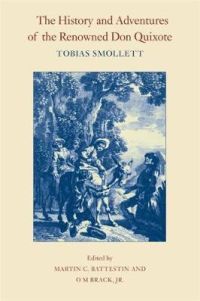
Get the Smollett/Brack translation of The History and Adventures of the Renowned Don Quixote (published by University of Georgia Press)
Edited by O.M. Brack. Includes an introduction and notes by Martin Battestin. Also includes Francis Hayman's twenty-eight illustrations engraved for the original edition, Smollett's explanatory notes, and his prefatory "Life of Cervantes."
Available as a hardcover (ISBN 9780820324302, 992 pages).
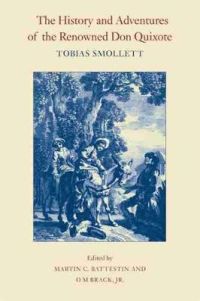
Get the Smollett/Brack translation of The History and Adventures of the Renowned Don Quixote (published by University of Georgia Press)
Edited by O.M. Brack. Includes an introduction and notes by Martin Battestin. Also includes Francis Hayman's twenty-eight illustrations engraved for the original edition, Smollett's explanatory notes, and his prefatory "Life of Cervantes."
Available as a paperback (ISBN 9780820346076, 992 pages).
2003 · Edith Grossman · Don Quixote
About Edith Grossman
Edith Grossman is an American translator of works in Spanish. She has translated works by Mario Vargas Llosa and Gabriel Garcia Marquez, among others.
» Read an interview about her process.
She is the author of a Yale University Press book titled Why Translation Matters.
About the Grossman translation of Don Quixote
Well, this is the translation everyone is talking about.
Ilan Stavans, in Quixote: The Novel and the World, says that “no recent rendition into English has generated as many accolades as Grossman’s. It has been enthusiastically embraced by readers, but it has also been attacked by some Cervantistas. Is it because she is female? Or because her inclination is to modernize?” (192)
Grossman, like Rutherford, chose to use modern language in her translation, again because Cervantes used what was modern language in his own time.
The Irish Times: “A light touch for the lost knight” by Alison Ribeiro de Menezes
“Grossman has a light touch and an easy style. At times she opts for the more discursive, less punchy option, though this is quite in keeping with the rambling nature of the original…. One of the greatest challenges for translators is to convey an impression of the foreignness of the original whilst maintaining a sense of intimacy between the author and reader of a text. Grossman achieves this admirably.” Grossman’s translation is a “faithful, highly readable rendering”.
The New Yorker: “Knight’s Gambit” by James Wood
“Edith Grossman’s English sensitively captures these shifting registers, as we move from the Knight’s ornate, sometimes pompous diction, via the narrator’s fluent and funny recounting, to the earthy Sancho Panza and his muddier music…. We are fortunate to have at present three excellent translations of ‘Don Quixote’: in addition to Grossman’s, there is John Rutherford’s recent version for Penguin Classics…, and Burton Raffel’s rendering for Norton. All are scholarly and elegant; in some places they are almost indistinguishable. But Grossman… has produced the most distinguished, and the most literary, of them, and those qualities are amply displayed on every page.”
The New York Times: “Tilt” by Carols Fuentes
“To make the classic contemporary: this is the achievement.”
LA Times: “A new Sancho Panza speaks for the knight-errant” by Ilan Stavans
“Grossman inherited from Gregory Rabassa the mantle of the official translator of Latin American letters and has illustriously rendered Gabriel Garcia Marquez and many other writers into English…. Quixote’s monologues in her rendition feel crisp and immediate. This is not to say that Grossman’s translation is perfect. Some word choices are questionable… [and her lack of access to an authoritative source text] seems suggested by her occasional footnotes, which are sometimes outmoded and even wrongheaded.”
Cervantes Society of America: Review by Tom Lathrop of Edith Grossman’s Translation of Don Quixote
“This is a trade book destined for the general reader, and in this role Grossman’s text is ideal—you read it, you get the story, you get lots of footnotes—in an altogether readable format…. There has been a flood of “reviews” of this translation, all favorable… [but] serious students of literature in translation should consider looking elsewhere for more faithful translations, such as Starkie and the discontinued and lamented Ormsby-Douglas-Jones version. There are just too many things that just are not right, or are confusing, in this translation.” Lathrop gives several pages of detailed examples, and also criticizes Harold Bloom’s introduction for not actually introducing the content or context of the novel, or even making useful reference to prominent literary critics. He also points out that Grossman did not work from the best source texts.
Prospect Magazine: “A rational quixote” by Julian Evans
“Edith Grossman’s new translation (apart from brief confusions of ‘thee’ and ‘thou’) is so good that it ought to compel us to start reading the Quixote again. Her text restores Cervantes’s readability, the vitality of his dialogue and characterisation and the darkening quality of his vision. The thought patterns of his madness, which earlier translations obscured by rendering the original too literally or too loosely, are here rendered as logical, and thus funnier and sadder.”
The Atlantic: “High Plains Drifter” by Terry Castle
“Edith Grossman actually makes it easy for you, O frazzled reader, because she has produced the most agreeable Don Quixote ever. Don’t be put off by Harold Bloom’s introduction (major windbag alert in effect); go right to the thing itself.”
New York Times: “Beholding Windmills and Wisdom from a New Vantage” by Richard Eder
Grossman “has provided a Quixote that is agile, playful, formal and wry. Once in a while there are odd choices and, in the translation’s 940 pages, some occasional flagging, but what she renders splendidly is the book’s very heart.”
Guardian: “There is nothing like a don” by Robert McCrum
“Grossman is a veteran of contemporary Latin-American literature. She comes to Cervantes with great experience and a fine ear for the nuances of Spanish and brings off the remarkable feat of giving the reader an utterly modern text that is still, unmistakably, a novel of the seventeenth century.”
Translation and Literature: “The Translator as Author: Two Quixotes” by Anthony Pym
“A translation entirely in the current language of today would necessarily hide the enormous distances travelled by the text, and the reasons why those distances have made it a classic for generations of readers. Grossman’s implicit defence is that, since English has built up a fair stock of archaic Quixotes, the only thing she could possibly add to the pile is a rendition in reasonably contemporary language… [but] a merely contemporary version will also age with the passing of time, adding to the heap, and speaking to no more than one receptive moment. That said, Grossman does rather more than she claims to do…. Unlike most of the other translations, including Smollett and many of those of the twentieth century, Grossman retains Spanish proper nouns and currency units [and includes] the mock sonnets…. [R]ead Grossman for information.”
First sentence of the Grossman translation of Don Quixote
» See extracts to compare the translations of Don QuixoteSomewhere in La Mancha, in a place whose name I do not care to remember, a gentleman lived not long ago, one of those who has a lance and ancient shield on a shelf and keeps a skinny
Get the Grossman translation of Don Quixote (published by Vintage)
Includes an introduction by Harold Bloom and footnotes by Grossman.
Available as a paperback (ISBN 9780099469698, 992 pages).
Get the Grossman translation of Don Quixote (published by Vintage Digital)
Includes an introduction by Harold Bloom and footnotes by Grossman.
Available as an ebook (ISBN 9781448114177, 992 pages).
Get the Grossman translation of Don Quixote (published by Ecco)
Includes an introduction by Harold Bloom and footnotes by Grossman.
Available as a paperback (ISBN 9780060934347, 976 pages).
Get the Grossman translation of Don Quixote (published by Ecco)
Includes an introduction by Harold Bloom and footnotes by Grossman.
Available as a hardcover (ISBN 9780060188702, 940 pages).
Get the Grossman translation of Don Quixote (published by Ecco)
Includes an introduction by Harold Bloom and footnotes by Grossman.
Available as an ebook (ISBN 9780061957888, 981 pages).
Get the Grossman translation of Don Quixote (published by Art of the Story Deluxe Edition)
Includes an introduction by Harold Bloom and footnotes by Grossman.
Available as a paperback (ISBN 9780062391667, 992 pages).
2005 · Tom Lathrop · Don Quixote
About Tom Lathrop
Thomas Lathrop was an American professor, linguist, writer, editor, translator, and publisher. Walter Starkie, whose translation of Don Quixote was published in 1964, was his professor. He was a founding member of the Cervantes Society of America.
The publishing company he founded, Linguatext, offers materials for study of French and Spanish classics.
About the Lathrop translation of Don Quixote
Lathrop wanted to UNcorrect the text, to create translation that reflects what he felt sure were intentional idiosyncrasies on the part of Cervantes.
Cervantes Society of America: Review by Stephen Hessel of the Lathrop translation
“Throughout his career Tom Lathrop has frequently and fervently argued against the ‘correcting’ that over more than four centuries has transformed some versions of Cervantes’s novel into a very different book. This desire to present Don Quixote, ‘errors’ and all, springs from his belief that these so-called mistakes are instead carefully placed rhetorical ploys…. Perhaps my personal favorite feature of this edition is the fairly direct style of translation. It appears that Lathrop was able to resist the temptation to play with the language in the name of style—an all too common pitfall.”
The Cervantes Society of America: Review by Michael J. McGrath of the Lathrop translation
“Lathrop’s translation is, for the most part, highly accurate…. Lathrop’s translation contains more than a thousand footnotes that explain in detail the literary, historical, and cultural milieu that surrounds the knight’s many adventures…. While the primary target audience of Lathrop’s translation is students of literature in translation at the university level, non-specialists and specialists alike will find Don Quixote a pure joy to read. Lathrop is to be commended for producing a translation that is not only a faithful recreation of the original, but also one that is easy to read and to comprehend.”
First sentence of the Lathrop translation of Don Quixote
» See extracts to compare the translations of Don QuixoteIn a village in La Mancha, which I won’t name, there lived not long ago an hidalgo of the kind that have a lance in the lance rack, an old shield, a lean nag, and a fleet greyhound.
Get the Lathrop translation of Don Quixote (published by Signet Classics)
Fourth-centenary translation. Includes footnotes by Tom Lathrop.
Available as a paperback (ISBN 9780451531810, 1072 pages).
Get the Lathrop translation of Don Quixote (published by Signet Classics)
Fourth-centenary translation. Includes footnotes by Tom Lathrop.
Available as an ebook (ISBN 9781101525371, 1075 pages).
Get the Lathrop translation of Don Quixote (published by Alma Classics Evergreens)
Includes an extensive critical apparatus, extra reading material including a section of photographs, and notes.
Available as a paperback (ISBN 9781847493774, 800 pages).
2006 · James H. Montgomery · The adventures and misadventures of Don Quixote
About James H. Montgomery
He is a retired American professor and university librarian.
About the Montgomery translation of Don Quixote
Cervantes Society of America: Review by Michael J. McGrath of the Montgomery translation
“It is evident from the quality of Montgomery’s translations of the proverbs and word-play humor throughout the novel that he values their literary function as well as the impact they have upon the reader’s appreciation of the novel…. The passion with which Montgomery translated the novel… shines through in a translation that is faithful to the language, style, and spirit of the original. The overall quality of Montgomery’s translation is excellent, as I often found myself engrossed in the novel as if the original language were English, and only when I stopped reading did I realize that I was still reading a translation. Notwithstanding the minor deficiencies I noted, Montgomery’s translation merits consideration as one of the most noteworthy English translations of Don Quijote, and I recommend it highly.”
The Sixteenth Century Journal: Review by Alison Weber of the Montgomery translation
“Montgomery’s translation—fluent, unobtrusively modern, and attractively priced—is a welcome addition…. Excellent notes—one wishes there were more, especially for part 2—add to the attractiveness of this very competent translation.”
First sentence of the Montgomery translation of Don Quixote
» See extracts to compare the translations of Don QuixoteIn a village of La Mancha, whose name I have no intention of recalling, there lived not long ago one of those old-fashioned hidalgos who always have a lance in the rack, an ancient buckler, a skinny nag, and a swift greyhound for hunting.
Get the Montgomery translation of The adventures and misadventures of Don Quixote (published by Hackett Classics)
Includes an introduction by David Quint, a translator's preface, a list of "the principal works consulted in the preparation of this translation", an index of "selected proverbs, maxims, and passages", and a list for further reading.
Available as a hardcover (ISBN 9780872209596, 896 pages).

Get the Montgomery translation of The adventures and misadventures of Don Quixote (published by Hackett Classics)
Includes an introduction by David Quint, a translator's preface, a list of "the principal works consulted in the preparation of this translation", an index of "selected proverbs, maxims, and passages", and a list for further reading.
Available as a paperback (ISBN 9780872209589, 896 pages).

Get the Montgomery translation of The adventures and misadventures of Don Quixote (published by Hackett Classics)
Includes an introduction by David Quint, a translator's preface, a list of "the principal works consulted in the preparation of this translation", an index of "selected proverbs, maxims, and passages", and a list for further reading.
Available as an ebook (ISBN 9781603845458).
2008 · Jarvis revised by E.C. Riley · Don Quixote del la Mancha
About Jarvis revised by E.C. Riley
Edward C. Riley was a professor of Hispanic Studies at the University of Edinburgh. Born in Mexico, he studied at Oxford and worked in Madrid before beginning his professional career in Dublin.
More about Professor Edward Riley at The Herald and The Irish Times.
About the Jarvis/Riley translation of Don Quixote
See above for information on the Jarvis translation.
From the translator’s note on the text:
“The present edition… does not include Cervantes’s dedications of Parts One and Two or the prefatory verses to Part One, which are absent from Jarvis’s edition. The Introduction, Chronology, and Select Bibliography are entirely new, as are most of the explanatory notes. The text has been updated with modern paragraphing and dialogue markers for the sake of easier reading. The occasional mistranslation or really inadequate rendering—there are not many, given the size of the novel—has been amended.”
Philosophy and Literature: “Don Quixote: Translation and Interpretation” by James A. Parr
“The E. C. Riley edition of Jarvis offers a charming, archaic English that is reasonably close linguistically, in that regard, to Cervantes’s Spanish of the previous century. It is also rather British, and may therefore hold a certain charm for American readers.”
First sentence of the Jarvis/Riley translation of Don Quixote
» See extracts to compare the translations of Don QuixoteIn a village of La Mancha, the name of which I purposely omit, there lived not long ago, one of those gentlemen, who usually keep a lance upon a rack, an old target, a lean horse, and a greyhound for coursing.
Get the Jarvis/Riley translation of Don Quixote del la Mancha (published by Oxford World's Classics)
Includes the Jarvis translation edited by E.C. Riley, a note on the translation, an introduction and endnotes by E.C. Riley, and a chronology of the author.
Available as a paperback (ISBN 9780199537891, 1008 pages).
Get the Jarvis/Riley translation of Don Quixote del la Mancha (published by Oxford World's Classics)
Includes the Jarvis translation edited by E.C. Riley, a note on the translation, an introduction and endnotes by E.C. Riley, and a chronology of the author.
Available as an ebook (ISBN 9780191561498, 1008 pages).
2020 · Raffel revised by Diana de Armas Wilson · Don Quijote
About Raffel revised by Diana de Armas Wilson
She is a writer, a translator, and a professor emerita of English and Renaissance studies specializing in research on Cervantes.
» See Wilson’s profile on Huffington Post
About the Raffel/Wilson translation of Don Quixote
See above for information on the Raffel translation.
Note the J used in the title.
Cervantes Society of America: Review by Steven Wagschal of the Wilson edition of the Raffel translation
“Raffel’s translation is very readable and usually very close to the source text…. [H]is prose style captures much of the essence and the flavor of Cervantes’ original. This kind of pleasurable readability is particularly useful for contemporary North American college students, to whom this series is primarily directed…. Raffel’s translation is highly accurate, for the most part, and unlike J. M. Cohen’s widely-read version…, his prose style has grace and retains much of the Cervantine cadence and irony…. I think most English-speaking college students will prefer Raffel’s to other available translations, including Ormsby’s and Cohen’s…. Diana de Armas Wilson provides an informative introduction and concise footnotes, and has made a good, updated selection of background sources and contemporary criticism. The introduction contains clear biographical information (and there is an accompanying time-line of Cervantes’ life as an appendix). In addition, it presents important information on the romances of chivalry, which all students should know before reading the novel…. The five general interpretations and reflections on Don Quijote are all insightful, well-edited, and complementary…. The nine contemporary pieces of criticism… provide a good sampling of some of the major directions that Quijote studies have followed in the last quarter-century.” Among the minor criticisms are: preliminary materials are omitted; Raffel’s translation of the opening sentence of the novel sounds bad; sometimes dialog sounds too contemporary; more footnotes might have been useful; Raffel anachronistically replaced the original currency with dollars!!!
First sentence of the Raffel/Wilson translation of Don Quixote
» See extracts to compare the translations of Don QuixoteIn a village in La Mancha (I don’t want to bother you with its name) there lived, not very long ago, one of those gentlemen who keep a lance in the lance-rack, an ancient shield, a skinny old horse, and a fast greyhound.
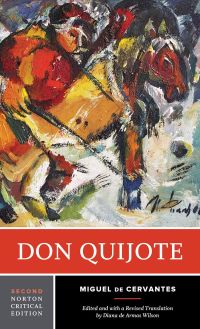
Get the Raffel/Wilson translation of Don Quijote (published by Norton)
2nd Norton Critical Edition. Includes the Raffel translation edited by Diana de Armas Wilson, a translator's note, a revised and expanded introduction and footnotes by Wilson, contextual materials, fifteen critical essays, a chronology, and a selected bibliography.
Available as a paperback (ISBN 9780393617474, 864 pages).
Notes on the work and its translation
Don Quixote: Other Editions
It’s a little difficult to decide what should count as a separate translation, but the ones listed above are those that seemed more important to me in the history of the translation of Don Quixote. I also saw these mentioned when I was constructing the list of translations of Don Quixote above.
- 1700 – Shelton revised by John Stevens: A revision of a previous translation.
- 1700 – Edward Ward aka Ned Ward: A verse adaptation inspired by Samuel Butler’s Hudibras.
- 1719 – Motteux revised by John Ozell: A revision of a previous translation.
- 1769 – Motteux revised by George Kelly: A revision of a previous translation.
- 1774 – Charles Henry Wilmot: An abridgement.
- 1809 – Jean-Pierre Claris de Florian: An abridgement… in French.
- 1818 – Mary Smirke: According to Ormsby, a “patchwork”.
- 1864 – Jarvis/Motteux revised by J.W. Clark: A revision with a biography of Cervantes by TT Shore (Thomas Teignmouth Shore).
- 2011 – Gerald J. Davis: A translation of Part 1 only.
- 2021 – Laurent Paul Sueur: An independently published translation.
Don Quixote and the Act of Translation
The novel has elements that are surprisingly modern, or even post-modern. In fact, it’s bizarrely self-referential.
Lit Hub: “Don Quixote: Sloppy, Inconsistent, Baffling, Perfect” by Ilan Stavans
“At one point in the Second Part, Don Quixote and Sancho enter a print shop in Barcelona, where they have a conversation about books and then about translations. The knight tells his squire that reading a novel in translation is like looking at a Flemish carpet from the back.” There is a “suggestion by Cervantes that what the reader has in hand is a palimpsest, one that originates in another language, with Cide Hamete Benengeli as its true author. That’s why I feel as if reading the book in Spanish is, in and of itself, an act of translation. Consequently, the fact that the vast majority of readers that have ever come to Don Quixote accessed it in translation is, at least to me, quite fitting.”
British Library / European Studies Blog: “The challenge of translating Cervantes’s Don Quixote” by Jonathan Thacker
“The passage of 400 years is also a problem: does the modern-day translator pepper the English version with explanatory footnotes about historical, cultural and linguistic matters, or make use of parenthetical explanations, as Raffel has done? Does it matter that we are unlikely to have read the popular romances of chivalry which addled Quixote’s brain and which are parodied particularly in Part I? What about the role of previous versions in English, what Rutherford calls the ‘predomestication’ undergone by the novel? Sometimes past errors by translators, such as the name given to Sancho Panza’s ass, Dapple, have become cherished parts of the furniture of the novel. And what of the overall tone of the work? Any translator’s version is likely to reflect one or other of the two dominant critical trends that developed in response to the work, the ‘funny book’ or the ‘Romantic’ approach. How seriously is the translator to take Cervantes? All of these issues – the iconic status of the novel, the legacy of its interpretation in the Academy, its in-jokes – require judgement and thought from modern-day translators before they even arrive at the rendering of words.”
Translation and Literature: “The Translator as Author: Two Quixotes” by Anthony Pym
“The nineteenth-century translations (Smirke, Duffield, Ormsby, Watts) [try] to make the text part of high culture, in opposition to the popular, when Cervantes’ form needs both in order to work. The tendency is also present in the twentieth-century versions (Cohen, Putnam, Raffel, Rutherford)… which gain in philological accuracy but do not take too many risks with indecorum. At the same time, those twentieth-century versions make the text increasingly Spanish.”
Jorge Luis Borges wrote a short story entitled “Pierre Menard, Author of the Quixote”.
is written in the form of a review or literary critical piece about Pierre Menard, a fictional eccentric 20th-century French writer and polymath. It begins with a brief introduction and a listing of Menard’s work. [It] describes Menard’s efforts to go beyond a mere ‘translation’ of Don Quixote by immersing himself so thoroughly in the work as to be able to actually ‘re-create’ it, line for line, in the original 17th-century Spanish. Thus, Pierre Menard often used to raise questions and discussion about the nature of authorship, appropriation, and interpretation.”
National Endowment for the Humanities: “One Master, Many Cervantes” by Ilan Stavans
“By the end of the twentieth century and the beginning of the twenty-first, the quality standards of translation were notably higher. The development of scholarship on literary matters, and the rise of translation as a legitimate, if poorly remunerated profession, raised the standards of quality. The work of John Rutherford (2000), Edith Grossman (2003), and Tom Lathrop (2005) is proof of it.”
What is the correct pronunciation of “Don Quixote”?
You want to read the book. Or you already read it. But you don’t know how Don Quixote’s name should be pronounced.
Try one of these: DAHN Key-HOE-Tee or (slightly more authentic) DAHN Key-HOE-Teh
The ‘H’ is meant to be not exactly an ‘h’ sound, but something a little different, occurring as a raspy sound deeper in the throat. The example consistently given in the English-speaking world, which doesn’t generally use this sound, is the sound of ch at the end of the Scottish word ‘loch’. The sound is represented by ‘x’ in the International Phonetic Alphabet. Here’s a sound file for Don Quixote.
Absolutely do not call him Dahn QUICKS-Oat, even though the adjective “quixotic”, derived from his name, is pronounced “quick-SAH-tick”. Go figure.
How should the title be spelled, ‘Don Quixote’ or ‘Don Quijote’?
Those who have studied a bit of high school Spanish will be puzzled by the “x”. Indeed, some translations spell the title of the novel with a “j”, which is more in line with what one would expect, since Spanish “j” sounds kind of like English “h” (as in jalapeño, which as you may know is properly pronounced in English as hah-lah-PAIN-yo.
Henry Edward Watts, in the preface to his 1888 translation, explains:
“The change from the x to the j in Spanish words came into fashion about the middle of the last century. Before that period, and even for some time after, x and j were used indiscriminately, having precisely the same sound, which there is some reason to believe has been changed since the time of Charles V. from the sound of the French ch, or the English sh, to that of the Arabic aspirate.”
Thus it seems the ‘x’ was once a ‘sh’ sound!
Further exploration
It would be hard to overstate the impact that Don Quixote has had on Western culture. The legacy of Cervantes includes uncounted translations in other languages across the world as well as the English translations enumerated here; the adjective ‘quixotic’ and the idiom “tilting at windmills”; various plays, operas and ballets, not to mention the 1965 musical Man of La Mancha; and a variety of paintings and other artworks. It was the antecedent of many other literary works, including The Life and Adventures of Tristam Shandy, Madame Bovary, and The Idiot.
Cervantes Society of America: “Prince Myshkin as a Tragic Interpretation of Don Quixote”
“No one doubts Fyodor Dostoevsky’s profound and direct indebtedness to Miguel de Cervantes in The Idiot, manifested in the obvious connection between Don Quixote and Prince Myshkin.”
Moreover, Don Quixote has been turned into a Broadway musical (Man of La Mancha, 1965), which was turned into a film starring Peter O’Toole (Man of La Mancha, 1972). Salmon Rushdie’s book Quichotte was inspired by Don Quixote. The protagonist of Dostoevsky’s The Idiot is an “idealized version of Don Quixote”. In Japan (and internationally), there’s a chain of discount stores called Don Don Donki, after the hero.
For more on Don Quixote, its author, its historical and literary context, and/or its adaptations, consider the resources below.
Get Cervantes: Don Quixote by Roberto Gonzalez Echevarria (editor)
Casebooks in Criticism: "All these essays ultimately seek to discover that which is peculiarly Cervantean in Don Quixote and why it is considered to be the first modern novel." Ebook also available.
Available as a paperback (ISBN 9780195169386, 296 pages).
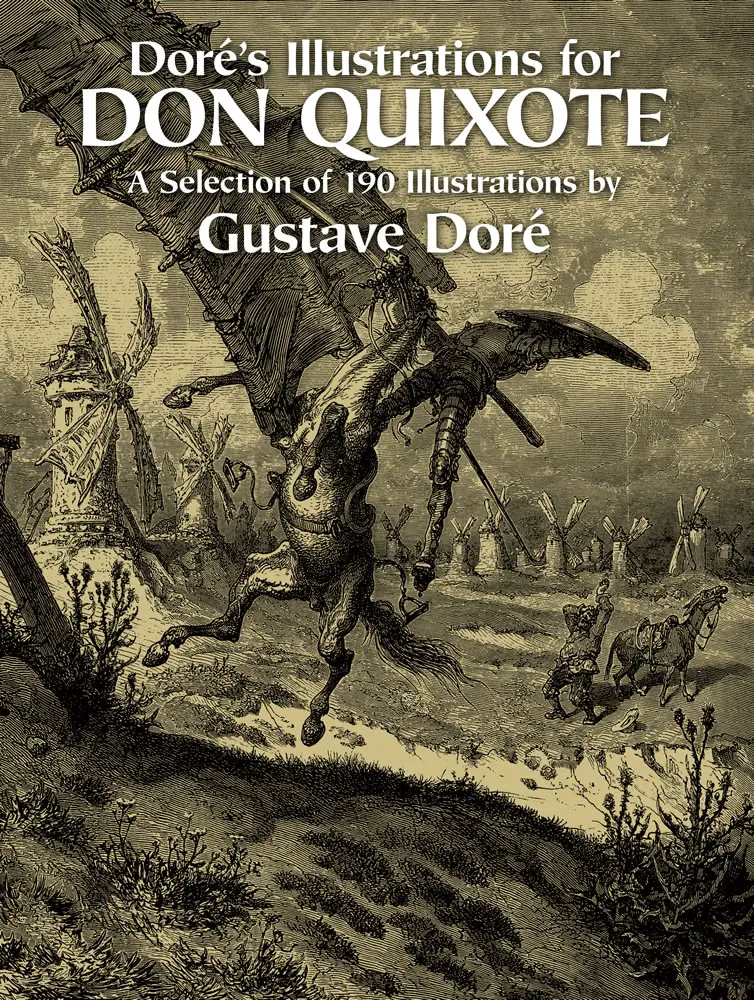
Get Doré's Illustrations for "Don Quixote": A Selection of 190 Illustrations by Gustave Doré
Dover Fine Art, History of Art: "The French translation of Cervantes that Doré illustrated is forgotten; here is the memorable remnant of that work -- all 120 full-page plates, plus a selection of 70 characteristic headpiece and tailpiece vignettes." Ebook also available.
Available as a paperback (ISBN 9780486243009, 160 pages).
Get Lectures on Don Quixote by Vladimir Nabokov
Harvest/HBJ: "A fastidiously shaped series of lectures based on a chapter-by-chapter synopsis of the Spanish classic. Rejecting the common interpretation of Don Quixote as a warm satire, Nabokov perceives the work as a catalog of cruelty through which the gaunt knight passes. Edited and with a Preface by Fredson Bowers; photographs." Ebook also available.
Available as a paperback (ISBN 9780156495400, 240 pages).
Get A Companion to Don Quixote by Anthony Close
Tamesis Books: "Beginning from a review of Don Quixote's relation to Cervantes's life, literary career, and its social and cultural context, Anthony Close goes on to examine the structure and distinctive nature of Part I (1605) and Part II (1615), the conception of the characters of Don Quixote and Sancho, Cervantes's word-play and narrative manner, and the historical evolution of posterity's interpretation of the novel, with particular attention to its influence on the theory of the genre. "
Available as a paperback (ISBN 9781855662087, 296 pages).
Get Quixote: The Novel and the World by Ilan Stavans
Norton: "A groundbreaking cultural history of the most influential, most frequently translated, and most imitated novel in the world." Hardcover and ebook also available.
Available as a paperback (ISBN 9780393353426, 288 pages).
Get Quichotte by Salman Rushdie
Vintage: "In a tour-de-force that is both an homage to an immortal work of literature and a modern masterpiece about the quest for love and family, Booker Prize-winning, internationally bestselling author Salman Rushdie has created a dazzling Don Quixote for the modern age." Shortlisted for the 2019 Booker Prize. Many editions available.
Available as a paperback (ISBN 9781787331921, 416 pages).
Get The Return of Don Quixote by GK Chesterton
Gutenberg: "In the prophetic climax of the tale, Herne warns about the unnatural growth of the machine. “Things have grown incalculable by being calculated. You have tied men to tools so gigantic that they do not know on whom the strokes descend.” Don Quixote tilts at the mills once more. He is fighting a mechanical beast."
Available as an ebook.
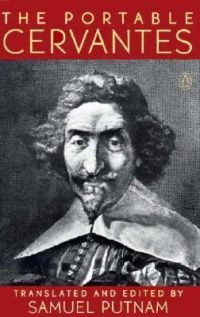
Get The Portable Cervantes by Putnam
Penguin: Contains an introduction; list of suggested readings; Don Quixote "substantially complete, with all omitted passages covered by editorial summaries"; the novel Rinconete and Cortadillo; the novel Man of Glass; "Foot in the Stirrup", Cervantes' Farewell to Life; and endnotes on all three novels. This book is out of print, but you may be able to find a second-hand copy.
Available as a paperback (ISBN 9780140150575, 864 pages).

Get Monsignor Quixote by Graham Greene
Penguin: From Wikipedia: "A pastiche of the classic 1605 and 1615 Spanish novel Don Quixote by Miguel de Cervantes with many moments of comedy, but also offers reflection on matters such as life after a dictatorship, Communism, and the Catholic faith."
Available as a paperback (ISBN 9780143105527, 224 pages).

Get The Female Quixote by Charlotte Lennox
Oxford World's Classics: "The Female Quixote (1752), a vivacious and ironical novel parodying the style of Cervantes, portrays the beautiful and aristocratic Arabella, whose passion for reading romances leads her into all manner of misunderstandings." Ebook also available.
Available as a paperback (ISBN 9780199540242, 464 pages).
Get Meditations on Quixote by by Ortega y Gasset, José,
Norton: "First published in 1914, Meditations on Quixote was Ortega's first book. It has immensely grown in value with time, and since the 1930's, when Ortega himself began to refer back to it in his later writings, it has become more and more important among students of his philosophy as a key to fuller understanding of his work. It may be said to represent the core of Ortega's thought, especially in regard to art and literature."
Available as a paperback (ISBN 9780393001259, 196 pages).
Get Don Quixote of La Mancha : (in Spanglish) by Ilan Stavans
Penn State University Press: "En esta adaptacion groundbreakeadora, el comentarista cultural Ilan Stavans y el ilustrador Roberto Weil reimaginan la masterpiece de Cervantes en ways que son a la vez faithfules y whimsicamente irreverentes."
Available as a paperback (ISBN 9780271082301, 136 pages).
Don Quixote: Translation recommendations
What’s the best Don Quixote translation?
What if there is no single best translation of Don Quixote?
Ilan Stavans says: “Given the assortment of interpretations, it isn’t advisable to suggest that a single English translation of Don Quixote is the best. I prefer to compare them—that is, to keep them all at my side. I believe the true spirit of Cervantes’ novel is to be found not by subtraction but by addition.”
Having learned so much about the different translations, and how the act of translation was performed in different periods by different translators, in different styles of language, I’m inclined to agree. If you can’t read Spanish, probably you need to read multiple English versions to avoid missing out on the sound or sense of the original.
“Yes, but what’s the best translation of Don Quixote if I *have* to choose?”
As I’ve noticed with other books that have been translated multiple times, many of the translators go out of their way to disparage previous efforts—though never in any other case have they had as many predecessors to disparage! The case of Smollett is particularly interesting: whether you believe in the worth of his work (assuming it was even his) depends entirely on whose account you believe.
And that’s the case with opinions about translations in general. Setting aside the opinions of translators, there’s still no actual consensus. Whose recommendation are you going to take? That of a scholar at the University of Georgia? A New York Times, Guardian, or New Yorker columnist’s? That of a member of the Cervantes Society of America? Your professor’s? An articulate redditor’s? Your cousin’s? Mine?
My impression of the conventional wisdom is that Grossman is the trendy one, and Ormsby is the most popular of the old ones (and if you want you can get it for free).
But my advice is, if your purpose is enjoyment (rather than scholarly study), read some excerpts and decide whose writing you think you’ll enjoy the most, because you’ll be reading his or her writing for many hundreds of pages.
No matter which you choose, it’s a wild ride.
To sum up, here's what I recommend.
Legitimately free, user-friendly ebook:
Get the Ormsby translation of Don Quixote (published by Standard Ebooks). Available as an ebook. Learn more about the Ormsby translation.
The translation everyone's talking about:
Get the Grossman translation of Don Quixote (published by Art of the Story Deluxe Edition). Available as a paperback (ISBN 9780062391667, 992 pages). Learn more about the Grossman translation.
Can't decide? Compare extracts from the different versions of Don Quixote.
I hope you find the reading worthwhile.
Help improve and support this site
Spotted an error or missing edition? Email me. I am grateful for corrections and additions, and I update pages whenever I can verify new information.
Have a question or recommendation? Leave a comment. Genuine comments are always welcome.
Want to hear about new posts? Subscribe to the mailing list. I send occasional emails when I publish substantial new material.
Found this guide useful? If you would like to support the research behind We Love Translations, you can buy me a coffee. Thank you.


Pingback: On First Looking into Don Quixote
I had to give up on the Ormsby as tedious and dry; continuing to read it had become downright painful. A switch to the Grossman, and the difference was like night and day. The book came alive and was finally as funny as so many have claimed.
YMMV, but that was my experience.
Thanks for sharing your experience, Aquaria! It’s great to hear from someone who read the Grossman translation *and* another translation, who can therefore compare/contrast them.
Pingback: DON QUIXOTE by CERVANTES | Dave's Book Group
Fine work, Lucy. Thanks.
Thank you for the positive feedback!
You are most welcome.
I am putting a link to you in the endnotes for my book.
(It’s my guide to Mexico City. “Don Quixote”, perhaps surprisingly, enjoys some importance in Mexican culture.)
You display a (C) 2021 notice.
So 2021 was the year you first posted your Parts 1 and 2?
(I include a publication date with the citation.)
Thanks.
Wow, the website gets to be mentioned in a book? That’s great! The two posts about the Don Quixote translations were published March 28, 2022.
I didn’t know Don Quixote is important in Mexican culture. Interesting. Thanks so much, Dave!
(An unpublished book! The only kind I know how to write!)
Mexico’s most important annual arts festival is the Cervantino in Guanajuato, named after Cervantes. One of Diego Rivera’s houses is there in Guanajuato.
In English, many of us would have been exposed to the book through “Man of La Mancha” and “The Impossible Dream”. I certainly was at an early age. But that only deals with the beginning of Part I.
But the famous (if you speak Spanish) Madrid rock band Mägo de Oz released their concept album “La Leyenda de La Mancha” in 1998. It deals with far more of the book. The album’s big hit “Molinos de viento” (Windmills) has 124 million views at YouTube as of today.
I know about this band and this album because Mexicans told me about it.
Cool! Here’s the YouTube link in case anyone’s interested:
» music video of “Molinos de Viento” (Windmills) by Spanish rock band Mägo de Oz
Immensely valuable – thanks!