
Disclosure: This page contains affiliate links. If you purchase through links to Amazon, AbeBooks, Bookshop.org, or Libro.fm, I may earn a commission at no additional cost to you. As an Amazon Associate I earn from qualifying purchases.
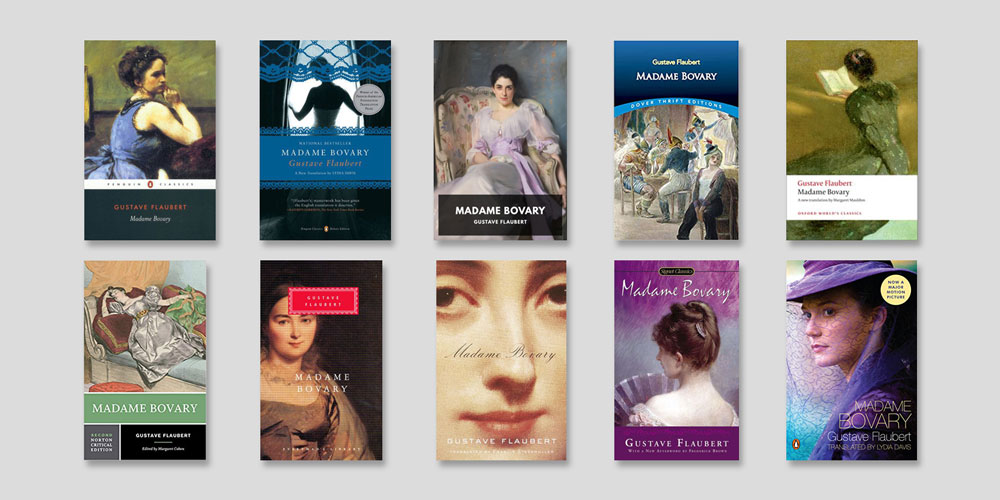
Which English translation of Madame Bovary should I read?
So, you want to read Flaubert’s literary masterpiece, a pioneering and exemplary work in the tradition of literary realism, whose central character, though said to be based on a real person and/or himself, Flaubert fashioned to resemble that of Don Quixote.
It’s such a foundational work that it’s easy to overlook its innovative characteristics.
Originally serialized in 1856 French with the title Madame Bovary: Mœurs de province, its author was legally accused of spreading obscenity—for the book’s depiction of adultery—and stood trial in January 1857. Flaubert was acquitted, and the book now bears a dedication to Maître Sénard, the lawyer who defended him.
Here's a quick recommendation.
Get the Davis translation of Madame Bovary (published by Penguin Classics Deluxe Edition). Available as a paperback (ISBN 9780143106494, 384 pages). Learn more about the Davis translation.
Want more choices? Keep reading for a comprehensive list of all translations and editions in English.
This page also provides more background on the work and a selection of related books and adaptations.
It also lists recommendations for different readers’ needs (affordability, scholarly apparatus, language style).
Madame Bovary: Translations in English
As of October 4, 2026, this list is (to the best of my knowledge) complete, and editions in bold are in print (or otherwise available).
- 1886 — Eleanor Marx-Aveling
- 1902 — W. Blaydes
- 1928 — J. Lewis May aka James Lewis May
- 1948 — Gerard Hopkins (Oxford)
- 1949 — Joan Charles
- 1950 — Alan Russell (Penguin)
- 1957 — Francis Steegmuller (Everyman/Vintage)
- 1959 — Lowell Bair (Bantam)
- 1964 — Mildred Marmur (Signet)
- 1965 — Marx-Aveling edited by Paul de Man (Norton)
- 1992 — Geoffrey Wall (Penguin)
- 2004 — Margaret Mauldon (Oxford)
- 2005 — Marx-Aveling edited by de Man and Margaret Cohen (Norton)
- 2009 — Raymond N. MacKenzie (Hackett)
- 2010 — Christopher Moncrieff (Alma)
- 2010 — Lydia Davis (Penguin)
- 2011 — Adam Thorpe (Vintage/Modern Library)
1886 · Eleanor Marx-Aveling · Madame Bovary: Provincial Manners
About Eleanor Marx-Aveling
She was the youngest daughter of Karl Marx, a socialist, a writer, and a translator. As translator and editor, she worked with her father and Friedrich Engels on Das Kaptial. She also translated some of Henrik Ibsen’s plays from Norwegian to English.
About the Marx-Aveling translation of Madame Bovary
The Oxford Guide to Literature in English Translation edited by Peter France
“Her plain version, though not attempting to match Flaubert’s style, stands comparison with several of the later versions.”
“Eleanor Marx and Gustave Flaubert” by Faith Evans
“It was the first English translation to appear and remained the only English version for many years, and although several more have been undertaken in the past half-century it remains among the most readable. Yet for reasons that I believe were sometimes unconnected with the translation itself, it has often suffered harshly at the hands of the critics. Vladimir Nabokov, for instance, in his reading of Madame Bovary, rages against translators in general – ‘ignorant, treacherous and philistine’ – and Marx in particular. Lectures on Literature, published after his death, reproduces a page from his teaching notebook in which he lists what he considers to be some of her mistakes.”
Paul de Man, whose edited version was published in 1965, says in his introduction: “[T]he Marx Aveling text has advantages and drawbacks. One of its main virtues is the relatively high degree of fidelity in rendering the cadence of Flaubert’s sentence… [but] Mrs. Aveling often loses track of the meaning in the meditative, inward passages and renders the already obscure original altogether opaque.”
From Marx-Aveling’s introduction to the 1886 and 1892 editions reproduced on the blog Exotic and Irrational Entertainment:
“Certainly no critic can be more painfully aware than I am of the weaknesses, shortcomings, the failures of my work; but at least the translation is faithful. I have neither suppressed a line, nor added a word. That often I have not found the best possible word to express Flaubert’s meaning I know; but those who have studied him will understand how impossible it must be for any one to give an exact reproduction of the inimitable style of the master. . . My work, then, I know is faulty. It is pale and feeble by the side of the original. Yet, if it induces some readers to go to that original, if it helps to make known to those who cannot thus study this work of the greatest of French novelists after Balzac, I am content. . . I do not regret having done this work; it is the best I could do.”
“Flaubert’s Voice: Retranslating Madame Bovary” by Geoffrey Wall
“She turned to the translation of Madame Bovary in the years just after her father’s death. In some sense, translation was an escape from the kind of intellectual work that would have connected her with her father. Curious to think of the daughter of Karl Marx immersing herself so intimately in the bourgeois world. Eleanor Marx, as far as I can tell, was bilingual or trilingual. German was spoken at home. English was not her first language. It must have been her third language, after Polish and French. You can tell because she writes English with a perpetual engaging oddity. She escaped the flowing style. Her translation achieves an austere literalism, which I greatly admire. She respects sentence boundaries and she respects the syntactical order of the original. Unfortunately, she mangles the poetic moments. Her translation falls down at those moments where Flaubert has invested, imaginatively, in his subject-matter.”
Since this translation is in the public domain, there are many print versions and also some free ebooks available. See below. There is also an edited version published by Norton.
First sentence of the Marx-Aveling translation of Madame Bovary
» See extracts to compare the translations of Madame BovaryWe were in class when the head-master came in, followed by a "new fellow," not wearing the school uniform, and a school servant carrying a large desk.
Get the Marx-Aveling translation of Madame Bovary: Provincial Manners (published by World Cloud Classics)
Word Cloud Classics have a flexible plastic/vinyl cover. They're not exactly hardcovers, but they're a step up from paperbacks in terms of esthetics and durability.
Available as a flexibound book (ISBN 9781607107347, 320 pages).
Get the Marx-Aveling translation of Madame Bovary: Provincial Manners (published by Enriched Classics)
Includes supplementary material written by Frederic Will: introduction, chronology, timeline, outline of themes and plot points, explanatory notes, critical analysis, discussion questions, list of recommended related books and films.
Available as a paperback (ISBN 9781416523741, 512 pages).

Get the Marx-Aveling translation of Madame Bovary: Provincial Manners (published by Enriched Classics)
Includes supplementary material written by Frederic Will: introduction, chronology, timeline, outline of themes and plot points, explanatory notes, critical analysis, discussion questions, list of recommended related books and films.
Available as an ebook (ISBN 9781416548164, 512 pages).
Get the Marx-Aveling translation of Madame Bovary: Provincial Manners (published by Macmillan Collector's Library)
Includes an introduction by Peter Harness. The books in the Macmillan Collector's Library series are SMALL hardcovers with gilt edges, a ribbon marker, and real cloth binding. As long as you're okay with a small font size, they are suitable for collectors or as gifts.
Available as a hardcover (ISBN 9781509842889, 432 pages).
Get the Marx-Aveling translation of Madame Bovary: Provincial Manners (published by Wordsworth Classics)
Includes an introduction by Roger Clark.
Available as a paperback (ISBN 9781853260780, 320 pages).
Get the Marx-Aveling translation of Madame Bovary: Provincial Manners (published by Barnes & Noble Classics)
Includes an introduction by Chris Kraus. Books in the Barnes & Noble Classics series include features such as: an introduction, author bio, chronology, notes, info on works inspired by the work, comments by other authors, study questions, list of books for further reading, index, glossary.
Available as a paperback (ISBN 9781593080525, 368 pages).
Get the Marx-Aveling translation of Madame Bovary: Provincial Manners (published by Dover Thrift Editions)
Reprint of the edition by Vizetelly and Company, London, 1886.
Available as a paperback (ISBN 9780486292571, 256 pages).
Get the Marx-Aveling translation of Madame Bovary: Provincial Manners (published by Dover Thrift Editions)
Reissue of the edition by Vizetelly and Company, London, 1886.
Available as an ebook (ISBN 9780486115160).
Get the Marx-Aveling translation of Madame Bovary: Provincial Manners (published by AmazonClassics)
Free if you subscribe to Kindle Unlimited.
Available as an ebook.
Get the Marx-Aveling translation of Madame Bovary: Provincial Manners (published by Standard Ebooks)
Free! Available in epub, Kindle, Kobo, and Advanced epub formats. Standard Ebooks are professionally edited, professionally designed versions of the Project Gutenberg texts.
Available as an ebook.
Get the Marx-Aveling translation of Madame Bovary: Provincial Manners (published by Project Gutenberg)
Free! Available in html, epub, Kindle, and plain text formats.
Available as an ebook.
1902 · W. Blaydes · Madame Bovary
About the Blaydes translation of Madame Bovary
The Blaydes translation was published by P.F. Collier & Son in New York with a 39-page introduction by Henry James and a 3-page biography of Flaubert by Edmund Gosse. It was illustrated with color facsimiles of paintings by George Jeanniot. I assume the translation is complete, but I don’t really know for sure.
You can find scans online at Hathi Trust: Visit Hathi Trust
See the copies of the Blaydes translation available from antiquarian booksellers: Search AbeBooks
First sentence of the Blaydes translation of Madame Bovary
» See extracts to compare the translations of Madame BovaryWe were at Preparation in the schoolroom when the head master entered, followed by a new boy dressed not in the school uniform but in ordinary plain clothes, and by a school servant bearing a large desk.
1928 · J. Lewis May aka James Lewis May · Madame Bovary
About J. Lewis May aka James Lewis May
He was an English author, translator, and publisher. He wrote studies of writers such as George Eliot and Charles Lamb and on Catholic subjects.
About the May translation of Madame Bovary
The Oxford Guide to Literature in English Translation edited by Peter France
The May and Hopkins translations “aim for an English style worthy of the original; in doing so, they reshape Flaubert’s sentences, lightening them and making them flow more easily.”
“Flaubert and the retranslation of Madame Bovary” by Sharon Deane
It was “presented in a luxurious, illustrated edition. Although ungenerously described by one reviewer as ‘one of those unfriendly monumental tomes which make a meretricious bid for popularity at Christmas time’, the same nevertheless welcomes the translator’s efforts, claiming that ‘Mr. May has given us Madame Bovary in a more becoming English dress than any of those who have hitherto attempted the insurmountable task’ “. May’s introduction casts doubt on the legitimacy of previous translations, implying that his will serve the author better. Nevertheless, “this particular translation still pales in quantitative comparison against the deluge of reprints of the Marx-Aveling version [albeit in part for financial reasons].”
See the copies of the May translation available from antiquarian booksellers: Search AbeBooks
First sentence of the May translation of Madame Bovary
» See extracts to compare the translations of Madame BovaryWe were in the prep.-room when the Head came in, followed V by a new boy in ‘mufti’ and a beadle carrying a big desk.
1948 · Gerard Hopkins · Madame Bovary: Life in a Country Town
About Gerard Hopkins
Gerard Manley Hopkins was an English poet and Jesuit priest.
About the Hopkins translation of Madame Bovary
The Oxford Guide to Literature in English Translation edited by Peter France
The May and Hopkins translations “aim for an English style worthy of the original; in doing so, they reshape Flaubert’s sentences lightening them and making them flow more easily…. Hopkins in particular writes with freedom and flourish, producing a readable, very English-sounding text.”
“Flaubert and the retranslation of Madame Bovary” by Sharon Deane
“[T]he Hopkins translation is taken up by Oxford University Press in 1959: it is at this point that we can note the very beginnings an evident competition between the houses of Penguin and OUP as far as the publication of Madame Bovary is concerned…. In 1981, OUP take the decision to reissue a revised version of Hopkins’s translation, replacing his foreword with an extensive introduction by the Oxford academic Terence Cave, and including a wealth of explanatory notes. Inherent in this move is a conscious attempt to appeal to a specifically academic market, along with evidence that the publishers hold with the ‘new equals improved’ ethos.”
“Flaubert’s Voice: Retranslating Madame Bovary” by Geoffrey Wall
“I felt that Gerard Hopkins (1949) made Flaubert flow too swift and smooth by altering sentence boundaries, by changing psychological verbs such as “songer”. Hopkins’ translation is a pleasantly readable approximation to Flaubert. I respected that, and yet I wanted something more demanding, more textured.”
The Hopkins translation is still under copyright but out-of-print. You may be able to find a second-hand copy. See below.
First sentence of the Hopkins translation of Madame Bovary
» See extracts to compare the translations of Madame BovaryWe were in the preparation room when the head came in, followed by a new boy in ordinary day clothes, and by a school servant carrying a large desk.
Get the Hopkins translation of Madame Bovary: Life in a Country Town (published by Oxford World's Classics)
Includes an introduction by Terence Cave and Notes by Mark Overstall. This edition is out of print, but you may be able to find a second-hand copy.
Available as a paperback (ISBN 9780192833990, 362 pages).
1949 · Joan Charles · Madame Bovary
About Joan Charles
According to Worldcat, she also translated Stendahl’s The Red and the Black and wrote novels.
About the Charles translation of Madame Bovary
The translation was issued by International Collectors Library with illustrations by Ben Stahl. I believe those copies contain a complete translation.
The Paris Review: “The Sins of a Translator” by Lydia Davis
This edition “follows the original very closely—she wouldn’t dream of adding or omitting material with the writerly flair of, for instance, Francis Steegmuller (American, 1957) or Gerard Hopkins (English 1948) [but] I came to see her as tight-laced and humorless.”
However! I believe the copies published by John C. Winston Co (or, presumably, Holt Rinehart & Winston) are abridged. They have the illustrations by Ben Stahl but they say “edited by William Somerset Maugham” and possibly render the title as “Gustave Flaubert’s Madame Bovary”. They belong to the series Maugham created called “Ten greatest novels of the world.”
My Maugham Collection: “W. Somerset Maugham and His 10 Best Novels of All Time”
“Maugham was approached by the publisher John C. Winston to reissue the 10 novels on his list, inviting him to write a preface for each and abridge the volumes.”
See the copies of the Charles translation available from antiquarian booksellers: Search AbeBooks
First sentence of the Charles translation of Madame Bovary
» See extracts to compare the translations of Madame BovaryWe were in study hall when the Headmaster entered, followed by a "new boy" dressed in ordinary clothes and by a classmate who was carrying a large desk.
1950 · Alan Russell · Madame Bovary: A Story of Provincial Life
About the Russell translation of Madame Bovary
The Oxford Guide to Literature in English Translation edited by Peter France
It is a “fluent” translation in the tradition of a tendency to “domesticate”.
The Atlantic: “No Way, Madame Bovary” by Clive James
The article says that Mauldon’s only improvement to Russell’s work is to change his use of the N-word to “black man”. “I can’t find even one other word in Russell’s translation that sounds dated in the wrong way. All the rest of it sounds dated in the right way—that is, closer to Flaubert in time. It must also be said… that most of it is closer to Flaubert in possessing a sense of style.”
The Russell translation is still under copyright but out-of-print. You may be able to find a second-hand copy. See below.
First sentence of the Russell translation of Madame Bovary
» See extracts to compare the translations of Madame BovaryWe were at preparation, when the headmaster came in, followed by a new boy dressed in 'civvies' and a school servant carrying a big desk.
Get the Russell translation of Madame Bovary: A Story of Provincial Life (published by Penguin Classics)
Includes an introduction by Alan Russell. This edition is out of print, but you may be able to find a second-hand copy.
Available as a paperback (ISBN 9780140440157, 368 pages).
1957 · Francis Steegmuller · Madame Bovary: Patterns of Provincial Life
About Francis Steegmuller
Francis Steegmuller was a prolific American writer and translator. His stories appeared in The New Yorker and elsewhere; he published a number of novels; he published biographies and other non-fiction; he translated and published a volume of selected letters of Flaubert’s and a “double portrait” entitled Flaubert and Madame Bovary.
About the Steegmuller translation of Madame Bovary
The Oxford Guide to Literature in English Translation edited by Peter France
“He is not always precise in his rendering of Flaubert’s meaning, he tends to interpret, and he treats the syntax quite freely. Nevertheless, his translation, as well as being highly readable, generally comes closer than the others to rendering the sense of Flaubert’s narrative and dialogue, his irony, and his poetry.
The London Review of Books: “Writer’s Writer and Writer’s Writer’s Writer” by Julian Barnes
After a long discussion of the ins and outs of translation, and of the recent Davis translation, Barnes says: “If you want a freer translation, Steegmuller is best.”
FWIW, I have posted on my blog about the cover of the Vintage Classics edition of the Steegmuller translation.
First sentence of the Steegmuller translation of Madame Bovary
» See extracts to compare the translations of Madame BovaryWe were in study-hall when the headmaster entered, followed by a new boy not yet in school uniform and by the handyman carrying a large desk.
Get the Steegmuller translation of Madame Bovary: Patterns of Provincial Life (published by Everyman's Library )
Includes an introduction by Victor Brombert.
Available as a hardcover (ISBN 9780679420316, 368 pages).
Get the Steegmuller translation of Madame Bovary: Patterns of Provincial Life (published by Everyman's Library)
Includes an introduction by Victor Brombert.
Available as a hardcover (ISBN 9781857151404, 376 pages).
Get the Steegmuller translation of Madame Bovary: Patterns of Provincial Life (published by Vintage Classics)
Just the text of the Steegmuller translation.
Available as a paperback (ISBN 9780679736363, 432 pages).
Get the Steegmuller translation of Madame Bovary: Patterns of Provincial Life (published by Vintage Classics)
Just the text of the Steegmuller translation.
Available as an ebook (ISBN 9780804151337, 432 pages).
1959 · Lowell Bair · Madame Bovary
About Lowell Bair
He translated numerous works from French, including: The Red and the Black by Stendhal; Candide by Voltaire; Dangerous Liaisons by Choderlos de Laclos; Cyrano de Bergerac by Edmond Rostand; The Three Musketeers and The Count of Monte Cristo by Alexandre Dumas; The Hunchback of Notre Dame and Ninety-Three by Victor Hugo; From the Earth to the Moon by Jules Verne; The Phantom of the Opera by Gaston Leroux; Nana by Emile Zola; Eugenie Grandet by Honoré de Balzac.
About the Bair translation of Madame Bovary
Edited and with an introduction by Leo Bersani. Also contains a brief biography of Flaubert at the front of the book, and several additional resources as backmatter: a biographical sketch, a critical supplement titled “The Novelist on His Art”, three contemporary views on Flaubert by Emile Zola, Guy de Maupassant, and Henry James, six critical essays, and a selected bibliography.
Some of Bair’s translations (e.g., The Count of Monte Cristo) are abridged, but not this one.
First sentence of the Bair translation of Madame Bovary
» See extracts to compare the translations of Madame BovaryWe were in study hall when the headmaster walked in, followed by a new boy not wearing a school uniform, and by a janitor carrying a large desk.
Get the Bair translation of Madame Bovary (published by Bantam Classics)
Edited and with an introduction by Leo Bersani. Contains an author bio, nine essays, and a bibliography.
Available as a paperback (ISBN 9780553213416, 512 pages).
1964 · Mildred Marmur · Madame Bovary
First sentence of the Marmur translation of Madame Bovary
» See extracts to compare the translations of Madame BovaryWe were studying when the headmaster came in, followed by a new boy, not yet wearing a school uniform, and a monitor carrying a large desk.
Get the Marmur translation of Madame Bovary (published by Signet Classics)
Includes an introduction by Robin Morgan and an afterword by Frederick Brown. Includes Evelyn Gendel's translation of The Trial of "Madame Bovary" (79 pages, comprising the opening speech for the prosecution, the speech for the defense, and the verdict.)
Available as a paperback (ISBN 9780451418500, 464 pages).
Get the Marmur translation of Madame Bovary (published by Signet Classics)
Includes an introduction by Robin Morgan and an afterword by Frederick Brown. Includes Evelyn Gendel's translation of The Trial of "Madame Bovary" (79 pages, comprising the opening speech for the prosecution, the speech for the defense, and the verdict.)
Available as an ebook (ISBN 9781101143773, 411 pages).
1965 · Marx-Aveling edited by Paul de Man · Madame Bovary
About Marx-Aveling edited by Paul de Man
Paul de Man (Paul Adolph Michel Deman) was a Belgian-born American literary critic.
About the Marx-Aveling/de Man translation of Madame Bovary
This is a revised version of the original 1886 English translation.
From the introduction: “The Victorian diction has, in part, been modernized. Flaubert’s original paragraphs, a fundamental and subtly measured unit of composition, have been restored throughout. Several misleading inaccuracies and mistranslations have been corrected.”
The Paris Review: “Some notes on Translation and on Madame Bovary” by Lydia Davis
This edition “exists for a couple of wrong reasons, and people buy it for another wrong reason. Wrong reason number one: Norton chose to use the Marx Aveling translation because it was in the public domain and wouldn’t cost anything (I’m assuming this, or I was told—I can’t remember which). Wrong reason number two (I’m certainly guessing here): They asked Paul de Man to revise and edit it not because he was conscientious and an excellent writer in English but because he had prestige, a reputation, and scholarly intelligence. He then apparently handed most or all of the work over to his wife, and did not acknowledge her. (This I was told by a reliable source.) Wrong reason number three: People buy the book not because it is an excellent translation of this important novel, but because the volume includes informative essays and other useful critical apparatuses.”
The Globe and Mail: Review by Jane Smiley of the Davis translation
The de Man translation “reads like an academic exercise.”
This edition is out of print. There is a revised Norton edition edited by Margaret Cohen.
First sentence of the Marx-Aveling/de Man translation of Madame Bovary
» See extracts to compare the translations of Madame BovaryWe were in class when the headmaster came in, followed by a new boy, not wearing the school uniform, and a school servant carrying a large desk.
Get the Marx-Aveling/de Man translation of Madame Bovary (published by Norton Critical Editions)
This is the First Norton Critical Edition, with text revised by Paul de Man. It includes a note on the translation, backgrounds and souces, 12 critical essays, and a bibliography. This edition is out of print. You may be able to find a second-hand copy.
Available as a paperback (ISBN 9780393096088, 484 pages).
1992 · Geoffrey Wall · Madame Bovary: Provincial Lives
About Geoffrey Wall
He is a professor of French, a translator, and a writer of literary biography, travel writing, journal articles, magazine articles, and news articles. He has produced translations of several of Flaubert’s works. His volume of selected letters and biography of Flaubert are now out of print.
About the Wall translation of Madame Bovary
The Oxford Guide to Literature in English Translation edited by Peter France
This translation “seeks to reproduce some of the formal features of Flaubert’s text, notably his punctuation and paragraphing. This ‘foreignizing’ version has real merits, but Wall is not always so careful with the meaning of the original and his version often sounds unnecessarily awkward.”
The London Review of Books: “Writer’s Writer and Writer’s Writer’s Writer” by Julian Barnes
After a long discussion of the ins and outs of translation, and of the recent Davis translation, Barnes says: “[F]or a tighter [translation], go to Wall.”
“Flaubert’s Voice: Retranslating Madame Bovary” by Geoffrey Wall
Wall referred to translations by Marx-Aveling, Hopkins, and Russell while preparing his own. “[My] translation of Madame Bovary was driven by an amorous imaginative fascination for the little details, for the textures, the shapes, the sentence-by-sentence immediacy of Flaubert’s writing. That is what held me, kept me going, as a translator. That writing has entangled me, induced me to spend half a life-time playing with Flaubert. Playing with his words, as his translator. Playing with the events of his life, as his biographer. Sustained by the impossible desire to be Flaubert, to voice his words once again, in my own voice…. Joycean English seemed to me the perfect medium in which to capture and convey the insidious pleasures of free indirect style.”
First sentence of the Wall translation of Madame Bovary
» See extracts to compare the translations of Madame BovaryWe were at prep, when the Head came in, followed by a new boy not in uniform and a school-servant carrying a big desk.
Get the Wall translation of Madame Bovary: Provincial Lives (published by Penguin Clothbound Classics)
Includes an introduction by Geoffrey Wall and a preface by Michele Roberts. Cover design by Coralie Bickford-Smith.
Available as a hardcover (ISBN 9780141394671, 384 pages).
Get the Wall translation of Madame Bovary: Provincial Lives (published by Penguin Classics)
Includes an introduction and notes by Geoffrey Wall and a preface by Michele Roberts.
Available as a paperback (ISBN 9780140449129, 384 pages).
2004 · Margaret Mauldon · Madame Bovary: Provincial Manners
About Margaret Mauldon
She is an Argentinian/British translator.
About the Mauldon translation of Madame Bovary
The Atlantic: “No Way, Madame Bovary” by Clive James
This rather snide and snobby review says this edition “bears on its cover James Tissot’s Young Woman in a Boat, dating from 1870…. But Madame Bovary was first published in 1857…. [A] pedant might wish that a French painter of a slightly earlier period could have been called in; but the young lady certainly has a sensual mouth, which can be said to fit. Already, though, it is hard to suppress a suspicion that in the matter of historical fidelity things are out of kilter, and the suspicion intensifies once the book is opened.” James cites the example of Rodolphe exclaiming “No way!” instead of “No, No, a thousand times no!”. “[R]ecent translations tend to be busywork, and earlier ones tend to be the real tributes, even when inaccurate by scholarly standards. No doubt this new translation of Madame Bovary is a labor of love. But affection and affectation don’t sit well together.”
New York Review of Books: “Flaubert, Imperfect” by Jonathan Raban
“Flaubert, for all his claims to objectivity, never sheds the mantle of an haut bourgeois writing, for the most part, about members of the petite bourgeoisie. Class fascinated him, and Madame Bovary is full of minute distinctions on matters of rank, status, and class usage (distinctions to which American translators, notably Margaret Mauldon, whose translation is otherwise graceful and sensitive, have sometimes been jarringly deaf).”
First sentence of the Mauldon translation of Madame Bovary
» See extracts to compare the translations of Madame BovaryWe were at prep when the Headmaster came in, followed by a 'new boy' not wearing school uniform, and by a school servant carrying a large desk.
Get the Mauldon translation of Madame Bovary: Provincial Manners (published by Oxford World's Classics)
Includes an introduction by Malcolm Bowie and notes by Mark Overstall.
Available as a paperback (ISBN 9780199535651, 368 pages).
Get the Mauldon translation of Madame Bovary: Provincial Manners (published by Oxford World's Classics)
Includes an introduction by Malcolm Bowie and notes by Mark Overstall.
Available as an ebook.
2005 · Marx-Aveling edited by de Man and Margaret Cohen · Madame Bovary
About Marx-Aveling edited by de Man and Margaret Cohen
“Margaret Cohen is Andrew B. Hammond Professor of French Language, Literature and Civilization, Professor of Comparative Literature and English and Professor by courtesy of French and Italian at Stanford University, USA. Her most recent book is The Novel and the Sea (2010), which was awarded the Louis R. Gottschalk Prize from the American Society for Eighteenth-Century Studies and the George and Barbara Perkins Prize from the International Society for the Study of the Narrative.”
About the Marx-Aveling/de Man/Cohen translation of Madame Bovary
This is a revised version of the 1965 Norton edition.
First sentence of the Marx-Aveling/de Man/Cohen translation of Madame Bovary
» See extracts to compare the translations of Madame BovaryWe were in class when the headmaster came in, followed by a new boy, not wearing the school uniform, and a school servant carrying a large desk.
Get the Marx-Aveling/de Man/Cohen translation of Madame Bovary (published by Norton Critical Editions)
This is the 2nd Norton edition. It contains the Marx-Aveling translation revised by Paul De Man, subsequently revised by Margaret Cohen. This edition has a new introduction and annotations, and twenty-one images. This Norton edition is the only one available that includes the complete manuscript from Flaubert’s 1857 trial. It also includes a translator's note, sixteen critical essays, twelve of them new to the Second Edition, and a chronology and selected bibliography.
Available as a paperback (ISBN 9780393979176, 576 pages).
2009 · Raymond N. MacKenzie · Madame Bovary: Provincial Lives
About Raymond N. MacKenzie
He is a translator of works in French and a professor of English specializing in Milton, 19th- and 20th-century British literature, literary criticism, and modern French literature.
First sentence of the MacKenzie translation of Madame Bovary
» See extracts to compare the translations of Madame BovaryWe were at our studies when the headmaster came in, followed by a new boy? still dressed in his street clothes, and a student assistant who was carrying a large desk.
Get the MacKenzie translation of Madame Bovary: Provincial Lives (published by Hackett Classics)
Includes footnotes, a bibliography and a chronology.
Available as a paperback (ISBN 9781603841238, 346 pages).
Get the MacKenzie translation of Madame Bovary: Provincial Lives (published by Hackett Classics)
Includes footnotes, a bibliography and a chronology.
Available as a hardcover (ISBN 9781603841245, 346 pages).
Get the MacKenzie translation of Madame Bovary: Provincial Lives (published by Hackett Classics)
Includes footnotes, a bibliography and a chronology.
Available as an ebook.
2010 · Christopher Moncrieff · Madame Bovary
About Christopher Moncrieff
He is a poet and a translator of French, German, and Romanian literature.
» Website of Christopher Moncrieff
First sentence of the Moncrieff translation of Madame Bovary
» See extracts to compare the translations of Madame BovaryWe were doing prep when the Headmaster came in, followed by a respectably dressed new boy and a porter carrying a large desk.
Get the Moncrieff translation of Madame Bovary (published by Alma Classics Evergreens)
Includes a note on the text, notes, an author bio, a list of works, a list of adaptations, and a bibliography.
Available as a paperback (ISBN 9781847493224, 352 pages).
Get the Moncrieff translation of Madame Bovary (published by Alma Classics Evergreens)
Includes a note on the text, notes, an author bio, a list of works, a list of adaptations, and a bibliography.
Available as an ebook.
2010 · Lydia Davis · Madame Bovary: Provincial Ways
About Lydia Davis
An award-winning American novelist, translator, and writer of ultra-short stories. She translated Swann’s Way, the first volume of Marcel Proust’s In Search of Lost Time aka Remembrance of Things Past.
About the Davis translation of Madame Bovary
The London Review of Books: “Writer’s Writer and Writer’s Writer’s Writer” by Julian Barnes
“The root feature of Davis’s translation is a close attention to Flaubert’s grammar and sentence structure, and an attempt to mirror it in English…. Davis’s Madame Bovary is a linguistically careful version, in the modern style, rendered into an unobtrusively American English. At its best, it conveys the precision – which some think dryness – of Flaubert’s prose in this novel, while its syntactical mirroring of the French sometimes brings us closer to Flaubert. At its worst, it takes us too far away from English, and makes us less aware of Flaubert’s prose than of Davis being aware of Flaubert’s prose. And such defects come from something very old-fashioned: a lack of love for the work being translated.”
The New Yorker: “What I Read This Year” by James Wood
“Davis got lots of attention, but rarely of the right kind, because her translation was too often reflexively praised by people who were not familiar with Flaubert’s French, or wanly criticized (see Julian Barnes in the London Review of Books) by people who have possessive agendas…. I consistently admired Davis’s attempts to get as close as possible to a quality of hardness, or coldness, in Flaubert’s own prose…. Flaubert’s strict, elegant, rhythmic sentences come alive in Davis’s English. She does not flinch.”
New York Review of Books: “Flaubert, Imperfect” by Jonathan Raban
“Should love for the work in hand be a necessary qualification for translating it? Like surgery, translation requires judgment, precision, and experience; the surgeon’s personal affection for the patient is likely to be as much a liability as an asset…. In her own work, she’s concerned with the smallest tonal effects of language, at the level of the word, the phrase, and the sentence, and this absorption in verbal and grammatical minutiae carries through into her translations. She has a finer ear for the natural cadences of English, in narrative and dialogue, than any of her predecessors, and there are many moments in her Madame Bovary when one pauses to admire how clean and spare a sentence seems by comparison with its earlier translated versions. But she can be a pedant, and nowhere more so than in her scolding insistence on the importance of the imparfait tense in Flaubert’s original…. [her translation] uses more ‘woulds’ than any previous one…. Davis’s version may be unfaultable in its accuracy to the tense of Flaubert’s verbs, but it turns Emma’s precious Thursdays into something like the plight of Bill Murray in Groundhog Day…. Where Flaubert uses Latinate words, she follows suit, resisting the temptation to substitute more informal, and more vivid, Anglo-Saxon alternatives. The bones of the original French show clearly through her English, and the rawness of her translation is, on the whole, invigorating. It’s written in a deliberately post- modernist spirit, exposing its own means like the pipes and ducts in a converted loft, and Davis’s unusual willingness to talk about her alienation from the novel is in keeping with that spirit. Yet I can’t rid myself of a lingering sense of annoyance with this translation.”
SFGate: Review by Benjamin Ivry of Madame Bovary translated by Lydia Davis
“Davis confesses herself a fan of Flaubert’s character Homais [who] exemplifies the evil of banality, how boredom can morph into detail-obsessed, deadly lunacy. Of this wretched villain, Davis writes: ‘It is hard not to enjoy [Homais’] cunning, his enterprise, his intellectual explorations, and even to agree with him sometimes.’ Flaubert compiled dictionaries of amusing misreadings, but even he never foresaw one of his translators’ being a friend of Homais…. This new translation is not quite faulty enough to be dismissed with a caveat emptor, but since good recent translations are readily available in paperback, perhaps only those readers who devoutly believe whatever Vanity Fair, or Homais, tells them, should buy this one.”
NPR: “’Bovary’ Translation Does ‘Le Mot Juste’ Justice” by Maureen Corrigan
“I’m not qualified to judge the accuracy of her translation, but I am grateful to Davis for luring me back to Madame Bovary and for giving us a version that strikes me as elegant and alive….
Reading In Translation: “Lydia Davis brings her concision and ironic sensibilities to a new translation of Madame Bovary” by Lucina Schell
This article provides three different versions of the famous ‘kettle’ passage (Davis, Hopkins, Steegmuller), and uses bold to highlight key phrases that are different, concluding that “Davis’ translation is the most successful at conveying the rhythm and music of the French and preserving the clarity and concision of the sentences for which Flaubert is known.”
BookForum: “Madame Bovary, C’est Toi!” by Rivka Galchen
“In Madame Bovary, we see Davis reading and also, yes, rewriting the seminal work of realism, and taking Flaubert’s novel for a text where the preservation of the original word merits all possible intellectual attention. One could say this of all translations, but with Davis one finds the zealous devotion that, were it exaggerated just a bit, would have prevented her from getting past the problems of translating a single sentence.” This article includes another analysis of the ‘kettle’ passage as Davis renders it.
New York Magazine: “Knee-Deep in ‘Bovary’” by Sam Anderson
This version “preserves glitches that previous translators silently corrected: odd capitalizations, for instance, and inconsistent verb tenses. (Viking made her address all of this in her introduction, so it wouldn’t just look like sloppy copyediting.)”
The Millions: “Bad Romance: Madame Bovary, Translated by Lydia Davis” by Kevin Frazier
This version “powerfully recreates the different elements of Flaubert’s style. Flaubert is often as hard on Emma as Cervantes was on Don Quixote and Sancho Panza, and Davis brings a tart, astringent tone to much of the writing. Some reviewers have complained about this, but it seems to me that Davis is usually just following Flaubert more closely than, say, the overly placid Francis Steegmuller version does…. For the most part, Davis sticks tightly both to the meaning of Flaubert’s text and to its constant changes of tone. She is especially good at following the different rhythms of the original and making them work in English, a difficult task with Flaubert.”
New York Times: “Desperate Housewife” by Kathryn Harrison
“Faithful to the style of the original, but not to the point of slavishness, Davis’s effort is transparent—the reader never senses her presence…. It is a shame Flaubert will never read Davis’s translation of Madame Bovary. Even he would have to agree his masterwork has been given the English translation it deserves.”
The Globe and Mail: Review by Jane Smiley of the Davis translation
“The great accomplishment of Davis’s translation has nothing really to do with her meticulousness, and everything to do with the spirit and energy that drive the narrative.”
First sentence of the Davis translation of Madame Bovary
» See extracts to compare the translations of Madame BovaryWe were in Study Hall, when the Headmaster entered, followed by a new boy dressed in regular clothes and a school servant carrying a large desk.
Get the Davis translation of Madame Bovary: Provincial Ways (published by Penguin Drop Caps)
Cover design by Jessica Hische.
Available as a hardcover (ISBN 9780143123804, 432 pages).
Get the Davis translation of Madame Bovary: Provincial Ways (published by Penguin Classics Deluxe Edition)
Includes an introduction and notes by Lydia Davis. Paperback with folding flaps and deckle-edged pages.
Available as a paperback (ISBN 9780143106494, 384 pages).
Get the Davis translation of Madame Bovary: Provincial Ways (published by Penguin Classics Deluxe Edition)
Includes an introduction and notes by Lydia Davis.
Available as an ebook (ISBN 9781101462430, 412 pages).
2011 · Adam Thorpe · Madame Bovary: Provincial Morals
About Adam Thorpe
He is a British writer of poetry, novels, short stories, translations, radio dramas, documentaries, reviews, news articles, journal articles, and magazine articles.
About the Thorpe translation of Madame Bovary
Thorpe, in the introduction to his 2011 edition: “The peculiar difficulties that Madame Bovary presents for the translator include the author’s fondness for the imperfect tense, varying levels of pastiche, and his habit of extending a certain lexical field (legal, military, etc.) through a whole paragraph; any translation has to be alert to changes of nuance and tone that are micrometrically calibrated, as well as the changing shades of irony, and attempt to find an equivalent for Flaubert’s verbal mimicry of wordless states or experiences.”
Guardian: “Madame Bovary: the Everest of translation” by Adam Thorpe
This is a fascinating article about the translator’s process. “Madame Bovary is perhaps the most carefully written book in literary history. It is the verbal equivalent of the Franck Muller Aeternitas Mega 4 wristwatch, with 36 complications and a 1,000-year calendar. The latter is totally unnecessary to the ordinary mortal, but then so is the exquisite music and mimicry of Flaubert’s language…. [I decided] I would stick to period language…. With an effort of the imagination we can think back to the past’s present, when it was fresh and frighteningly new to those who dwelt in it, and language can be the spell that gets us there…. I had to take an irony geiger count of every sentence – whose “right” translation lurked just around the corner. This was the version that combined accuracy, naturalness and musicality. The problem was the lack of corners: as in a dream, there would be one long traverse with nothing on it. The solution would appear (sometimes the novel felt like a vast crossword puzzle) through a combination of experiment, meditation and lateral thought: I had to step firmly away from the French and face a contrary direction – another track entirely. The solution usually had only two out of the three essential elements, and more work had to be done: less a path to climb than a Rubik’s Cube of words to be twisted about or thrown at the wall.”
The Longest Chapter: Review by Kassie Rose of The 100 Best Novels in Translation by Boyd Tonkin
“Tonkin does not recommend Lydia Davis for Madame Bovary, who’s widely considered to be among the best. Instead, he recommends Adam Thorpe. ‘Translation: Among recent versions, those by Lydia Davis and Geoffrey Wall both excel, but the novelist Adam Thorpe (2011) — who, brilliantly, employs only the English vocabulary of Flaubert’s time — achieves a flavour that approaches the dream-like strangeness of Flaubert’s hyper-realism.’ “
First sentence of the Thorpe translation of Madame Bovary
» See extracts to compare the translations of Madame BovaryWe were in study hour, when the Headmaster entered, followed by a new boy dressed in his everyday clothes and by a classroom servant carrying a big desk.
Get the Thorpe translation of Madame Bovary: Provincial Morals (published by Modern Library Classics)
Includes an introduction by Adam Thorpe.
Available as a paperback (ISBN 9780812985207, 464 pages).
Get the Thorpe translation of Madame Bovary: Provincial Morals (published by Modern Library Classics)
Includes an introduction by Adam Thorpe.
Available as an ebook (ISBN 9780812985214, 466 pages).
Get the Thorpe translation of Madame Bovary: Provincial Morals (published by Vintage Classics)
Includes an introduction by Adam Thorpe.
Available as a paperback (ISBN 9780099573074, 384 pages).
Get the Thorpe translation of Madame Bovary: Provincial Morals (published by Vintage Classics)
Includes an introduction by Adam Thorpe.
Available as an ebook (ISBN 9781448113927, 384 pages).
Get the Thorpe translation of Madame Bovary: Provincial Morals (published by Folio Society)
Luxury slicased hardcover with a foreword by Henry James, an introduciton by Karl Ove Knausgard and illustrations by Nushka. Gilded page edges, ribbon bookmark. Limited to 750 hand-numbered copies.
Available as a hardcover.
Notes on the work and its translation
Other Translations
The Marx-Aveling translation was the first to be published, but Marx-Aveling was not the first translator of Madame Bovary into English. There had already been two others.
The London Review of Books: “Writer’s Writer and Writer’s Writer’s Writer” by Julian Barnes
The first to attempt a translation was Juliet Herbert, who worked closely with the author. For lack of a publishing contract, Flaubert dropped the project.
“Flaubert and the retranslation of Madame Bovary” by Sharon Deane
Then in 1878, George Saintsbury published an essay containing translations of excerpts from the novel.
An Abridgement
In 1905, Greening & Co. published an abridged translation, titled Madame Bovary Done into English by Henry Blanchamp, in their Lotus Library series.
“Flaubert and the retranslation of Madame Bovary” by Sharon Deane
“[T]his edition may wish to strike a balance between readability, titillation and decorum. As to its persistence, the Blanchamp translation is only reissued twice (1910; 1929) and hereafter falls into obscurity.”
The Challenges of Translation
The London Review of Books: “Writer’s Writer and Writer’s Writer’s Writer” by Julian Barnes
This detailed article explains some of the challenges, and the change in people’s approach to translation, which in the last century has moved “away from smoothness and towards authenticity…. [A translation] must be written for the contemporary reader, yet give that reader the same, or a similar, ease or difficulty as an original reader would have had. And just as there can be delinquent looseness, so there can be misguided over-accuracy…. To compare several different versions of Madame Bovary is not to observe a process of accumulation, some gradual but inevitable progress towards certainty and authority (except in the occasional discarding of error); rather, it is to gaze at a sequence of approximations.”
Flaubert and the Imperfect Tense
New York Review of Books: “Flaubert, Imperfect” by Jonathan Raban
“Every modern translator has been alert to how well the imparfait conveys the numbing repetitiousness of life in Madame Bovary: it is (among several other shades of meaning and implication) the tense of the daily round and the routine action, the tense of provincial boredom. It also tends to be cumbersome and obtrusive in its English form, working best when used sparingly and in short passages.”
Flaubert and Italics
De Man says, in the note in his 1965 edition: “[Flaubert] italicizes certain words, especially when he is reporting someone’s speech, in order to catch a nuance which is particularly important to him: the use of stilted, inert speech that reveals the degradation of the character’s relation towards language. Sometimes entire expressions are italicized… but at other times it is a single word, quite inconspicuous at first sight, whose cliché-like nature is revealed only by the use of this typographic device…. Except in some more obvious instances, the effect is irrevocably lost in translation.”
Exotic and Irrational Entertainment: “”The best I could do”: Eleanor Marx and translating Madame Bovary”
“In the novel’s opening passage Flaubert italicizes ‘nouveau,’ as he does many phrases in Madame Bovary—generally signalling a habitual or hackneyed expression. But in English italics function differently: they provide emphasis or indicate words kept in the original language. Marx generally chooses to place Flaubert’s italicized phrases in quotes, while Davis provides italics wherever Flaubert does. Paradoxically, Marx’s quotes seem like a closer English equivalent to Flaubert’s intended meaning than do Davis’s more literal italics. (Hopkins and Steegmuller are inconsistent; often, as in the opening passage, they silently ignore Flaubert’s italics altogether.)”
Flaubert and Precision
NPR: “’Bovary’ Translation Does ‘Le Mot Juste’ Justice” by Maureen Corrigan
“Flaubert created Madame Bovary through a process of ruthless pruning…. ‘To be simple,’ wrote Flaubert, ‘is no small matter.’ Repetitions of words, sounds and even letters annoyed him, particularly so in this emotionally radical novel where so much depends on style alone.”
New York Magazine: “Knee-Deep in ‘Bovary’” by Sam Anderson
“Perfect translation, in the common-sense fantasy of one-to-one correspondence, is of course impossible. Even the simplest message, moved from one language to another, inevitably gets warped: It loses its music, its cultural resonance, and the special pace at which it surrenders its information…. Bovary’s contemporaries include Moby-Dick, Bleak House, and Les Misérables. Flaubert’s novel, however, demonstrates the kind of perfect control seen more often in poetry: seamless sentences that unite, seamlessly, into paragraphs, which then flow seamlessly into episodes and chapters—craftsmanship so advanced that the craftsmanship disappears.”
Further exploration
Emma Bovary, the Female Don Quixote
Flaubert deliberately chose to create a character whose mental state was disturbed by books just as Don Quixote was.
Books Are Our Superpower: “Don Quixote and Emma Bovary” by Walter Bowne
“Although the premise to each book is essentially the same, life imitating art, romantic art, and the tragic results of such an aim, each book upholds a different view of art for its main character, as well as a different view of romanticism…. Cervantes has a lighter, noble view of his hunted hero, while Flaubert has a darker, more sinister view of the world that surrounds his haunted heroine.”
The Millions: “Bad Romance: Madame Bovary, Translated by Lydia Davis” by Kevin Frazier
“Flaubert first read Don Quixote in 1832, when he was eleven years old, and he had heard tales from the book when he was even younger. By the time Madame Bovary was published, in 1857, he had already been thinking about Cervantes for at least a quarter of a century. Moreover, he had created in Emma Bovary a character who would renew and deepen the meaning of Don Quixote for the future. Emma embodies, in one person, the conflict between idealism and pragmatism that Cervantes divides between Don Quixote and Sancho Panza. The argument between the knight and the squire is Emma’s argument with herself: she touches both of their extremes at once, as well as many points in between those extremes.”
If you read Don Quixote, you can do some comparison and contrast yourself.
Other Fiction by Flaubert
Madame Bovary is the best-known of Flaubert’s novels, and also the first that he wrote. He is also the author of the following works of fiction:
1862 – Salammbô
1869 – Sentimental Education
1874 – The Temptation of Saint Anthony (a prose poem)
1877 – Three Tales: “A Simple Heart”, “Saint Julian the Hospitalier”, and “Hérodias”.
1881 – Bouvard and Pécuchet (unfinished)
Movie Adaptations of Madame Bovary
There have been many adaptations… there’s a book about them, called Madame Bovary at the Movies.
For more on Madame Bovary, its author, its historical and literary context, and/or its adaptations, consider the resources below.
Get The Perpetual Orgy: Flaubert and Madame Bovary by Mario Vargas Llosa
This is a book-length essay first published in 1975 by the Nobel Prize–winning Peruvian novelist Mario Vargas Llosa. It examines Flaubert's 1857 book Madame Bovary as the first modern novel. Translated from the Spanish by Helen Lane. Ebook also available.
Available as a paperback (ISBN 9780374520625, 256 pages).
Get Flaubert and Madame Bovary by Francis Steegmuller
First published in 1939 and again in 1966. Now (in 2005) with an introduction by Victor Brombert. "Francis Steegmuller's beautifully executed double portrait of Madame Bovary and her maker is a remarkable and unusual biographical study, a sensitive and detailed account of how an unpromising young man turns himself into one of the world's greatest novelists."
Available as a paperback (ISBN 9781590171165, 384 pages).
Get Madame Bovary on Trial by Dominick LaCapra
This is a work of literary criticism that examines how the novel Madame Bovary and the trial of Madame Bovary can be said to interact. It is legitimately a FREE ebook. It seems to have been released under a creative commons license rather than a copyright.
Available as an ebook.
Get Flaubert and Don Quixote by Soledad Fox
"This book tells the story of how Flaubert’s admiration for Cervantes’ Don Quijote unfolded, and how profoundly it shaped and influenced Flaubert’s ambition and his approach to all his major works, beginning with his breakthrough novel Madame Bovary." Ebook also available.
Available as a hardcover (ISBN 9781845192570).
Get Charles Bovary, Country Doctor by Jean Amery
"Fans of Flaubert's Madame Bovary will want to read this reimagination of one of literature's most famous failures, Charles Bovary. Part fiction, part philosophy, Charles Bovary, Country Doctor is also a book about love." Ebook also available.
Available as a paperback (ISBN 9781681372501, 176 pages).
Madame Bovary: Translation recommendations
Don’t read the introduction if you don’t want the ending spoiled.
Here's a summary of my recommendations.
Legitimately free, user-friendly ebook:
Get the Marx-Aveling translation of Madame Bovary (published by Standard Ebooks). Available as an ebook. Learn more about the Marx-Aveling translation.
Influential 1950s American translation:
Get the Steegmuller translation of Madame Bovary (published by Vintage Classics). Available as a paperback (ISBN 9780679736363, 432 pages). Learn more about the Steegmuller translation.
Standard 1990s British translation:
Get the Wall translation of Madame Bovary (published by Penguin Classics). Available as a paperback (ISBN 9780140449129, 384 pages). Learn more about the Wall translation.
The translation everyone's talking about:
Get the Davis translation of Madame Bovary (published by Penguin Classics Deluxe Edition). Available as a paperback (ISBN 9780143106494, 384 pages). Learn more about the Davis translation.
Can't decide? Compare extracts from the different versions of Madame Bovary.
Whichever one you choose... happy reading!
Help improve and support this site
Spotted an error or missing edition? Email me. I am grateful for corrections and additions, and I update pages whenever I can verify new information.
Have a question or recommendation? Leave a comment. Genuine comments are always welcome.
Want to hear about new posts? Subscribe to the mailing list. I send occasional emails when I publish substantial new material.
Found this guide useful? If you would like to support the research behind We Love Translations, you can buy me a coffee. Thank you.


Get the translation everyone's talking about!