
Disclosure: This page contains affiliate links. If you purchase through links to Amazon, AbeBooks, Bookshop.org, or Libro.fm, I may earn a commission at no additional cost to you. As an Amazon Associate I earn from qualifying purchases.
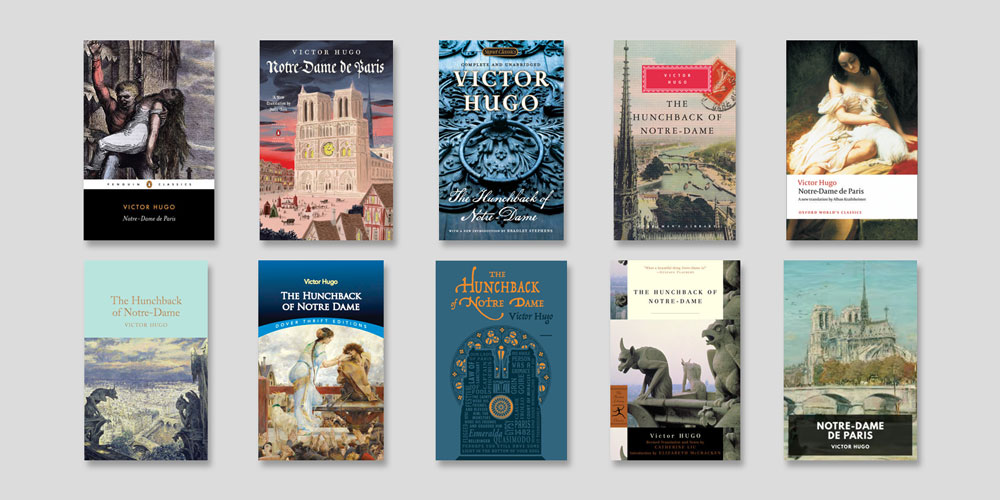
Which English translation of The Hunchback of Notre-Dame should I read?
So, you want to read Victor Hugo’s wildly popular novel. Originally published in 1831, it’s been translated into English more than a dozen times and adapted for comics, children’s books, plays, tv shows, and movies—including, of course, a Disney animated feature film. You might think it’s a dramatic story about a deformed bell-ringer, a priest, a captain, and a dancing girl with a goat, but it was actually written with the primary objective of arousing public interest in preserving threatened Gothic architecture in France.
Here's a quick recommendation.
Dive into a reliable, smooth, modern English translation:
Get the Sturrock translation of The Hunchback of Notre-Dame (published by Penguin). Available as a paperback (ISBN 9780140443530, 496 pages). Learn more about the Sturrock translation.
Want more choices? Keep reading for a comprehensive list of all translations and editions in English.
This page also provides more background on the work and a selection of related books and adaptations.
It also lists recommendations for different readers’ needs (affordability, scholarly apparatus, language style).
The Hunchback of Notre-Dame: Translations in English
As of October 3, 2026, this list is (to the best of my knowledge) complete, and editions in bold are in print (or otherwise available).
- 1833 — William Hazlitt
- 1833 — Frederic Shoberl
- 1839 — Anonymous (published by Foster and Hextall)
- 1862 — Henry L. Williams
- 1882 — A. Langdon Alger
- 1888 — Isabel F. Hapgood
- 1888 — Anonymous (published by Little, Brown, & Co.)
- 1892 — J. Caroll Beckwith
- 1902 — Jessie Haynes
- 1956 — Lowell Bair
- 1964 — Walter J. Cobb
- 1978 — John Sturrock
- 1993 — Alban J. Krailsheimer
- 2002 — Shoberl revised by Catherine Liu (published by Modern Library)
- 2027 — Julie Rose (coming in 2027)
1833 · William Hazlitt · The Hunchback of Notre Dame
About William Hazlitt
Son of the critic William Hazlitt, William Hazlitt the Younger was an English lawyer, writer, and translator. His son and his grandfather were also named William Hazlitt.
About the Hazlitt translation of The Hunchback of Notre-Dame
The title of this translation was originally Notre-Dame: A Tale of the Ancien Regime.
The Oxford Guide to Literature in English Translation edited by Peter France on page 278 says that Hazlitt’s translation was “unfortunately based on the first edition” and uses “antiquated English.”
Articulating Bodies by Kylee-Anne Hlingston
Hazlitt’s translation was “less popular” than Shoberl’s, which was cheaper, illustrated, and “aimed at a wider audience than Hazlitt’s expensive and essentially unillustrated one.” (pages 22–23).
From Hazlitt’s “Prefatory Notice”:
“We have called this a tale of the ‘ancient regime.’ We use this term in the most comprehensive sense, as expressing the violent internal state of things in France…. The new regime… however short of perfection in its details… is in its principle a regime of right” (xx-xi).
“In rendering from one language into another a work of fiction consisting almost wholly of dialogue and incident, in which there is little or no occasion to make the author appear in propria persona, it is clear that the mode most convenient for embodying those scattered words and sentences of illustration, which, in such a case, are always found necessary, is that the translator should speak in his own person. This course the editor of these volumes has adopted, finding it convenient to himself, conceiving it to be advantageous to the reader, and confident that it implies no disrespect for the author, seeing that such passages as the translator is wholly responsible for, will, by their own internal evidence, betray themselves to the reader” (xxviii).
The current hardcover Everyman’s Library edition says: “This edition reprints the anonymous nineteenth-century translation used by the first Everyman edition in 1910.” However, the text seems to match the Hazlitt translation, and Peter France acknowledges that it’s a reprint in The Oxford Guide to Literature in English Translation. The original Hazlitt translation, however, does not have the three “missing” chapters, and the Everyman edition does. So Hazlitt later translated the added chapters, or someone built on his translation subsequently (by copying most of it word for word).
What’s interesting about the Hazlitt translation is how the beginning of the first chapter got so much longer than the first chapter in the original French. There is quite a lot of material that appears to have been inserted regarding the Feast of Fools.
This translation is in the public domain. There are digital scans of the three volumes available free at Google Books:
Notre-Dame: A Tale of the Ancien Regime (Vol I)
Notre-Dame: A Tale of the Ancien Regime (Vol II)
Notre-Dame: A Tale of the Ancien Regime (Vol III)
First sentence of the Hazlitt translation of The Hunchback of Notre-Dame
» See extracts to compare the translations of The Hunchback of Notre-DameOn the 6th of January, 1482, the Parisians were awakened by the noise of all the bells within the triple circuit of the City, the University, and the Town, ringing in full peal.
Get the Hazlitt translation of The Hunchback of Notre Dame (published by Everyman's Library)
Includes an introduction by Jean-Marc Hovasse. "This edition reprints the anonymous nineteenth-century translation used by the first Everyman edition in 1910."
Available as a hardcover (ISBN 9780307957818, 504 pages).
1833 · Frederic Shoberl · The Hunchback of Notre Dame
About Frederic Shoberl
Frederic Shoberl was an English writer, translator, and illustrator.
About the Shoberl translation of The Hunchback of Notre-Dame
Articulating Bodies by Kylee-Anne Hlingston
“Shoberl’s translation slightly bowdlerized Hugo’s original, cutting a few blasphemies… and overtly sexual references ‘which, though not startling to our continental neighbours, would offend the severer taste of the English reader’ (Shoberl xiii-xiv).” Hazlitt’s was “less popular”; Shoberl’s was cheaper, illustrated, and “aimed at a wider audience than Hazlitt’s expensive and essentially unillustrated one…. The [Shoberl] edition’s affordability, popular retitling, and minor censorship to accommodate English prudery, as well as its positive reviews and reprintings, lead me to believe that Shoberl’s translation was the most influential edition in popularizing Hugo’s novel in England” (pages 22–23).
In Encyclopedia of Literary Translation into English edited by Olive Classe, (Volume 1, page 673), John R. Whittaker says, “[Shoberl’s] translation is sound and clear, and there is no doubt that his example influenced subsequent versions. Shoberl attempts, from time to time, to allude to the medieval setting by inserting archaisms.”
From Shoberl’s “Sketch of the Life and Writings of Victor Hugo”, which prefaces his translation:
“[I]t would be useless to accumulate opinions upon a work now before the British public, which can of course form its own judgment upon it. The translator will therefore merely add, that this version has been made with care; that it has been his aim in the task to preserve as much as possible the peculiarities of the author’s style and manner; and that he has taken no further liberty with the original than here and there pruning away certain luxuriances, or softening down expressions, which, though not startling to our continental neighbours, would offend the severer taste of the English reader” (page xi).
This translation is in the public domain. Scans are freely available online at Archive.org, Google Books, and Hathi Trust:
First sentence of the Shoberl translation of The Hunchback of Notre-Dame
» See extracts to compare the translations of The Hunchback of Notre-DameIt is this day three hundred and forty-eight years six months and nineteen days since that the good people of Paris were awakened by a grand peal from all the bells in the three districts of the City, the University, and the Ville.
Get the Shoberl translation of The Hunchback of Notre Dame (published by Tor)
"This edition of The Hunchback of Notre-Dame includes a Foreword, Biographical Note, and Afterword by Elizabeth Massie." Complete and unabridged. There's no translator credited but the text seems to match the Shoberl translation. This book is out of print, but you may be able to find a second-hand copy using the links below.
Available as a paperback (ISBN 9780812563122, 480 pages).

Get the Shoberl translation of The Hunchback of Notre Dame (published by Tor)
"This edition of The Hunchback of Notre-Dame includes a Foreword, Biographical Note, and Afterword by Elizabeth Massie." Complete and unabridged. There's no translator credited but the text matches the Shoberl translation.
Available as an ebook (ISBN 9781466804814).
1839 · Anonymous · La Esmeralda, or, The Hunchback of Notre Dame
About the 1839 Anonymous translation of The Hunchback of Notre-Dame
Articulating Bodies by Kylee-Anne Hlingston
“This unsigned translation was published in six parts in Foster and Hextall’s The Novelist: A Collection of the Standard Novels.”
Volume 1 of The Novelist is 494 pages and contains: The last of the Mohicans; Lionel Lincoln; Clarence; The pilot; and La Esmeralda, or, The hunchback of Notre Dame (pages 401 to 494). On the page where La Esmeralda begins, it says “Translated expressly for ‘The Novelist,’ from the original French.” The text is miserably tiny, and in two columns, but I don’t think it’s abridged.
I gather that the book is a reprint of what was basically a bunch of issues of a cheap magazine, where people would buy each issue for a small price. After all the issues had been published, then the same publishers (Foster and Hextall) and at least one other (Peirce) put out a version of the same text that readers could buy as a whole volume rather than as separate issues.
The Novelist Vol 1, 1839:
London/G. Peirce reprint, 1844: “This work will contain three chapters never before published in England, having but just appeared in the eighth edition, now in course of publication in Paris.”
First sentence of the 1839 Anonymous translation of The Hunchback of Notre-Dame
» See extracts to compare the translations of The Hunchback of Notre-DameThree hundred and forty-eight years, six months, and nineteen days have now elapsed since the citizens of Paris were aroused from their slumbers by the tolling of the bells of the three districts of the City, the University, and the Ville.
1862 · Henry L. Williams · The Hunchback of Notre Dame
About Henry L. Williams
Henry Llewellyn Williams, Jr. was an American writer and translator.
John Adcock: “Henry Llewellyn Williams (Sr.): A Literary Pirate”
According to an 1883 article quoted in a blog post by John Adcock, the work that H.L. Williams did with his father, also a writer, may not have been completely legitimate.
The Alexandre Dumas père Web Site: “Henry Llewellyn Williams Jr.” by CadyTech
“Translated many works of Alexandre Dumas into English for lesser-known American publishers, often with unusual or variant titles.”
Among his translations of works by Dumas is The Three Musketeers.
About the Williams translation of The Hunchback of Notre-Dame
In Encyclopedia of Literary Translation into English edited by Olive Classe, (Volume 1, page 673), John R. Whittaker says, “Williams’s The Hunchback of Notre-Dame (1862) reads quite well, though in an attempt to make the language as accessible as possible, the lexical range of the original may have been diminished.”
This translation is in the public domain. Scans are freely available online at Hathi Trust and Google Books.
First sentence of the Williams translation of The Hunchback of Notre-Dame
» See extracts to compare the translations of The Hunchback of Notre-DameIt is to-day three hundred and forty- eight years, six months, and nineteen days since that on which the Parisians were aroused by the clangor of all the bells ringing at their highest pitch within the triple enclosure of the Cité, the Universitié, and the Ville.
1882 · A. Langdon Alger · Notre-Dame de Paris
About A. Langdon Alger
Abby Langdon Alger was an American writer, ethnologist, and translator.
About the Alger translation of The Hunchback of Notre-Dame
The title of this translation was originally Notre-Dame de Paris.
In Encyclopedia of Literary Translation into English edited by Olive Classe, (Volume 1, page 673), John R. Whittaker says, “Alger’s Notre-Dame de Paris (1891) contains a number of variations from the original sense, though they are generally justified in a clear rendering which keeps the spirit of the source.”
This translation is in the public domain. Scans are freely available online at Archive.org.
First sentence of the Alger translation of The Hunchback of Notre-Dame
» See extracts to compare the translations of The Hunchback of Notre-DameThree hundred and forty-eight years, six months, and nineteen days ago to-day the Parisians were waked by the sound of loud peals from all the bells within the triple precincts of the City, the University, and the Town.
Get the Alger translation of Notre-Dame de Paris (published by Dover)
"This Dover edition, first published in 2006, is an unabridged one-volume republiscation of Notre Dame de Paris, published in two volumes by H.M. Caldwell Co., New York and Boston, 1888." Copyright notice says translated by A.L. Alger.
Available as a paperback (ISBN 9780486452425, 448 pages).
Get the Alger translation of Notre-Dame de Paris (published by Dover)
"This Dover edition, first published in 2006, is an unabridged one-volume republiscation of Notre Dame de Paris, published in two volumes by H.M. Caldwell Co., New York and Boston, 1888." Copyright notice says translated by A.L. Alger.
Available as an ebook (ISBN 9780486114507).
Get the Alger translation of Notre-Dame de Paris (published by Barnes & Noble)
Contains quotes from the novel, an author bio, extra material on the author and novel, the author's note added to the definitive edition, an introduction by Isabel Roche, endnotes, a list of works inspired by the novel, comments and questions, and suggestions for further reading. It says "Translated anonymously" but the text matches the Alger translation. Out of print.
Available as a paperback (ISBN 9781593081409, 544 pages).
Get the Alger translation of Notre-Dame de Paris (published by Barnes & Noble)
Contains quotes from the novel, an author bio, extra material on the author and novel, the author's note added to the definitive edition, an introduction by Isabel Roche, endnotes, a list of works inspired by the novel, comments and questions, and suggestions for further reading. It says "Translated anonymously" but the text matches the Alger translation.
Available as an ebook (ISBN 9781411432352).
1888 · Isabel F. Hapgood · Notre-Dame de Paris
About Isabel F. Hapgood
She was an American writer and translator. She was strongly religious, and worked on uniting different Christian denominations. She translated works by Tolstoy, Chekhov, and Dostoevsky, among others. She translated not only Notre-Dame de Paris by Victor Hugo, but also Les Miserables and Toilers of the Sea.
About the Hapgood translation of The Hunchback of Notre-Dame
The title of this translation was originally Notre-Dame de Paris.
The Oxford Guide to Literature in English Translation edited by Peter France on page 278 says “All of [these 19th-c. translations], especially Hapgood’s sometimes inaccurate rendering, show their age; none has the intense vitality which characterizes Hugo’s prose at best.”
First sentence of the Hapgood translation of The Hunchback of Notre-Dame
» See extracts to compare the translations of The Hunchback of Notre-DameThree hundred and forty-eight years, six months, and nineteen days ago to-day, the Parisians awoke to the sound of all the bells in the triple circuit of the City, the University, and the Town ringing a full peal.
Get the Hapgood translation of Notre-Dame de Paris (published by Thomas Nelson)
A fine exclusive edition of one of literature’s most beloved stories. Featuring a laser-cut jacket on a textured book with foil stamping, all titles in this series will be first editions. No more than 10,000 copies will be printed, and each will be individually numbered from 1 to 10,000.
Available as a hardcover (ISBN 9780785239772, 640 pages).
Get the Hapgood translation of Notre-Dame de Paris (published by Word Cloud Classics)
Word Cloud Classics have a flexible plastic/vinyl cover. They're not exactly hardcovers, but they're a step up from paperbacks in terms of esthetics and durability.
Available as a paperback (ISBN 9781645171782, 624 pages).
Get the Hapgood translation of Notre-Dame de Paris (published by AmazonClassics)
Free for Kindle Unlimited subscribers.
Available as an ebook.
Get the Hapgood translation of Notre-Dame de Paris (published by Project Gutenberg)
Free! Available in html, epub, Kindle, and plain text formats.
Available as an ebook.
Get the Hapgood translation of Notre-Dame de Paris (published by Standard Ebooks)
Free! Available in epub, Kindle, Kobo, and Advanced epub formats. Standard Ebooks are professionally edited, professionally designed versions of the Project Gutenberg texts.
Available as an ebook.
1888 · Anonymous · The Hunchback of Notre Dame
About the 1888 Anonymous translation of The Hunchback of Notre-Dame
I dug this translation up from the shadowy depths of the internet myself. It doesn’t exactly match any of the other translations. It could be a new translation, or an updated edition an earlier translation. In any case, there are differences from other editions, as the publishers state in the preface:
The present edition of Notre-Dame will be found more complete than any which has hitherto been printed in English. It contains a special translation of Book V., embracing the chapter entitled “Abbas Beati Martini,” and the important chapter on Architecture and Printing; also the author’s long note added to the edition of 1832, and not included in any other translation. The English edition has been carefully examined and a number of errors have been corrected.
Boston, June 6, 1888
This translation is in the public domain. Scans are freely available from Hathi Trust, Archive.org, and Google Books. There are multiple copies; here are some representative links.
First sentence of the 1888 Anonymous translation of The Hunchback of Notre-Dame
» See extracts to compare the translations of The Hunchback of Notre-DameExactly three hundred and forty-eight years, six months, and nineteen days have passed away since the Parisians were awakened by the noise of all the bells within the triple walls of the city, the University, and the town, ringing a full peal.
1892 · J. Caroll Beckwith · The Hunchback of Notre Dame
About J. Caroll Beckwith
Strangely, as far as Wikipedia is concerned, James Carroll Beckwith was a portrait and landscape painter, not a translator, yet someone named J. Carroll Beckwith is definitely responsible for a translation of Notre-Dame of Paris. It’s possible there are two people with similar names who have become conflated, but Worldcat attributes the Beckwith translation and the Beckwith art to the same person, a man who was born in 1852 and died in 1917. Perhaps he didn’t translate anything else, and his paintings were just more memorable than his writing.
This book tells the real-live story of a police detective who believes he was the painter Carroll Beckwith in a past life.
About the Beckwith translation of The Hunchback of Notre-Dame
The title of this translation was originally Notre-Dame of Paris.
The Oxford Guide to Literature in English Translation edited by Peter France says Beckwith’s translation “reads quite fluently, adding brief glosses as it goes, treating Hugo’s syntax rather freely and sometimes failing to catch the meaning of the dialogue” (page 278).
In Encyclopedia of Literary Translation into English edited by Olive Classe, (Volume 1, page 673), John R. Whittaker says, “Beckwith’s The Hunchback of Notre-Dame (1899, 1953) combines respect for the original with a competence that has justified a number of reprints in more recent times.”
Beckwith’s note on the translation in the 1892 edition says:
“If translated too literally, the English becomes harsh, disconnected; if rendered into modern, well-rounded phrases, the virility the peculiar historical accent, disappear…. [I]t behooves the translator to consider his quantities even more carefully, if possible, than did the author himself,—working as he does in an alien tongue as well as an alien time.”
This translation is in the public domain. Scans are freely available online at Archive.org.
» View scans online at Archive.org
First sentence of the Beckwith translation of The Hunchback of Notre-Dame
» See extracts to compare the translations of The Hunchback of Notre-DameOne morning, three hundred and forty-eight years, six months, and nineteen days ago, the Parisians were awakened by a grand peal from all the bells within the triple enclosure of the City, the University and the Town.
Get the Beckwith translation of The Hunchback of Notre Dame (published by Wordsworth)
With an Introduction and Notes by Keith Wren.
Available as a paperback (ISBN 9781853260681, 480 pages).
Get the Beckwith translation of The Hunchback of Notre Dame (published by Collector's Library)
Includes an afterword by John Grant. I couldn't find any translator credit, but the text matches the Beckwith translation.
Available as a hardcover (ISBN 9781909621619, 664 pages).
Get the Beckwith translation of The Hunchback of Notre Dame (published by Collector's Library)
Includes an afterword by John Grant. I couldn't find any translator credit, but the text matches the Beckwith translation.
Available as an ebook (ISBN 9781509826841).
1902 · Jessie Haynes · Notre Dame de Paris
About the Haynes translation of The Hunchback of Notre-Dame
From looking at a copy published in 1902 by P.F. Collier & Son in New York, it seems that perhaps this translation was originally done for a 20-volume series called “The Trench Classical Romances”, edited by Edmund Gosse. The Haynes translation is the one reprinted in “The Harvard Classics Shelf of Fiction”, selected by Charles W. Eliot, edited with notes and introductions by William Allan Neilson, also published by P.F. Collier & Son.
I see reprints available from 1930, 1955, and 1983, but no current editions.
This translation is in the public domain. Scans are freely available on Archive.org.
First sentence of the Haynes translation of The Hunchback of Notre-Dame
» See extracts to compare the translations of The Hunchback of Notre-DamePrecisely three hundred and forty-eight years six months and nineteen days ago Paris was awakened by the sound of the pealing of all the bells within the triple enclosing walls of the city, the University, and the town.
1956 · Lowell Bair · The Hunchback of Notre Dame
About Lowell Bair
He translated Madame Bovary, The Phantom of the Opera, The Count of Monte Cristo, Cyrano de Bergerac, Candide, The Three Musketeers, and The Red and the Black, among other works in French.
About the Bair translation of The Hunchback of Notre-Dame
This translation is ABRIDGED.
In Encyclopedia of Literary Translation into English edited by Olive Classe, (Volume 1, page 674), John R. Whittaker says, “Bair’s The Hunchback of Notre Dame (1956) tends towards [modern, well-rounded phrases]. The simple and direct language, though generally appropriate, is sometimes strained. This translation displays little or no attempt to convey a period flavour, and it is apt to omit problematic phrases.”
First sentence of the Bair translation of The Hunchback of Notre-Dame
» See extracts to compare the translations of The Hunchback of Notre-DameOn January 6, 1482, the people of Paris were awakened by the tumultuous clanging of all the bells in the city.
Get the Bair translation of The Hunchback of Notre Dame (published by Bantam)
ABRIDGED.
Available as a mass-market paperback (ISBN 9780553213706, 384 pages).
Get the Bair translation of The Hunchback of Notre Dame (published by Bantam)
ABRIDGED.
Available as an ebook (ISBN 9780553903980).
1964 · Walter J. Cobb · The Hunchback of Notre Dame
About the Cobb translation of The Hunchback of Notre-Dame
The Oxford Guide to Literature in English Translation edited by Peter France on page 278 says that the Cobb translation is “stilted and inaccurate [compared to Sturrock].”
First sentence of the Cobb translation of The Hunchback of Notre-Dame
» See extracts to compare the translations of The Hunchback of Notre-DameIt is three hundred forty-eight years, six months, and nineteen days ago today that the citizens of Paris were awakened by the pealing of all the bells in the triple precincts of the City, the University, and the Town.
Get the Cobb translation of The Hunchback of Notre Dame (published by Signet)
Includes an introduction by Bradley Stephens and an afterword by Graham Robb.
Available as a mass-market paperback (ISBN 9780451531513, 528 pages).
1978 · John Sturrock · Notre-Dame of Paris
About John Sturrock
John Sturrock is a writer, critic, and translator. He contributed to the Penguin translation of Marcel Proust’s In Search of Lost Time.
About the Sturrock translation of The Hunchback of Notre-Dame
The Oxford Guide to Literature in English Translation edited by Peter France on page 278 says that the Sturrock translation is “freer” than Krailsheimer’s: “tending to eschew archaism, it reads very naturally, especially the dialogue.”
Sturrock says in his introduction: “[The previous translations] which I have seen have all seemed to me to betray Hugo to some degree by making him read like a historical novelist of a much stiffer, more archaic kind than he actually was. The striking thing about the French of Notre-Dame, as about Hugo’s style generally, is its formidable directness and resourcefulness, directness in syntax and resourcefulness in vocabulary…. There is no strong sense, reading Notre-Dame today, of a story written in the French of 1830, and no disloyalty at all, consequently, in translating it into plain, colloquial English.”
Sturrock also says in the introduction to his translation: “There is one specific difficulty in translating this novel, which is Hugo’s tireless introduction of archaisms, including, to make things worse, the archaic jargon of the 15th century underworld…. [H]e loves the lexicology of secret languages.”
First sentence of the Sturrock translation of The Hunchback of Notre-Dame
» See extracts to compare the translations of The Hunchback of Notre-DameThree hundred and forty-eight years, six months and nineteen days ago today, the people of Paris awoke to hear all the church-bells in the triple enclosure of the City, the University and the Town in full voice.
Get the Sturrock translation of Notre-Dame of Paris (published by Penguin)
Includes an introduction by the translator.
Available as a paperback (ISBN 9780140443530, 496 pages).
1993 · Alban J. Krailsheimer · Notre-Dame de Paris
About Alban J. Krailsheimer
According to Oxford World’s Classics, “A. J. Krailsheimer was Emeritus Student and Tutor in French at Christ Church, Oxford from 1957 until his retirement in 1988. His published work is mostly on the sixteenth and seventeenth centuries, but among his translations are Balzac’s Pere Goriot, Flaubert’s Three Tales (both also in Oxford World’s Classics), Samammbo, and Bouvard et Pechuchet.”
He died 7 May 2001 at the age of 80.
About the Krailsheimer translation of The Hunchback of Notre-Dame
The Oxford Guide to Literature in English Translation edited by Peter France on page 278 says that the Krailsheimer translation sticks “closely to Hugo’s syntax, avoiding unnecessary interpretation and keeping explanation for the end notes.”
In Encyclopedia of Literary Translation into English edited by Olive Classe, (Volume 1, page 674), John R. Whittaker says, “Krailsheimer’s Notre-Dame de Paris (1993) is closer [than Bair’s] to the sense of the original.”
First sentence of the Krailsheimer translation of The Hunchback of Notre-Dame
» See extracts to compare the translations of The Hunchback of Notre-DameJust three hundred and forty-eight years, six months, and nineteen days ago today Parisians woke to the sound of all the bells pealing out within the triple precinct of City, University, and Town.
Get the Krailsheimer translation of Notre-Dame de Paris (published by Oxford)
Includes an introduction by the translator.
Available as a paperback (ISBN 9780199555802, 592 pages).
Get the Krailsheimer translation of Notre-Dame de Paris (published by Oxford)
Includes an introduction by the translator.
Available as an ebook.
2002 · Shoberl revised by Catherine Liu · The Hunchback of Notre-Dame
About Shoberl revised by Catherine Liu
Catherine Liu is a Chinese-American writer and academic.
» Read a three-page biography of Catherine Liu from the University of Minnesota.
About the Shoberl and Liu translation of The Hunchback of Notre-Dame
According to her translator’s preface, Liu has restored the eroticism of the French original that was largely absent from the anonymous 1941 Modern Library English translation (which I believe is the Shoberl translation) that she was working from:
“Not only were descriptions of La Esmeralda’s heaving bosom and graceful legs simply dropped, Claude Frollo’s erotic obsession and sadism were veiled in Anglo-Saxon euphemisms that Hugo would have ridiculed. The novel is much more sensual, much earthier, and much more troubling when this erotic language is restored to Hugo’s portrait of unreciprocated love.”
This version contains the three chapters from 1832, even though Shoberl’s original did not.
Elizabeth McCraken’s introduction addresses misconceptions arising from the novel’s ubiquity in popular culture. She worries that people won’t want to read the book because they already know the story and the characters, but knows that those who nevertheless plunge in will be well rewarded, as there are many subtleties as well as obvious merits to appreciate.
First sentence of the Shoberl and Liu translation of The Hunchback of Notre-Dame
» See extracts to compare the translations of The Hunchback of Notre-DameThree hundred and forty-eight years, six months, and nineteen days ago, the good people of Paris awoke to the sound of all the bells pealing in the three districts of the Cité, the Universite, and the Ville.
Get the Shoberl and Liu translation of The Hunchback of Notre-Dame (published by Modern Library)
Revised translation and notes by Catherine Liu. Includes an author bio, the author's preface, a translator's preface, and an introduction by Elizabeth McCracken.
Available as a paperback (ISBN 9780679642572, 512 pages).
Get the Shoberl and Liu translation of The Hunchback of Notre-Dame (published by Modern Library)
Revised translation and notes by Catherine Liu. Includes an author bio, the author's preface, a translator's preface, and an introduction by Elizabeth McCracken.
Available as an ebook (ISBN 9780307417152).
2027 · Julie Rose · Notre-Dame de Paris (The Hunchback of Notre Dame)
About Julie Rose
Julie Rose is a translator of French. She has translated works by Racine, Moliere, Emile Zola, and Alexandre Dumas as well as Victor Hugo. She has also taught French language and literature and served as an interpreter in Paris. In 2016 she was made a Chevalier dans l’Ordre des arts et des lettres by the French government. She loves to read crime fiction.
» About the Rose translation of Victor Hugo’s Les Miserables
About the Rose translation of The Hunchback of Notre-Dame
From the publisher: “This sparkling new translation, the first major one in English in more than thirty years, by a celebrated translator of Hugo’s Les Misérables, is complete and unabridged, and based on the authoritative 1832 text established by the Bibliothèque de la Pléaide.”
As of October 2026, the release date is set for January 26, 2027.
First sentence of the Rose translation of The Hunchback of Notre-Dame
» See extracts to compare the translations of The Hunchback of Notre-Dame[Not yet available.]

Get the Rose translation of Notre-Dame de Paris (The Hunchback of Notre Dame) (published by Penguin Classics Deluxe)
Coming in January 2027. Introduction and notes by Julie Rose. A Penguin Classics Deluxe Edition, with flaps and deckle-edged paper.
Available as a paperback (ISBN 9780143135845, 560 pages).

Get the Rose translation of Notre-Dame de Paris (The Hunchback of Notre Dame) (published by Penguin Classics Deluxe)
Coming in January 2027. Introduction and notes by Julie Rose.
Available as an ebook (ISBN 9780525507437).
Notes on the work and its translation
Many of the old translations are still out there today! Translators not getting their names on stuff was common practice in the 1800s; reprinting old public domain translations is common practice now; and if I’m not mistaken, some translators whose names were on their translations aren’t getting credit for today’s reprints. Wherever I’ve had to try, by looking at extracts, to identify the translation in a newer edition, I’ve added a note to say so.
Three early English translations (Hazlitt, Shoberl, the serialized version published by Foster & Hextall) and the modern abridged translation by Lowell Bair were based on the 1831 French original and did not include three chapters added to the French version in 1832. The three chapters, inserted after Book IV Chapter V, are “Impopularité” (inserted as Chapter VI of Book IV) and “Abbas Beati Martini” and “Ceci tuera cela” (inserted as Chapter I and II of Book V). Chapter II of Book V contains the famous “this will kill that” passage. With the three chapters, Hugo also added “Note ajoutée à l’édition définitive”, which explains that these chapters were always part of the book; written with but not published with the other chapters. Hugo also uses the note to exhort readers to preserve the architecture of Paris.
In a way, Hugo succeeded. Maybe video killed the radio star, but the printing press still hasn’t killed architecture. The internet—modern-day heir to the printing press—in April 2019 helped raise millions of dollars, literally overnight, to salvage the cathedral Hugo loved.
Further exploration
In France, Hugo is known as a poet. He also wrote plays. However, in the English-speaking world, he’s known as a novelist, primarily for Notre-Dame and Les Miserables. Hugo’s other fictional works include the novels Toilers of the Sea, The Man Who Laughs, and Ninety-Three, and the novella The Last Day of a Condemned Man.
» What’s the best translation of Les Miserables?
For more on The Hunchback of Notre-Dame, its author, its historical and literary context, and/or its adaptations, consider the resources below.
Get Notre-Dame de Paris by Victor Hugo
Hugo's original French text.
Available as an ebook.
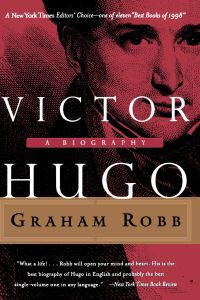
Get Victor Hugo: A Biography by Graham Robb
“Both necessary and highly readable, and easily outclasses all existing Hugo biographies in English.” ― New York Times Book Review front-page review
Available as a paperback (ISBN 9780393318999, 720 pages).
Get Notre Dame of Paris: The Biography of a Cathedral by Allan Temko
It's out of print, but you may be able to find a second-hand copy using the links below.
Available as a hardcover or paperback.
Get Notre-Dame de Paris: History, Art, and Revival from 1163 to Tomorrow by Antonia Felix
"This stunning photographic ode to one of the world's most beloved treasures pays tribute to Notre-Dame--its place in history and in culture, and its rebirth--in the wake of the tragic fire that nearly destroyed it."
Available as a hardcover (ISBN 9781454938316).
Get Notre Dame de Paris : A Celebration of the Cathedral by Kathy Borrus
Details the impressive architecture of the building, the priceless artefacts it contains, and the major historical events that have taken place in its presence. Shows, through film stills and artwork reproductions, the ways in which the Notre Dame has permeated our popular culture. Coupled with informative text for each image, Notre Dame is the definitive book on the history of this landmark building.
Available as a hardcover (ISBN 9780762497119, 128 pages).

Get The Hunchback of Notre Dame by Disney
1996 Disney animated feature film. 1h 30m.
Available as streaming video.
Get The Hunchback of Notre-Dame by Victor Hugo
Puffin classics ABRIDGED version for children. Based on the Walter J. Cobb translation (1965), abridged by Robin Waterfield (1996).
Available as a paperback (ISBN 9780140382532, 320 pages).

Get The Hunchback of Notre Dame by Victor Hugo
Real Reads children's adaptation, retold by Tony Evans and illustrated by Catty Flores. Ebook also available.
Available as a paperback (ISBN 9781906230692, 64 pages).
The Hunchback of Notre-Dame: Translation recommendations
Between Alger, Hapgood, and Beckwith, I’m not sure which public domain reprint I’d recommend if you want a physical copy. You can choose based on how the extracts sound, or based on price or physical appearance.
Here's a summary of my recommendations.
Legitimately free, user-friendly ebook:
Get the Hapgood translation of The Hunchback of Notre-Dame (published by Standard Ebooks). Available as an ebook. Learn more about the Hapgood translation.
Smooth, modern English translation:
Get the Sturrock translation of The Hunchback of Notre-Dame (published by Penguin). Available as a paperback (ISBN 9780140443530, 496 pages). Learn more about the Sturrock translation.
Careful scholarly translation with French flavor:
Get the Krailsheimer translation of The Hunchback of Notre-Dame (published by Oxford). Available as a paperback (ISBN 9780199555802, 592 pages). Learn more about the Krailsheimer translation.
Can't decide? Compare extracts from the different versions of The Hunchback of Notre-Dame.
Whichever one you choose... happy reading!
Help improve and support this site
Spotted an error or missing edition? Email me. I am grateful for corrections and additions, and I update pages whenever I can verify new information.
Have a question or recommendation? Leave a comment. Genuine comments are always welcome.
Want to hear about new posts? Subscribe to the mailing list. I send occasional emails when I publish substantial new material.
Found this guide useful? If you would like to support the research behind We Love Translations, you can buy me a coffee. Thank you.


Thanks for your detailed analysis. It was quite timely as I was visiting a second hand bookshop and deciding between some translations. In the end I choose the Sturrock translation from Penguin.
Of course Les Miserables has been translated many times but it’s a shame Hugo’s 5 other novels (Hans of Iceland, Bug Jargal, Toilers of the Sea, The Man Who Laughs and Ninety-Three) haven’t received an updated translations. I think Toilers maybe got one some time back.
Hi Rob, thanks for your comment! Yes, Wikipedia says there’s a 2002 Modern library translation of Toilers of the Sea by James Hogarth. For Ninety-Three, there’s a 1988 translation by Frank Lee Benedict, and a 1962 translation by Lowell Bair. Wikipedia says the 2004 translation by Chris Bongie is the only modern English one. Hans of Iceland doesn’t seem to have any English translation newer than… 1891! I have seen some “new translations” on Amazon, dated 2025 or so, that were clearly produced using AI translation tools. It would be great if an expert human could produce modern versions of some of Hugo’s less well known works.
My library has a xlation by Catherine Liu but I’ve not found it talked about anywhere. Do you have any info? Thanks.
I believe you are talking about the Modern Library edition from 2002 listed above. There are a few mentions of this version on Reddit, but I couldn’t find any articles or reviews devoted to assessing this version, maybe because it’s not a new translation, just a revision of an existing one.
You’re so right regarding translations. I started reading the classics via Classic Illustrated Comics and as an adult continued to read them…Hugo was a favourite. I have read 4 of the translations you have included in your research and settled on my favourite. Your work here will be very helpful to others interested in this great novel. Translations do make a difference so many thanks.
The Oxford World’s Classics is now my recommended version,followed by the Penguin version. Interestingly enough, I have also enjoyed the older Hapgood translation and would still recommend it…I have read it 3 times now!
Thanks for sharing your experience! It certainly sounds like you’ve spent a lot of time with Hugo’s works. 🙂
Thanks for all this info! There were so many versions out there, but I would prefer to stick to as close to the original verison of Hugo’s work as possible. Decided to go with the Oxford Krailsheimer translation!
Good Lord!! Way TMI!! Is it so difficult to just say this one’s pretty good and seems true to the original text…? 🤷🏼♀️
You’re right! Many people are perfectly happy with the typical responses you can see on forums and message boards, which usually more or less say “I read this one, it was fine.” But some people like to gather more information before making a decision, or are just generally interested in knowing random details about famous books. Information about translations tends to be scattered, so… I collected it. I hope it was at least somewhat entertaining!
They are super helpful! Much better than simple comments about each translation. Thank you for collecting these information!
Thank you for the positive feedback!
Thank you very much! You did a wonderful and thorough comparison and saved me both time and money. I cannot thank you enough for doing this!
That’s what I like to hear! Thanks for taking the time to comment. 🙂
I just recently discovered this website. Thank you to everyone involved. I want to get more into the classics but I know I cannot be the only person who feels overwhelmed with all the translation options. It’s easy to get discouraged and want to give up. This is a valuable resource!
Hi again, Mo! I think a lot of people when they first get into the classics don’t think much about the choice of translation. People just buy whatever’s newest or cheapest or locally available, or whatever is assigned for a class, and I think usually that works out just fine. But sometimes the translation has a big impact on how a reader experiences a novel, so I think it’s worth considering different versions in advance. An option for anyone new to classics who feels overwhelmed by all the different translation choices is to first focus on English and American classics that don’t need to be translated (many of which are public domain and can be obtained online for free), or more recent foreign “modern classics” that have probably only been translated once (like One Hundred Years of Solitude, for example).
Thank you so much. I wish I had discovered this site earlier! I do want to read Hunchback this year. I appreciate all the information as I make my decision.
I found this fascinating! I read all of your Part 1. It’s interesting to notice the variation in translation — that people “hear” the same language differently, and express it differently. Translation can make or break a story. One of my favourite books of all time is Dumas’ The Three Musketeers. Having read it in my teens, I picked up a copy in adulthood and was utterly dismayed by how unengaging it was, not at all as I’d remembered it. Translation was the difference between a story that would leave an indelible, lifelong mark — or be relegated to the DNF pile. It’s valuable to have this insight for making an informed choice. Thanks.
Wow, what a clear-cut example of a reader experiencing two translations as two entirely different books! Thanks for sharing your story about The Three Musketeers, Monica. 🙂 Do you know which two versions they were?
As a very avid reader of translated classics, I for one sure appreciate that you do it—I’ve learned to just come here first!
Thanks for the positive feedback! It’s good to hear. 🙂