
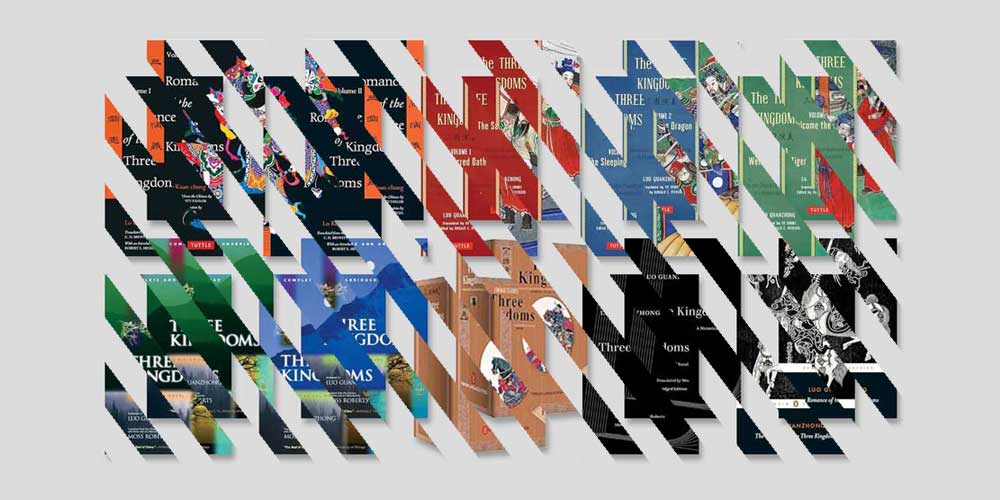
This page is a companion to: What’s the best translation of The Romance of the Three Kingdoms?
Below are extracts from 4 different English translations of The Romance of the Three Kingdoms by Luo Guanzhong, shown in a random fixed order.
Use the side‑by‑side links to choose two translations for comparison in the comparison section further down the page. (If you're on a mobile phone, they won't really be side by side, but they'll be together at the bottom of the list.)
Unity succeeds division and division follows unity. One is bound to be replaced by the other after a long span of time. This is the way with things in the world. At the end of the Zhou Dynasty the empire was divided into seven competing principalities, warring against one another till finally they were united by Qin. When Qin had fulfilled its destiny, there arose Chu and Han to contend for the reign, and ultimately it was Han that united the country.
The rise of the fortunes of the Hans began when Liu Bang, later its first emperor, slew the white serpent and staged an uprising against Qin. After seven years of fighting he succeeded in gaining control of the whole empire and the Han Dynasty ruled the land for more than two centuries. Then their power weakened and the empire was lost for a brief period of time to a usurper. Later, it was Emperor Guang Wu that restored the line of Han—which continued for another century or more until the reign of Emperor Xian, when the empire was divided into three parts, known to history as The Three Kingdoms.
In fact, the trouble started in the reigns of the two previous emperors, Huan and Ling. The former prohibited many upright men from holding office, but trusted the palace eunuchs. When Emperor Ling inherited the throne, he was aided by General Dou Wu and Grand Tutor Chen Fan. Disgusted with the way the eunuchs meddled in state affairs, these two men planned their destruction. Unfortunately, the secret leaked out and they fell victims instead. From that time the eunuchs became even more powerful.
The empire, long divided, must unite; long united, must divide. Thus it has ever been. In the closing years of the Zhou dynasty,1 seven kingdoms warred among themselves until the kingdom of Qin prevailed and absorbed the other six. But Qin soon fell, and on its ruins two opposing kingdoms, Chu and Han, fought for mastery until the kingdom of Han prevailed and absorbed its rival, as Qin had done before. The Han court’s rise to power began when the Supreme Ancestor slew a white serpent, inspiring an uprising that ended with Han’s ruling a unified empire.
Two hundred years later, after Wang Mang’s usurpation, Emperor Guang Wu restored the dynasty, and Han emperors ruled for another two hundred years down to the reign of Xian, after whom the realm split into three kingdoms. The cause of Han’s fall may be traced to the reigns of Xian’s two predecessors, Huan and Ling. Huan drove from office and persecuted officials of integrity and ability, giving all his trust to his eunuchs. After Ling succeeded Huan as emperor, Regent-Marshal Dou Wu and Imperial Guardian Chen Fan, joint sustainers of the throne, planned to execute the power-abusing eunuch Cao lie and his cohorts. But the plot came to light, and Dou Wu and Chen Fan were themselves put to death. From then on, the Minions of the Palace knew no restraint.
Empires wax and wane; states cleave asunder and coalesce. When the rule of Chou weakened seven contending principalities sprang up, warring one with another till they settled down as Tsʻin and when its destiny had been fulfilled arose Chʻu and Han to contend for the mastery. And Han was the victor.
The rise of the fortunes of Han began with the slaughter of the White Serpent. In a short time the whole Empire was theirs and their magnificent heritage was handed down in successive generations till the days of Kuang-Wu, whose name stands in the middle of the long line of Han. This was in the first century of the western era and the dynasty had then already passed its zenith. A century later came to the Throne the Emperor Hsien, doomed to see the beginning of the division into three parts, known to history as The Three Kingdoms.
The descent into misrule hastened in the reigns of the two Emperors Huan and Ling, who sat in the dragon seat about the middle of the second century. The former of these two paid no heed to the good men of his court, but gave his confidence to the palace eunuchs. He lived and died, leaving the sceptre to Ling, whose trusted advisers were the General Tou Wu and the Grand Tutor Chʻên Fan. These two, disgusted with the abuses resulting from the meddling of the eunuchs in affairs of State, plotted their destruction. But the chief eunuch Tsʻao Chieh was not to be disposed of easily. The plot leaked out and the two honest men fell, leaving the eunuchs stronger than before.
Empires arise from chaos and empires collapse back into chaos. This we have known since time began.
The Zhou dynasty collapsed when seven kingdoms tore apart the empire by fighting among themselves, until eventually the Qin kingdom conquered all of the other kingdoms. But the Qin did not last long, and after them came the competing forces of Chu and Han. They also fought among themselves until the Han triumphed, uniting all under Heaven into one empire again. Many years later, the empire was divided by an uprising, but unity was restored by Emperor Guang Wu, and all was well again – until, that is, the reign of Emperor Xian, when the empire split into three kingdoms. It was brought about by two previous bad emperors: Emperor Huan, who favoured eunuchs over men of distinction and integrity, and Emperor Ling, his successor, who failed to support a palace conspiracy against the eunuchs, and the instigators were executed. From that time on the eunuchs were in complete control, and nobody could stop them.
話說天下大勢,分久必合,合久必分:周末七國分爭,并入於秦。及秦滅之後,楚 、漢分爭,又并入於漢。漢朝自高祖斬白蛇而起義,一統天下。後來光武中興,傳至獻 帝,遂分為三國。推其致亂之由,殆始於桓、靈二帝。桓帝禁錮善類,崇信宦官。及桓 帝崩,靈帝即位,大將軍竇武、太傅陳蕃,共相輔佐。時有宦官曹節等弄權,竇武、陳 蕃謀誅之,作事不密,反為所害。
[Google translation of this Chinese version:] The general trend of the world is that long division leads to unity, and long unity leads to division. The Warring States period saw seven kingdoms contending for power until they were all absorbed by Qin. After the fall of Qin, the states of Chu and Han vied for supremacy, eventually resulting in the unification under the Han Dynasty. The Han rose to power when Emperor Gaozu slew the White Serpent and launched his uprising, uniting the realm. Later, after the restoration under Emperor Guangwu, the empire eventually fractured into the Three Kingdoms. The root causes of this turmoil can be traced back to the reigns of Emperors Huan and Ling. Emperor Huan suppressed upright officials while placing his trust in eunuchs. Upon his death, Emperor Ling ascended the throne, assisted by the Grand General Dou Wu and the Grand Tutor Chen Fan. However, eunuchs such as Cao Jie usurped power; Dou Wu and Chen Fan plotted to eliminate them, but their plans lacked secrecy, and they were killed by the very eunuchs they sought to destroy.
Side-by-side comparison
Choose any two translations above; they will appear here side by side.