
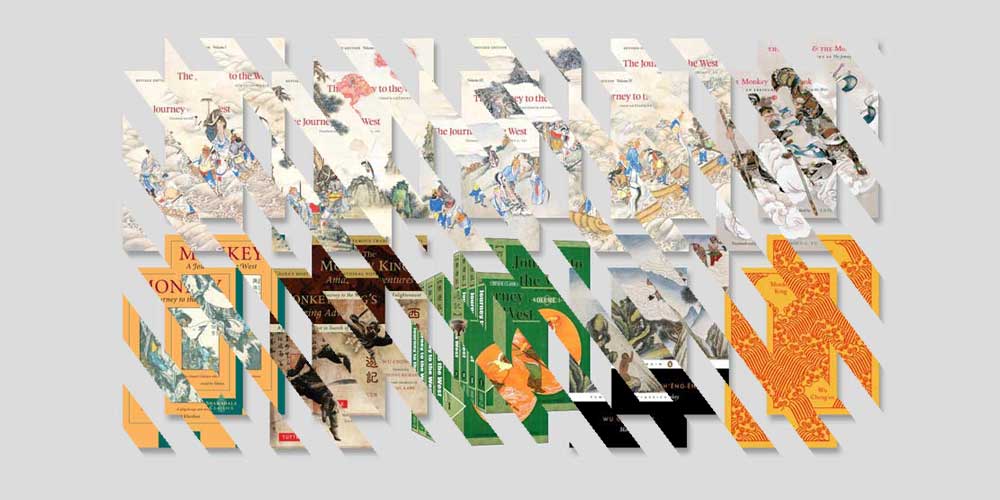
This page is a companion to: What’s the best translation of Journey to the West?
Below are extracts from 8 different English translations of Journey to the West by Wu Cheng'en, shown in a random fixed order.
Use the side‑by‑side links to choose two translations for comparison in the comparison section further down the page. (If you're on a mobile phone, they won't really be side by side, but they'll be together at the bottom of the list.)
1. Monkey Gets Restless and Seeks Immortality
Chaos reigned ere order came,
Darkness wrapped the world around,
When at last Pangu appeared.
Light and bright he placed above,
Heavy things he ranged below.
Living creatures he called forth,
All things needed he supplied.
Creation’s wonders if you’d see,
Read this journey to the sky.
We have heard that the age of the world is 129,600 years for one kalpa, that these kalpas are divided into 12 periods, just as the day and night are divided into 12 Chinese hours, and each period is 10,800 years, or two half periods of 5,400 each. Speaking of the divisions in a day, there are twelve of 2 hours each, from midnight to midnight. But if we speak of the division of the kalpas, at the end of each there is a return to chaos and darkness. After the first period of 5,400 years, everything should be dark like night without any living thing. This state is called chaos. After the second period of 5,400 years comes the era which gradually begins to open up with light. Hence the saying, “The winter solstice is the re-beginning.” But Nature never changes. Everything is dead. Soon after, life again begins. After a third period of 5,400 years, the lighter parts of matter rise up, forming the sun and moon and stars. Towards the end of a fourth period of 5,400 years, the solid parts combine. The Book of Changes says, “How great is Heaven, how perfect is the Earth producing all things. The Earth henceforth becomes solid.” After a fifth period of 5,400 years more, all the solids resolve into water and fire, into mountains, rocks, and earth. After a sixth period of 5,400 years, at the end of another kalpa, all things are reproduced again. Heavenly influences descend and earthly influences rise, and by the union of the two, all living things are produced. After the seventh period of 5,400 years, men and birds and beasts are produced. Thus we have the three great powers, Heaven, Earth, and Man.
Chapter One
After Pan Gu created the universe, by separating earth and sky with his mighty ax, the world was divided into four continents, in the north, south, east, and west. Our story takes place in the east.
By a great ocean lay a land called Aolai, within which was a mountain called Flower-Fruit, home to sundry immortals. What a mountain it was: of crimson ridges and strange boulders, phoenixes and unicorns, evergreen grasses and immortal peaches. And on its peak sat a divine stone, thirty-six and a half feet high, twenty-four in circumference.
Since creation, this rock had been nourished by heaven and earth, the sun and the moon, until it was divinely inspired with an immortal embryo, and one day gave birth to a stone egg about as large as a ball. After exposure to the air, it turned into a stone monkey, with perfectly sculpted features and limbs. This monkey learned to climb and run, then bowed in all four directions of the compass. Two golden rays shone from his eyes all the way to the Palace of the Polestar, startling the benevolent sage of Heaven, the Jade Emperor, while he sat on his throne in the Hall of Divine Mists surrounded by his immortal ministers. The emperor ordered two of his generals, Thousand-Mile Eye and Follow-the-Wind Ear, to look out of the South Gate of Heaven and locate the source of this light. “Your humble servants,” they soon reported back, “have traced it back to Flower-Fruit Mountain, in the small country of Aolai on the eastern continent, where a rock has given birth to an egg, which has turned into a stone monkey, whose golden eyes have dazzled even Your Majesty. But now the monkey has paused for some refreshment, and the blaze has dimmed.”
One:
The divine root being conceived, the origin appears;
The moral nature cultivated, the Great Dao is born.
The poem says:
Ere Chaos’s divide, with Heav’n and Earth a mess,
No human appeared in this murkiness.
When Pan Gu broke the nebula apart,
The dense and pure defined, did clearing start.
Enfold all life supreme humaneness would
And teach all things how become good they should.
To know cyclic time’s work, if that’s your quest,
Read Tale of Woes Dispelled on Journey West.
We heard that, in the order of Heaven and Earth, a single period consisted of 129,600 years. Dividing this period into twelve epochs were the twelve stems of Zi, Chou, Yin, Mao, Chen, Si, Wu, Wei, Shen, Yu, Xu, and Hai, with each epoch having 10,8o0 years. Considered as the horary circle, the sequence would be thus: the first sign of dawn appears in the hour of Zi, while at Chou the cock crows; daybreak occurs at Yin, and the sun rises at Mao; Chen comes after breakfast, and by Si everything is planned; at Wu the sun arrives at its meridian, and it declines westward by Wei; the evening meal comes during the hour of Shen, and the sun sinks completely at Yu; twilight sets in at Xu, and people rest by the hour of Hai. This sequence may also be understood macrocosmically. At the end of the epoch of Xu, Heaven and Earth were obscure and all things were indistinct. With the passing of 5,400 years, the beginning of Hai was the epoch of darkness. This moment was named Chaos, because there were neither human beings nor the two spheres. After another 5,400 years Hai ended, and as the creative force began to work after great perseverance, the epoch of Zi drew near and again brought gradual development. Shao Kangjie said:
When to the middle of Zi winter moved,
No change by Heaven’s mind had been approved.
The male principle had but barely stirred,
But the birth of all things was still deferred.
At this point, the firmament first acquired its foundation. With another 5,400 years came the Zi epoch; the ethereal and the light rose up to form the four phenomena of the sun, the moon, the stars, and the Heavenly bodies. Hence it is said, the Heaven was created at Zi.
Chapter 1:
The Divine Root Conceives and the Spring Breaks Forth
As the Heart’s Nature is Cultivated, the Great Way Arises
Before Chaos was divided, Heaven and Earth were one;
All was a shapeless blur, and no men had appeared.
Once Pan Gu destroyed the Enormous Vagueness
The separation of clear and impure began.
Living things have always tended towards humanity;
From their creation all beings improve.
If you want to know about Creation and Time,
Read Difficulties Resolved on the Journey to the West.
In the arithmetic of the universe, 129,600 years make one cycle. Each cycle can be divided into twelve phases: III, I.N, V, VI, MI, VI, IX, X, XI and XII, the twelve branches. Each phase lasts 10,800 years.
Now within a single day, the positive begins at the time I; at Il the cock crows; at III it is not quite light; at IV the sun rises: V is after breakfast; and at VI one does business. VIl is when the sun reaches noon; at VIIl it is slipping towards the west; IX is late afternoon; the sun sets at X: Xl is dusk; and at XIl people settle down for the night.
If you compare this with the big numbers, then at the end of Phase XI Heaven and Earth were still one, and no beings had appeared. 5,400 years later came the beginning of Phase XII, when all was darkness and there were still no people or other creatures; for this reason it was called Chaos. Another 5,400 years later Phase XIl was drawing to a close and a new cycle was about to begin. As Phase I of the new era approached, gradually there was light. As Shao Yong said,
“When winter reaches the mid-point of Phase I
The heart of Heaven does not move.
Where the Positive first appears
Nothing has yet come to life.”
At this time, Heaven first had a foundation. 5,400 years later, in the middle of Phase I, the light and pure rose upwards, and sun, moon, stars, and constellations were created. These were called the Four Images. Hence the saying that heaven began in I.
1. The Stone Monkey
“The Records of the Journey to the Western Paradise,” or, as I have called it, “The Buddhist Pilgrim’s Progress,” opens in the very beginning of all things as a true pilgrimage should. It tells the story of the creation of life and the world, and the evolution of man from the simple to the complex, from the cosmic germ of lite to his inheritance of the golden fruit of Buddahood. For this reason the author braces painstakingly yet most amusingly the early adventures and origin of his Monkey hero Sun.
First comes the account of the world creation, half legend, half symbol, marvellously intuitive in the light of our present scientific knowledge. It is the Buddhist conception of the Cosmic Mind Stuff differentiating within itself worlds that will one day dissolve in it again as a dream passes with the morning. It knows no Prime Mover in the Christian interpretation: Incalculable æons succeed each other, in which darkness and light are manifested, and then follow further differentiations in rhythmic periods of movement and rest, during which take place the formation of matter, the universes, the sun, moon, the earth with its lands and mountains, seas and rivers. Finally, on this earth, the scene of man’s activities—individual life.
The action of the book takes place in the Eastern Continent of Aolai, the home of the Dragon Gods washed by a sweeping sea. their rocky home is a great mountain crowned with a stone vibrating with life in unison with sun and moon—a strange intuition surely of the Western science which admits stones to participation in life. Within this stone, as a child in its mother’s womb, lay a hidden germ of life, and on a certain day an expanding force rent the matrix and a stone egg lay beneath the sun. From it sprang a Stone Monkey, the hero of our tale, with five senses complete, able to creep and run, and with a piercing light in his eyes which penetrated even to the Pure Land whence the Celestial Beings looked down upon the grotesque creature.
Chapter One: The Stone Monkey is born on the Mountain of Many Flowers
When the legendary Creator, P’an Ku, divided the earth and the sky, three emperors ordered the world and five rulers laid down its moral principles. In those days the world consisted of four continents, and in one of these was the land of Ao-lai. It was bounded on all sides by the sea and out of the sea there grew the Mountain of Many Flowers, which was known far and wide. On the top of this mountain was a magic rock. One day this rock burst asunder and gave birth to a stone egg the size of a ball. Fertilised by the wind, the egg came to life and changed into a monkey, whom they called Stone Monkey. This Monkey possessed all the five senses and all four limbs. He quickly learned to climb and walk, and he made a deep bow to the four quarters.
The Monkey then ran and bounded over the hills, feeding on grasses and roots, drinking from the mountain streams, gathering mountain flowers, and looking for fruits. The baboons and all the other monkeys were his relations, the wolves, tigers and panthers, the deer and fallow-deer his friends. At night he made his bed under the rock cliffs, by day he wandered over the hills and in the caves. He had no idea of time, and thus one winter followed another, year succeeded year.
One very hot morning the monkeys took shelter from the sun in the shade of a pinewood. They climbed the trees and scrambled among the branches, picked flowers and looked for fruit, played marbles and tag, made hollows in the sand and built sandcastles. Then they chased dragonflies and caught grasshoppers, occasionally looking up at the sky and bowing to the gods; then they started tearing down tendrils of ivy, making grass cushions, licking each other’s fur, clipping their nails, pulling and pushing and jostling and pinching. When they had frolicked to their hearts’ content in the shade of the pine-trees, they went to bathe in a mountain stream. The water came rushing down from the rocks like a rolling melon, dispersing into a fine spray.
1. Stone Monkey King
High atop a mountain, surrounded by favored earth that nourished magic fungi and wild orchids, there came to be a magic stone of immortal dimensions and properties. It was fructified by the seeds of Heaven and Earth, and by the essences of the sun and moon, until one day it was impregnated by divine inspiration, and became pregnant with a divine embryo. The embryo continued to develop in secret, until one day it burst open to reveal a stone egg. Once the egg was exposed to the elements, the wind soon transformed it into a stone monkey, complete in every way and in all aspects of its being.
With his first breath, Monkey began to run and climb, and as he bowed to the four quarters his steely eyes shot two beams of golden light toward the Palace of the Pole Star. Those twin shafts of light startled the Celestial Jade Emperor, who was sitting with his divine ministers in the Miraculous Mist of the Cloud Palace of Golden Arches. He immediately ordered Thousand-League Eye and Wind-Knowing Ears to open the Southern Gate of Heaven and look out.
The two captains hurried to the gate, and after looking with sharpened eyes and ever-keen ears, they returned to the Holy Chamber to make their report. “Your Majesty, the light you have seen comes from the borders of the country Ao-lai, east of the Exalted Continent, from the Mountain of Flowers and Fruit, where a magic stone gave birth to an egg that was transformed by the wind into a stone monkey who just now bowed to the four quarters, shooting beams of golden light toward the Palace of the Pole Star. But now he is eating, and the light is growing dim.”
Chapter 1
There was a rock that since the creation of the world had been worked upon by the pure essences of Heaven and the fine savours of Earth, the vigour of sunshine and the grace of moonlight, till at last it became magically pregnant and one day split open, giving birth to a stone egg, about as big as a playing ball. Fructified by the wind it developed into a stone monkey, complete with every organ and limb. At once this monkey learned to climb and run; but its first act was to make a bow towards each of the four quarters. As it did so, a steely light darted from this monkey’s eyes and flashed as far as the Palace of the Pole Star. This shaft of light astonished the Jade Emperor as he sat in the Cloud Palace of the Golden Gates, in the Treasure Hall of the Holy Mists, surrounded by his fairy Ministers. Seeing this strange light flashing, he ordered Thousand-league Eye and Down-the-wind Ears to open the gate of the Southern Heaven and look out. At his bidding these two captains went out to the gate and looked so sharply and listened so well that presently they were able to report, ‘This steely light comes from the borders of the small country of Ao-lai, that lies to the east of the Holy Continent, from the Mountain of Flowers and Fruit. On this mountain is a magic rock, which gave birth to an egg. This egg changed into a stone monkey, and when he made his bow to the four quarters a steely light flashed from his eyes with a beam that reached the Palace of the Pole Star. But now he is taking a drink, and the light is growing dim.’
第一回 靈根育孕源流出 心性修持大道生
詩曰:
混沌未分天地亂,茫茫渺渺無人見。
自從盤古破鴻濛,開闢從茲清濁辨。
覆載群生仰至仁,發明萬物皆成善。
欲知造化會元功,須看西遊釋厄傳。
蓋聞天地之數,有十二萬九千六百歲為一元。將一元分為十二會,乃子、丑、寅、卯、辰、巳、午、未、申、酉、戌、亥之十二支也。每會該一萬八百歲。且就一日而論:子時得陽氣,而丑則雞鳴﹔寅不通光,而卯則日出﹔辰時食後,而巳則挨排﹔日午天中,而未則西蹉﹔申時晡,而日落酉,戌黃昏,而人定亥。譬於大數,若到戌會之終,則天地昏曚而萬物否矣。再去五千四百歲,交亥會之初,則當黑暗,而兩間人物俱無矣,故曰混沌。又五千四百歲,亥會將終,貞下起元,近子之會,而復逐漸開明。邵康節曰::「冬至子之半,天心無改移。一陽初動處,萬物未生時。」到此,天始有根。再五千四百歲,正當子會,輕清上騰,有日,有月,有星,有辰。日、月、星、辰,謂之四象。故曰,天開於子。
[Google translation of this Chinese:]
Chapter 1: The Divine Root Sprouts and the Source Emerges; Cultivating Nature and Spirit Gives Birth to the Great Way
A poem says:
In the undifferentiated chaos before heaven and earth parted,
Vast and boundless, unseen by any living soul.
Since Pangu cleaved the primordial mist,
Creation began, distinguishing the pure from the turbid.
All living things look up to supreme benevolence for their sustenance,
And the unfolding of all creation tends toward goodness.
To understand the wondrous works of cosmic evolution,
One must read the *Journey to the West*.
It is said that in the cosmic cycle of time, one *Yuan* (Great Cycle) comprises 129,600 years. This *Yuan* is divided into twelve *Hui* (Epochs), corresponding to the twelve Earthly Branches: Zi, Chou, Yin, Mao, Chen, Si, Wu, Wei, Shen, You, Xu, and Hai. Each Epoch spans 10,800 years. Consider the progression of a single day: at the *Zi* hour, the *Yang* energy begins to stir; at *Chou*, the roosters crow; at *Yin*, light is not yet visible, but at *Mao*, the sun rises; at *Chen*, the morning meal is finished, and at *Si*, the day advances; at *Wu*, the sun is at its zenith, and at *Wei*, it begins to decline westward; at *Shen*, the late afternoon arrives, and at *You*, the sun sets; at *Xu*, dusk falls, and at *Hai*, the night deepens into stillness. By analogy to the cosmic cycle, when the *Xu* Epoch draws to a close, heaven and earth grow murky and all things fall into stagnation. After another 5,400 years, as the *Hai* Epoch begins, total darkness prevails, and all living beings between heaven and earth vanish; this state is known as Chaos. Another 5,400 years pass, and as the *Hai* Epoch nears its end—marking the transition from the close of one cycle to the beginning of the next—the time approaches the *Zi* Epoch, and light gradually returns. Shao Kangjie wrote: “At the Winter Solstice, in the midst of the *Zi* hour, the Heart of Heaven remains unchanged. It is the moment when the single *Yang* energy first stirs, before the myriad things are born.” At this point, Heaven acquires its root. Another 5,400 years pass, bringing the *Zi* Epoch itself; the light and pure elements rise upward, forming the sun, the moon, the stars, and the constellations. These four—sun, moon, stars, and constellations—are known as the Four Phenomena. Thus, it is said that Heaven opened at the *Zi* hour.
Side-by-side comparison
Choose any two translations above; they will appear here side by side.