
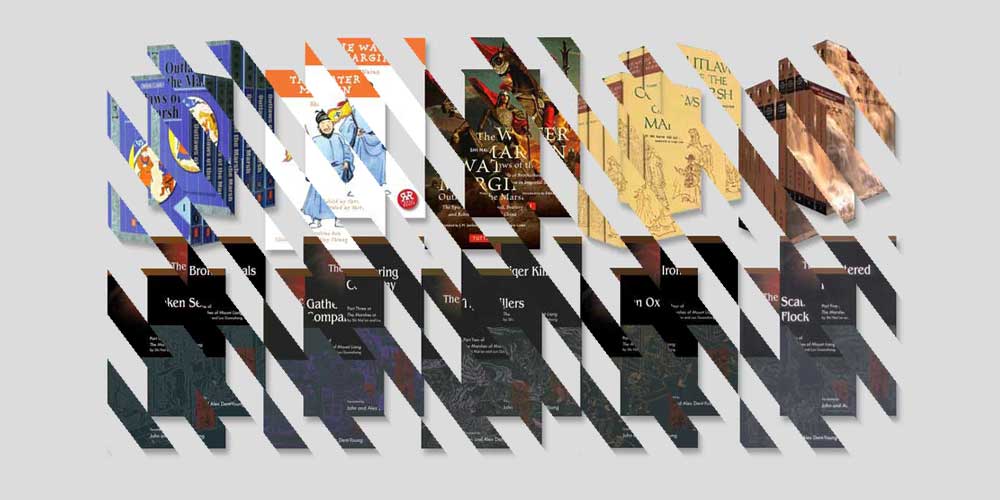
This page is a companion to: What’s the best translation of Water Margin?
Below are extracts from 7 different English translations of Water Margin by Luo Guanzhong and Shi Nai’an, shown in a random fixed order.
Use the side‑by‑side links to choose two translations for comparison in the comparison section further down the page. (If you're on a mobile phone, they won't really be side by side, but they'll be together at the bottom of the list.)
During the reign of Emperor Zhe Zong, who ruled a long time after Ren Zong, in Bianliang the Eastern Capital, in Kaifeng Prefecture previously called Xuanwu District, there lived a young scamp named Gao. A second son, he was quite useless. He cared only for jousting with spear and staff, and was an excellent football player. People in the capital were fond of making quips. They dubbed him Gao Qiu, or “Gao the Ball”. Later, when he prospered, he changed “Qiu” to another character with the same sound but with a less inelegant meaning.
In addition to his skill with weapons, Gao Qiu could play musical instruments and sing and dance. He also learned a bit about poetry and versifying. But when it came to virtue and proper behavior, he didn’t know a thing. He spent his time gadding about the city and its environs. Thanks to him, the son of master Wang, and iron-shop owner, dissipated a considerable sum of money in theaters, gambling dens and brothels.
For this reason the father made a written complaint against Gao to Kaifeng Prefecture. The prefect gave Gao twenty strokes, banished him from the city, and forbade the people of the Eastern Capital from either feeding him or giving him shelter. Gao Qiu’s solution was to proffer his services to one Liu Shiquan, known as Liu the Eldest, who ran a gambling house in Linhuai Prefecture, west of the Huahe River. Liu surrounded himself with idlers and riffraff from all over.
It is said: In the time of the Sung Dynasty in the reign of the Emperor Ché Chung, somewhat distant from the time of the Emperor Jen Chung, there lived in the eastern capital of K’ai Feng Fu, Honan, in P’ien Liang county, an idling, noisy, bragging fellow surnamed Kao, a second son, who from his youth had never established a home. His sole ability was in wielding weapons, in fencing with a staff, and in kicking a ball and at this he was most skillful. People did not call him by his name Kao The Second, but all called him Kao The Ball Kicker, and the name became no longer a nickname but a proper name, Ball Kicker.
This man could blow a wind instrument, could play a stringed instrument, could dance, could shoot, could fence and move swiftly, could play about at anything. He had also learned to compose a little poetry and he could write characters and make such compositions as rhymes and songs. But in the five virtues, in patience, pity, purity, wisdom, reliability, perfection in accomplishing anything, in loyalty and righteousness, he had no ability whatsoever. He went inside and outside the city meddling in people’s affairs. He lived in the house of an official nick-named Raw Iron, and there he helped the official’s son to waste money. Every day they wasted money in small towns and in houses of ill repute such as men call “Wind, Flowers, Snow, Moonlight.”
When the young man’s father, the official, heard of this he accused Kao before the court in the eastern capital and the court ordered Kao beaten twenty strokes and exiled to a distant place. Even the people in the capital did not want Kao sleeping and eating there. Kao was desperate.
Shi Jin followed the road leading to Yanan Prefecture. He ate and drank when hungry and thirsty, he stopped only at night and set out again the next day at dawn. He travelled in this manner, alone, for more than half a month until he arrived in Weizhou.
“This is also a border garrison,” he said to himself. “Maybe my teacher, Instructor Wang, is here.” He entered the town. It was a bustling place, with several streets and market-places. On a street corner he saw a small tea-house. He went in and sat down.
A waiter approached him. “What kind of tea would you like, sir?”
“I’ll have a cup of steeped.”
The waiter brought his order and placed it on the table before him.
“Where is the town’s garrison command?” asked Shi Jin.
“It’s that place just up ahead.”
“Do you know whether they have an arms instructor from the Eastern Capital, a man called Wang Jin?”
“The garrison has many arms instructors. There are three or four named Wang. But I don’t know whether any of them is Wang Jin.”
While the waiter was talking, a big fellow who looked like an army officer strode in. His head was bound in a bandanna with figured swastikas, buckled in the back with twisted gold rings from Taiyuan. A raven-black plaited sash bound his parrot-green warrior’s gown at the waist. On his feet were yellow boots embossed with four welts of brown leather in hawk talon design. He had large cars, a straight nose and a broad mouth. A full beard framed his round face. He was six feet tall and had a girth of ten spans.
Now there was in those days in the Xuanwu district of the Eastern Capital, Bianliang, or Kaifeng as it is now called, a certain profligate son of a ruined family named Gao. He was the second son, and since his youth he had neglected family affairs and devoted himself entirely to the manipulation of sword or staff, and to football, at which he was very skilled. The people of the capital therefore referred to him not in the customary way as Second Brother Gao, but as Gao Qiu or Gao-the-Ball. Later, when he began to get on in the world, he transformed this nickname into Gao-le-Bel. He could play various instruments, wind and string, danced well, and had a good voice. He was an adept at martial arts, with spear or staff, and wrestling. He had some idea of rhyming and calligraphy, and could turn out a song or an ode. But of generosity, virtue, the rites, wisdom, trustworthiness, reliability, loyalty, or excellence he knew absolutely nothing. He spent his days within and without the walls of the capital, pandering to the rich and famous. He had abetted the son of a wealthy man, Mr. Wang, in squandering a fortune: the two of them used to haunt the pleasure gardens, where they were forever in and out of those Houses of the Wind, the Flowers, the Snow, or the Moonlight. After this the father took out a writ against Gao, and the district court sentenced him to twenty lashes and banishment, forbidding any inhabitant of the capital to give him food or shelter. Thus beleaguered, Gao-the-Ball betook himself to Linhuaizhou, west of the River Huai, where he found refuge with the owner of a gaming parlour, one Gentleman Liu, or Liu Shiquan, to give him his proper name. The latter had devoted his life to harbouring and supporting riff-raff, and it was his pleasure to shelter miscreants from the four corners of the empire. Gao-the-Ball came to rest in Gentleman Liu’s abode and lived there three years.
In the Sung dynasty, during the reign of Emperor Che Tsung, there lived in the capital, Kaifeng, a profligate named Kao. He was skilful with both spear and club, and a good football player. Although the second son in the family, he was not called Kao the Second. Instead, he was nicknamed Kao Chiu (High Ball). Later, he adopted the name Chiu.
He was also a good musician on both wood and string instruments, but he had no taste for poetry or literature and could take no part in philosophical discussions. Instead, he wasted away his time in places of pleasure, accompanied by a friend who was the son of a wealthy man. Kao Chiu’s conduct became so bad that eventually a formal complaint against him was lodged with the governor. Kao was arrested, given twenty blows with the bamboo and banished from the capital. At Hwai Hsin in Lin Hwai Chou, he found refuge in a gambling den which was the haunt of scoundrels from near and far. Three years later, in an act of benevolence, the emperor granted a general amnesty. When he learned of this, Kao returned to the capital, with a letter of introduction to a man named Tun Chiang-shih who owned a medicine shop at the Bridge of Golden Girders. However, this man remembered Kao’s bad reputation and was afraid that if he lived with them, he might have a harmful influence on his children. So after about ten days, Tung said to Kao Chiu, “We can’t do much for you here, but I could recommend you to a certain Mr. Su, who might be able to start you on a successful career. What do you say to that?”
During the reign of the Emperor Zhezong of the Song Dynasty there lived at the Eastern Capital Bianliang, in Kaifeng Prefecture, a loose profligate, named Gao.* He could handle well either spear or cudgel, and was an extremely good player at football. He was the second son of a Gao family, but instead of calling him Gao the Second,† people gave him the nickname of Gao Qiu meaning Gao “the Ball.” Later on, however, he adopted another character, also pronounced Qiu.
He could play well on wood or string instruments, but was no good at poetry or literature. If there was a discussion of benevolence, justice, propriety, wisdom, or virtue he was unable to take part. He wasted his time in the company of the son of a wealthy man, and every day these two spent their time in pleasure resorts. His conduct became so bad that at last the wealthy man lodged a complaint before the Prefect who had him arrested, punished with twenty blows of the bamboo, and then banished from the capital.
Gao Qiu went to Huaixi in Linhuai Prefecture where he found refuge in a gambling den, which afforded shelter to all the lazy rascals from all places. Three years after this, however, the Emperor granted an amnesty so as to show his benevolence. Upon hearing of this, Gao Qiu decided to return to the capital, and got an introduction to a man named Dong Jiangshi who kept a drug store at the Jinliang Bridge. Upon reading the letter, this man remembered the bad reputation of Gao Qiu, and was afraid that if he lived at his house he might have an evil influence on his children. So after about ten days Dong spoke to Gao Qiu, “Here we can offer you little help. I will however recommend you to a certain Su the Younger, a scholar, who may assist you in cutting a fine career. What do you think of that?”
During the reign of the emperor Che Tsung of the Sung dynasty there lived at the capital, Kaifeng, a loose profligate, named Kao. He could handle well either spear or cudgel, and was an extremely good player at football. He was the second son of a Kao family, but instead of calling him Kao, the Second, people gave him the nickname of Kao Chiu (High Ball). Later on, however, he adopted a character Chiu (a name only).
He could play well on wood or string instruments, but was no good at poetry or literature. If there was a discussion of benevolence, justice, propriety, wisdom or virtue he was unable to take part. He wasted his time in the company of the son of a wealthy man, and every day these two spent their time in pleasure resorts. His conduct became so bad that at last the wealthy man lodged a complaint before the governor who had him arrested, punished with twenty blows of the bamboo, and then banished from the capital.
Kao Chiu went to Hwai Hsi in Lin Hwai Chou where he found refuge in a gambling den, which afforded shelter to all the lazy rascals from all places. Three years after this, however, the emperor granted an amnesty so as show his benevolence. Upon hearing of this, Kao Chiu decided to return to the capital, and got an introduction to a man named Tung Chiang-shih who kept a drug store at the Golden Girder Bridge. Upon reading the letter, this man remembered the bad reputation of Kao Chiu, and was afraid that if he lived at his house he might have an evil influence on his children. So after about ten days Tung spoke to Kao Chiu, “Here we can offer you little help. I will however recommend you to a certain Mr. Su, who may assist you in cutting a fine career. What do you think of that?”
話說故宋,哲宗皇帝在時,其時去仁宗天子已遠,東京,開封府,汴梁,宣武軍 便有一個浮浪破落戶子弟,姓高,排行第二,自小不成家業,只好刺鎗使棒,最是得 好腳氣毬。京師人口順,不叫高二,卻都叫他做高毬。後來發跡,便將氣毬那字去了 「毛傍」,添作「立人」,改作姓高,名俅。這人吹彈歌舞,刺鎗使棒,相撲頑耍, 亦胡亂學詩書詞賦;若論仁義禮智,信行忠良,卻是不會,只在東京城裏城外幫閒。
因幫了一個生鐵王員外兒子使錢,每日三瓦兩舍,風花雪月,被他父親在開封府 裏告了一紙文狀,府尹把高俅斷了二十脊杖,迭配出界發放,東京城裏人民不許容他 在家宿食。高俅無計奈何,只得來淮西,臨淮州,投奔一個開賭坊的閒漢柳大郎,名 喚柳世權。他平生專好惜客,養閒人,招納四方干隔澇漢子。
[Google translation of this Chinese version:] In the Song Dynasty, during the reign of Emperor Zhezong, long after the reign of Emperor Renzong, there lived a dissolute and impoverished young man named Gao, the second son of a wealthy family, in the capital cities of Kaifeng, Bianliang, and Xuanwu. He was a good-for-nothing from a young age, unambitious and only interested in spear and club fighting, especially polo. The people of the capital, being polite, didn’t call him “Second Gao,” but rather “Gao the Ball.” Later, he rose to prominence, so he removed the “hair” radical from the character for “ball,” added the “person” radical, and changed his surname to Gao and his given name to Qiu. This man was skilled in playing musical instruments, singing, dancing, spear and club fighting, and wrestling, and also dabbled in poetry and prose; however, he knew nothing of benevolence, righteousness, propriety, wisdom, trustworthiness, loyalty, or virtue, and only idled away his time in and around the capital.
Because he had helped the son of a wealthy iron merchant, spending his days indulging in pleasure and extravagance, the son’s father filed a lawsuit against Gao Qiu in Kaifeng Prefecture. The prefect had Gao Qiu flogged twenty times and exiled, forbidding him from staying in the capital. Desperate, Gao Qiu went to Huaixi, near Huaizhou, and sought refuge with a lazy, unemployed man named Liu Shiquan, who ran a gambling den. Liu Shiquan was known for his hospitable nature, hosting idlers and men from all over the country.
Side-by-side comparison
Choose any two translations above; they will appear here side by side.