
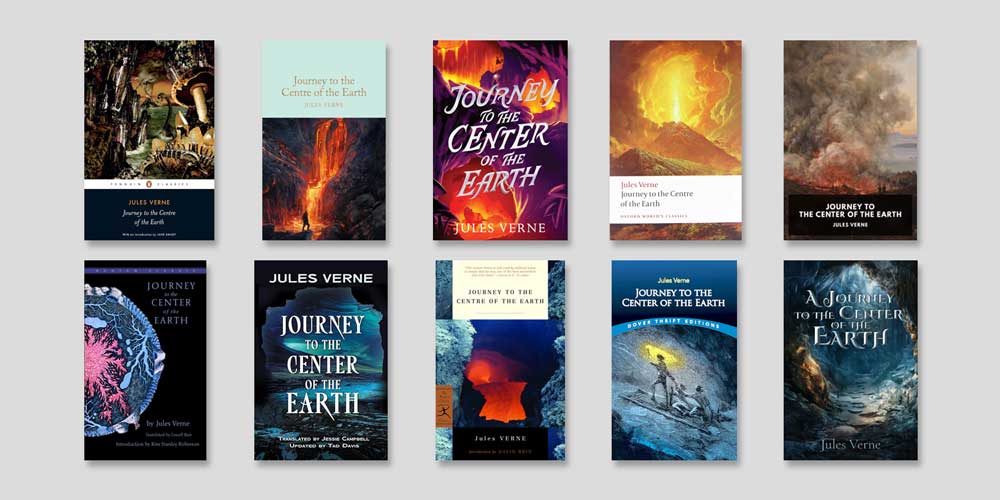
“Which English translation of Journey to the Center of the Earth should I read?”
TL;DR? If you just want a quick-and-dirty recommendation, jump to the conclusion.
Why do people still read Journey to the Center of the Earth?
North American Jules Verne Soceity: “Adapting Jules Verne’s Journey to the Center of the Earth” by Brian Taves
“The steadily growing popularity of Journey to the Center of the Earth on the screen has made it the third most widely read Verne novel after Around the World in Eighty Days and Twenty Thousand Leagues Under the Seas. This suggests that accelerating interest in the novel, continuing enjoyment of the 1959 movie, and the frequency of other film, television, radio, and stage adaptations since then have become mutually reinforcing, each fueling the demand for the other. […] Perhaps part of the novel’s appeal is its premise, transcending science fiction to present an adventure which can never be realized, yet still retains a powerful grip on human curiosity. For it is also a fantasy of the ultimate conquest of nature, traveling through its most hidden recesses to regions that will never be seen. Journey to the Center of the Earth offers the reader and moviegoer not only a prehistoric world, but one entirely of the imagination, a realm conjured by the mind of Jules Verne, and ever more often by the magicians of the screen who have found his idea a source of inspiration.”
From Iceland to the Americas: Vinland and historical imagination: “Journeys to the center of the mind: Iceland in the literary and the professorial imagination” by Seth Lerer
“Verne’s book [Journey to the Centre of the Earth] has long been seen as the inspiration for a range of later fantasies. Echoes of its subterranean adventure have been heard in Tom Sawyer’s wanderings through a Missouri cave. Its paleontological landscape mapped out travels from Arthur Conan Doyle’s Lost World (1912) to Greg Bear’s Dinosaur Summer (1998). Generations of so-called ‘hollow earth’ adventures (from Edgar Rice Burroughs’s At the Earth’s Core of 1914, to the early 2000s television steampunk series Sanctuary) follow Verne’s guidance. Films, comics, video, and digital experiences too numerous to mention here invite the watchers or players to dig deep into the earth’s great past and, in the process, find themselves.”
Bear Manor Media: “Q & A with Rev. Matthew Hardesty On His Jules Verne Anthology [Extraordinary Visions: Stories Inspired by Jules Verne]“
“Whether you first read him as child or as an adult, [Verne’s] imagination is so vivid and creative that it immediately captures your attention. He was also a champion of the beauty and wonder of this world we live in and of mankind’s ingenuity and ability to explore and thrive in it. Much modern science fiction is bleak and dystopian. His fiction is encouraging and awe-inspiring. I think his novels are a breath of fresh air…. There has been a recent renaissance in Vernian scholarship and we are seeing (and producing) much better translations of his original French. These are allowing his works to be taken more seriously and seen as not only children’s adventure tales but worthy of adult interest as well. Jules Verne is a top-5 most translated author in the world, of all time.”
Journey to the Center of the Earth: Translations in English
Three old public-domain texts are still in print, including the notorious Griffith and Farran translation that changed the characters’ names. In addition, there are seven—well, six—modern in-print translations to choose from. (See below to find out which public domain translation was recently reincarnated.)
- 1870 – Anonymous (Henry Vickers)
- 1871 – Anonymous (Griffith and Farran)
- 1874 – Stephen W. White
- 1876 – Frederick Amadeus Malleson
- 1876 – Anonymous (Routledge)
- 1890 – Anonymous (Hutchinson)
- 1925 – Isabel C. Fortey
- 1956 – Willis T. Bradley
- 1961 – IO Evans
- 1965 – Robert Baldick
- 1991 – Lowell Bair
- 1992 – William Butcher
- 2009 – Frank Wynne
- 2010 – FP Walter
- 2013 – Ron Miller
- 2022 – Matthew G. Jonas
- 2024 – Jessie Campbell and Tad Davis
Journey to the Center of the Earth: Title variants
The original title in French was Voyage au centre de la terre. In English, it has been known as:
- A Journey to the Centre of the Earth
- A Journey into the Interior of the Earth
- Journey to the Center of the Earth
- Journey to the Centre of the Earth
Journey to the Center of the Earth: Translation comparison
Extracts have been included wherever possible so that you can compare how the different translations sound.
Journey to the Center of the Earth: Collections, omnibus editions, and other resources
For listings of books or sets of multiple Verne titles, links to Jules Verne sites, and more, jump to Other Info and Resources.
Quick facts about the Anonymous (Vickers) translation of Journey to the Center of the Earth
Title: A Journey to the Centre of the Earth: A Story of Wonderful and Marvellous Adventure
Availability: In the public domain but not reprinted and not available digitally.
Completeness: Likely incomplete.
More about the Anonymous (Vickers) translation of Journey to the Center of the Earth
This was a 12-part monthly serialization in The Boys’ Journal. It included the original illustrations by Édouard Riou. It is likely there are omissions and simplifications because this translation was specifically produced to fit into a specific format and was targeting a young audience, and because early Verne translations were, in general, not very careful.
The Boys’ Journal is published in book form. The 1870 issues containing Journey to the Center of the Earth are Volume 11; other volumes have been digitized and are on Google Books and Hathi Trust (here’s Volume 9), but not Volume 11. (Doh!) I also can’t find any second-hand printed copies for sale.
Science Fiction Studies: “Jules Verne’s English Translations” by Arthur B. Evans
“[A] few words should be said about how these translations were originally published. Why? Because, at least in Verne’s case, how his novels were published often determined what was published. A very shrewd businessman, Verne’s French publisher Pierre-Jules Hetzel had great success in marketing his books to readers both young and old. American and British publishers adopted many of Hetzel’s successful strategies, but they chose to promote Verne’s English translations exclusively to a juvenile audience…. Did the editors of these English-language publishing houses deliberately shorten, simplify, and ‘cleanse’ Verne’s narratives in order to enhance their appeal to this youthful public? Or were the translation manuscripts they received for publication judged to be so unsophisticated in content and tone that only adolescents and pre-adolescents could reasonably be targeted as their potential readers? It is impossible to know. But whatever the sequencing of these events, the outcome was the same: Verne’s works were marketed primarily to British and American boys.”
Quick facts about the Anonymous (Griffith and Farran) translation of Journey to the Center of the Earth
Title: A Journey to the Centre of the Earth
Availability: In the public domain and available online free. Also available in modern reprints.
Completeness: Beware! This “Hardwigg” version is notoriously inaccurate!!!
More about the Anonymous (Griffith and Farran) translation of Journey to the Center of the Earth
Characters’ names were changed: Professor Otto Lidenbrock is called “Professor Von Hardwigg” in this version; Axel is called “Harry Lawson” or “Henry Lawson”, and Gräuben is called “Gretchen”.
Scientific content and detailed descriptions were omitted, changes were made for political/nationalistic reasons, and a completely new incident was added in which “Harry” fights two monsters (!!!).
Science Fiction Studies: “Jules Verne’s English Translations” by Arthur B. Evans
“Another charter member of the Jules Verne Translation Hall of Infamy is the ‘Hardwigg’ edition of Journey to the Centre of the Earth published by Griffith and Farran in 1871. Sadly, this atrocious translation was the first English version to be published of this popular Verne novel. Even more sadly, it is still sometimes published today as the ‘standard’ version…. [T]he authorial hubris of this anonymous translator rivaled that of Edward Roth. Not content to rewrite Verne’s original story line by line and paragraph by paragraph, he too added to the novel entire plot episodes of his own invention. The most incredible of these occurs late in the novel: young Harry’s nightmare encounter with two ferocious prehistoric monsters—a hybrid shark-crocodile and a carnivorous ‘antediluvian gorilla’ fourteen feet high ([New York: Tor, 1992] 226-29). The chapter that features these events is itself retitled and is now called ‘The Ape Gigans.’ […] In the first chapter, a close reading reveals that certain ‘ideological adjustments’ have been made to Verne’s narrative.”
North American Jules Verne Society: “Journey to the Centre of the Earth: A Word on Translations” by Arthur B. Evans”
“Beware of a bogus translation! Jules Verne’s novel Journey to the Center of the Earth, written and published in French in 1864 (a somewhat expanded, definitive edition appeared in 1867), was first translated into English in 1871 and published in London. The identity of the translator is not known, but the quality of the work was poor in every way. It changed the names and nationalities of Verne’s characters (Lidenbrock became Hardwigg, Axel became Harry, etc.), it ‘dumbed down’ the story by chopping out most of the science, and it added melodramatic episodes to the plot that did not exist in the original.”
“Journey Without End: On Translating Verne” by William Butcher
“[The translator had a] regular tendency to insert at least one invented sentence at the end of each paragraph. Thus extraneous growths appear like ‘This day, as on other Sundays, we observed as a day of rest and pious meditation.’ or ‘The whole state in which we existed was a mystery—and it was impossible to know whether or not I was in earnest.’ The opening paragraphs of the book are in fact an authentic Hardwiggian tumour from beginning to end.”
Below, you can see for yourself the many obvious differences within the first 300 words.
Extract from the Anonymous (Griffith and Farran) translation of Journey to the Center of the Earth
First ~300 words of Chapter 1 (from Project Gutenberg):
Looking back to all that has occurred to me since that eventful day, I am scarcely able to believe in the reality of my adventures. They were truly so wonderful that even now I am bewildered when I think of them.
My uncle was a German, having married my mother’s sister, an Englishwoman. Being very much attached to his fatherless nephew, he invited me to study under him in his home in the fatherland. This home was in a large town, and my uncle a professor of philosophy, chemistry, geology, mineralogy, and many other ologies.
One day, after passing some hours in the laboratory—my uncle being absent at the time—I suddenly felt the necessity of renovating the tissues—i.e., I was hungry, and was about to rouse up our old French cook, when my uncle, Professor Von Hardwigg, suddenly opened the street door, and came rushing upstairs.
Now Professor Hardwigg, my worthy uncle, is by no means a bad sort of man; he is, however, choleric and original. To bear with him means to obey; and scarcely had his heavy feet resounded within our joint domicile than he shouted for me to attend upon him.
“Harry—Harry—Harry—”
I hastened to obey, but before I could reach his room, jumping three steps at a time, he was stamping his right foot upon the landing.
“Harry!” he cried, in a frantic tone, “are you coming up?”
Now to tell the truth, at that moment I was far more interested in the question as to what was to constitute our dinner than in any problem of science; to me soup was more interesting than soda, an omelette more tempting than arithmetic, and an artichoke of ten times more value than any amount of asbestos.
But my uncle was not a man to be kept waiting; so adjourning therefore all minor questions, I presented myself before him.

Get the Signet Anonymous (Griffith and Farran) translation of A Journey to the Centre of the Earth
Introduction by Bear Grylls, afterword by Leonard Nimoy. Ebook also available (ISBN 9781101127100).
Available as a mass-market paperback (ISBN 9780451532152, 320 pages).
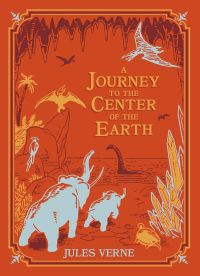
Get the Barnes and Noble Anonymous (Griffith and Farran) translation of A Journey to the Centre of the Earth
Available as a bonded leather hardcover (ISBN 9781435144736, 384 pages).
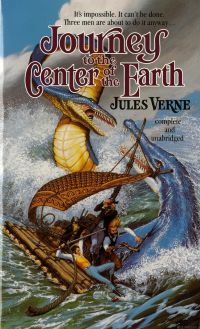

Get the Tor Anonymous (Griffith and Farran) translation of A Journey to the Centre of the Earth
Available as an ebook (ISBN 9781466803541).

Get the Project Gutenberg Anonymous (Griffith and Farran) translation of A Journey to the Centre of the Earth
Free!
Available as an ebook.
Who was Stephen W. White?
According to Wikipedia, Stephen William White was an American who worked for railway companies in Pennsylvania, and today is best known for his translation of Around the World in Eighty Days.
His other Jules Verne translations were: A Fancy of Doctor Ox; The Tour of the World in Eighty Days; A Winter’s Sojourn in the Ice; The Mysterious Island. His translations were serialized in the Philadelphia Evening Telegraph before being reprinted in book form.
“Victorian Translators: Stephen W. White and William Struthers Revealed” by Normal Wolcott and Kieran O’Driscoll
White’s translations are characterized by “. . .his ‘problem-solving’ approach to translating Verne, his straight-forward language transfer of Verne’s French without the creative, literary, and non-imitative embellishments of other translators such as Desages, Towle, or Glencross.” From a biography in the Pennsylvania Railroad History: “His writings are all clean and terse, displaying careful study and methodical arrangement, resultants of his early training in stenography, in which science he is not only an expert but an accomplished devotee.” Wolcott and O’Driscoll conclude from their biographical discoveries that White, like other Verne translators, “entered the translation business out of financial necessity.” According to his educational background at an unusual high school: “Clearly not a hack writer, he was a literate product of the American public schools capable of comparison and perhaps superior to many of the translators employed by Sampson Low in England. His training in phonography [shorthand] gave him an excellent ear for languages, supplementing his academic achievements.”
Quick facts about the White translation of Journey to the Center of the Earth
Title: A Journey to the Centre of the Earth
Availability: In the public domain. Out of print and not available digitally or second-hand.
Completeness: Probably slightly cut due to serialization, but still better than Griffith and Farran!
More about the White translation of Journey to the Center of the Earth
This was the first American translation of the novel. Now, it is seemingly not available in any modern reprints or anywhere online, except partially at an archive on ibiblio.
Verne scholar Kieran O’Driscoll has analyzed and praised White’s translation of Around the World in Eighty Days, but there does not seem to be any similar analysis of his translation of Journey.
Extract from the White translation of Journey to the Center of the Earth
First ~300 words of Chapter 1 (from an archive on ibiblio):
One Sunday, the 24th of May, 1863, my uncle, Professor Lidenbrock, returned hurriedly to his little house, No. 19 Königstrasse, one of the oldest streets of the old quarter of Hamburg.
The good, Martha thought that she was very much behind time, for the dinner was scarcely commencing to sing on the kitchen stove.
“Good,” said I to myself, “if my uncle is hungry, and he is the most impatient of men, he will soon let you hear from him.”
“M. Lidenbrock is already here,” cried the good Martha, stupefied, half opening the door of the dining‑room.
“Yes, Martha; but the dinner ought not to be done yet, for it is not 2 o’clock. The half hour has scarcely ceased striking at Saint Michael’s.”
“Then, why does M. Lidenbrock return?’
“He will probably tell us.”
“Here he is! I save myself. Monsieur Axel, you make him listen to reason.”
And the good Martha re‑entered her culinary laboratory.
I remained alone. But my somewhat undecided character did not allow me to make the most irascible of professors listen is reason. So I prepared prudently to return to my little room upstairs, when the street door swung noisily upon its hinges; heavy steps made the wooden staircase creak, and the master of the house, crossing the dining-room, rushed immediately into his cabinet.
But, during this rapid passage, he had thrown into a corner his heavy‑headed cane, and on the table his large, rough fur hat, and said to his nephew these terrible words: —
“Axel, follow me!”
I had not had time to budge when the Professor cried to me, already in a sharp, impatient accent: ‑–
“Well! aren’t you here yet?”
I rushed into the cabinet of my dreaded master.
Who was Frederick Amadeus Malleson?
Frederick Amadeus Malleson was a British clergyman and translator of works from French to English, primarily religious works.
He may have translated other Verne novels for the same publisher. He is credited with a translation of Verne’s Five Weeks in a Balloon, but Verne scholar Norman Wolcott doubts this attribution for reasons of style.
Quick facts about the Malleson translation of Journey to the Center of the Earth
Title: A Journey into the Interior of the Earth
Availability: In the public domain and available free online, also available in modern reprints.
Completeness: Good for its time, not comparable to modern translations in terms of accuracy.
More about the Malleson translation of Journey to the Center of the Earth
The translation was produced for publisher Ward, Lock, and Tyler, a publisher in the UK, which was not authorized to produce Verne translations.
There is quite a nice digital version online at Archive.org.
“The Victorian Translators of Verne: Mercier to Metcalfe” by Norman Wolcott
“As with other clergymen, Malleson avoided his own name in publishing these non-religious books, signing only the preface with ‘F.A.M.’ […] His translation of Interior of the Earth is careful and accurate; he indicated such was his desire in the preface. Changes for religious reasons are only a few lines where Verne discusses the ‘creation’.”
Words: Journey to the Center of the Earth: Redactor’s Note
“This version is believed to be the most faithful rendition into English of this classic currently in the public domain…. While the translation is fairly literal, and Malleson (a clergyman) has taken pains with the scientific portions of the work and added the chapter headings, he has made some unfortunate emendations mainly concerning biblical references, and has added a few ‘improvements’ of his own [which] have kindly been pointed out by Christian Sánchez of the Jules Verne Forum.”
Extract from the Malleson translation of Journey to the Center of the Earth
First ~300 words of Chapter 1 (from Standard Ebooks):
On the 24th of May, 1863, my uncle, Professor Liedenbrock, rushed into his little house, No. 19 Königstrasse, one of the oldest streets in the oldest portion of the city of Hamburg.
Martha must have concluded that she was very much behindhand, for the dinner had only just been put into the oven.
“Well, now,” said I to myself, “if that most impatient of men is hungry, what a disturbance he will make!”
“M. Liedenbrock so soon!” cried poor Martha in great alarm, half opening the dining-room door.
“Yes, Martha; but very likely the dinner is not half cooked, for it is not two yet. Saint Michael’s clock has only just struck half-past one.”
“Then why has the master come home so soon?”
“Perhaps he will tell us that himself.”
“Here he is, Monsieur Axel; I will run and hide myself while you argue with him.”
And Martha retreated in safety into her own dominions.
I was left alone. But how was it possible for a man of my undecided turn of mind to argue successfully with so irascible a person as the Professor? With this persuasion I was hurrying away to my own little retreat upstairs, when the street door creaked upon its hinges; heavy feet made the whole flight of stairs to shake; and the master of the house, passing rapidly through the dining-room, threw himself in haste into his own sanctum.
But on his rapid way he had found time to fling his hazel stick into a corner, his rough broadbrim upon the table, and these few emphatic words at his nephew:
“Axel, follow me!”
I had scarcely had time to move when the Professor was again shouting after me:
“What! Have you not come yet?”
And I rushed into my redoubtable master’s study.
Get the Sky Publishing Malleson translation of A Journey into the Interior of the Earth
Includes old illustrations by Riou. Includes a quiz at the end. Paperback (ISBN 978-9916732779) and ebook (ISBN 978-9916732786) also available.
Available as a hardcover (ISBN 9789916732762, 212 pages).

Get the AmazonClassics Malleson translation of A Journey into the Interior of the Earth
Paperback also available (ISBN 9781542099370).
Available as an ebook (ISBN 9781542099370).
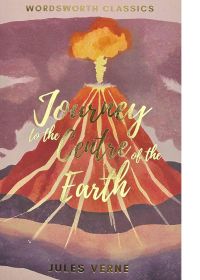
Get the Wordsworth Classics Malleson translation of A Journey into the Interior of the Earth
With an introduction by David Stuart Davies.
Available as a paperback (ISBN 9781853262876, 192 pages).

Get the Standard Ebooks Malleson translation of A Journey into the Interior of the Earth
Free!
Available as an ebook.
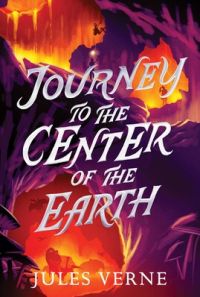
Get the Aladdin Malleson translation of A Journey into the Interior of the Earth
Hardcover (ISBN 9781665934190) and ebook (ISBN 9781665934206) also available.
Available as a paperback (ISBN 9781665934183, 368 pages).

Get the Macmillan Collector's Library Malleson translation of A Journey into the Interior of the Earth
Afterword by Ned Halley.
Available as a hardcover (ISBN 9781509827886, 328 pages).
Who was Jessie Campbell?
Jessie Cook Campbell was a translator and adapter of French and German works for Routledge and at least one other publisher. She may also have been a governess. Her work was often anonymous, but was sometimes signed as “Crichton Campbell”, “Crichton” being her mother’s maiden name. This signature, and Routledge’s records, enabled Alex Kirstukas to identify her. The results of his investigation were published in 2022.
Victorian Popular Fictions Journal: “Jules Verne’s Routledge Translators” by Alex Kirstukas
“This article… presents newly located biographical details on Frith, Linklater, and a previously unidentified third translator, Jessie Campbell; and it offers a comparative critical appraisal of the techniques and styles of the translators, with particular focus on Campbell, now recognisable as one of the numerous freelancing women writers who first brought Verne into English…. [Campbell] survived a dogmatical upbringing, a nearly fatal illness, and a precarious financial situation to produce work still read, discussed, and reprinted a full century and a half later.”
Quick facts about the Anonymous (Routledge) translation of Journey to the Center of the Earth
Title: A Journey to the Centre of the Earth
Availability: In the public domain and available in modern reprints, but not available digitally for free.
Completeness: Good for its time, but not as good as modern retranslations.
More about the Anonymous (Routledge) translation of Journey to the Center of the Earth
Routledge, a publisher in the UK, was not authorized to produce Verne translations.
Verne scholar Arthur B. Evans calls the introduction by Kim Stanley Robinson in the 2006 Bantam edition “excellent”.
Amazon: review of Dover Thrift edition by Norman M. Wolcott
“This Dover Thrift edition (1995) of ‘Journey to the Centre of the Earth’ published by Routledge in 1876 is one of the three translations which are faithful to the Verne original. Although an anonymous translation, it may have been made by Henry Frith who translated other Verne books for Routledge.”
Victorian Popular Fictions Journal: “Jules Verne’s Routledge Translators” by Alex Kirstukas
“[W]hile Campbell does some descriptive passages injustice, her ear for dialogue is remarkable…. Campbell’s dialogue also shows an appreciation for Verne’s allusions and citations – the stylistic aspect now recognised as intertextuality…. Campbell’s omissions are generally limited to minor details, with some larger cuts, up to a paragraph or two, occurring mostly when the surrounding text shows signs of being translated hurriedly.”
Amazon: “Early translations of historical interest” by F.P. Walter
“In fact I prefer Routledge’s edition of JOURNEY (1876) to any of its Victorian rivals – it’s respectful, good-humored, essentially complete, and doesn’t embroider like its 1877 competitor from Ward, Lock. Of course its language is quaint, and there are a few blunders (those ‘3,000 square miles’ on p. 153), yet it does the work real justice.”
Extract from the Anonymous (Routledge) translation of Journey to the Center of the Earth
First ~300 words of Chapter 1 (preview Dover Thrift Edition on Google Books):
It was on Sunday, the 24th of May, 1863, that my uncle, Professor Lidenbrock, came rushing suddenly back to his little house in the old part of Hamburg, No. 19, Königstrasse.
Our good Martha could not but think she was very much behind- hand with the dinner, for the pot was scarcely beginning to simmer, and I said to myself:
“Now, then, we’ll have a fine outcry if my uncle is hungry, for he is the most impatient of mortals.”
“Mr. Lidenbrock, already!” cried the poor woman, in dismay, half opening the dining-room door.
“Yes, Martha; but of course dinner can’t be ready yet, for it is not two o’clock. It has only just struck the half-hour by St. Michael’s.”
“What brings Mr. Lidenbrock home, then?”
“He’ll probably tell us that himself.”
“Here he comes. I’ll be off, Mr. Axel; you must make him listen to reason.”
And forthwith she effected a safe retreat to her culinary laboratory.
I was left alone, but not feeling equal to the task of making the most irascible of professors listen to reason, was about to escape to my own little room upstairs, when the street-door creaked on its hinges, and the wooden stairs cracked beneath a hurried tread, and the master of the house came in and bolted across the dining-room, straight into his study. But, rapid as his flight was, he managed to fling his nutcracker-headed stick into a corner, and his wide-brimmed rough hat on the table, and to shout out to his nephew:
“Axel, follow me.”
Before I had time to stir he called out again, in the most impatient tone imaginable:
“What! Not here yet?”
In an instant I was on my feet and in the study of my dreadful master.
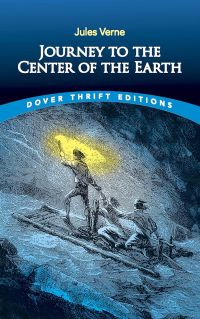
Get the Dover Anonymous (Routledge) translation of A Journey to the Centre of the Earth
Includes a 1.5-page introductory note. "Reprint of an anonymous English translation as published by George Routledge and Sons, London, 1876." Ebook also available (ISBN 9780486111612).
Available as a paperback (ISBN 9780486440880, 160 pages).
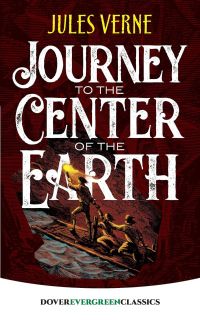
Get the Dover Children's Evergreen Anonymous (Routledge) translation of A Journey to the Centre of the Earth
"This Dover edition, first published in 2018, is an unabridged republication of the work originally published in 1876 by George Routledge and Sons, London and New York." Ebook also available (ISBN 9780486830308).
Available as a paperback (ISBN 9780486822495, 272 pages).
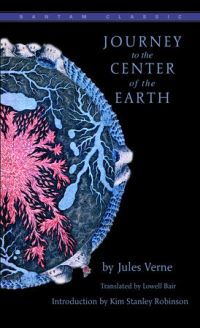
Get the Bantam Anonymous (Routledge) translation of A Journey to the Centre of the Earth
It says Bair, but according to "A Note on the Text" in the current edition, it isn't, it's the 1876 Routledge translation. Introduction by Kim Stanley Robinson. Ebook also available (ISBN 9780553902549).
Available as a mass-market paperback (ISBN 9780553213973, 240 pages).
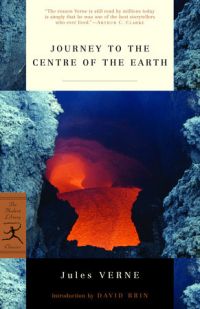
Get the Modern Library Anonymous (Routledge) translation of A Journey to the Centre of the Earth
Introduction by David Brin. Ebook also available (ISBN 9781588363954).
Available as a paperback (ISBN 9780812970098, 224 pages).
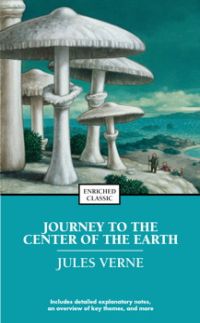
Get the Enriched Classics Anonymous (Routledge) translation of A Journey to the Centre of the Earth
Ebook also available (ISBN 9781416596882).
Available as a mass-market paperback (ISBN 9781416561460, 352 pages).
Quick facts about the Anonymous (Hutchinson) translation of Journey to the Center of the Earth
Title: A Journey to the Centre of the Earth
Availability: In the public domain but out of print and hard to find.
Completeness: Okay? (I haven’t seen any deep analysis.)
More about the Anonymous (Hutchinson) translation of Journey to the Center of the Earth
Hutchinson, a publisher in the UK, was not authorized to produce Verne translations.
Hutchinson published Journey to the Centre of the Earth in one volume together with another Verne novel, Five Weeks in a Balloon. Some editions used a slightly different title: Voyage to the Centre of the Earth. If you’re a collector, you’ll be interested in Andrew Nash’s pages on Journey and Verne sets, which has a lot more details.
I found some bookseller listings on Abebooks, eBay, and around the web, but none of them happened to take a photo of the first page of Chapter 1, and I couldn’t find any online transcripts or scans of the Hutchinson edition, and I don’t think there are any modern reprints.
Extract from the Anonymous (Hutchinson) translation of Journey to the Center of the Earth
First two sentences (from the bibliography by Arthur B. Evans):
On Sunday, the 24th of May, 1863, my uncle, Professor Lidenbrock, returned to his little dwelling, No. 19 in the Königstrasse, one of the oldest streets in the most ancient part of Hamburg. Martha, the housekeeper, must have fancied she was very much behind her usual time, for she had only just begun to cook the dinner.
Who was Isabel C. Fortey?
Information is lacking. She also wrote an abridged adaptation of Victor Hugo’s Les Miserables.
Quick facts about the Fortey translation of Journey to the Center of the Earth
Title: A Journey to the Centre of the Earth
Availability: In the public domain, but out of print. Scans are available.
Completeness: Unknown. I haven’t seen any deep analysis.
More about the Fortey translation of Journey to the Center of the Earth
This translation was originally made for London publisher Blackie & Son in 1925 for the “Blackie’s Famous Books” series. It has been reprinted repeatedly (with a stunning variety of generally garish covers) but does not seem to be in print now. You may be able to find a second-hand copy.
Extract from the Fortey translation of Journey to the Center of the Earth
First ~300 words of Chapter 1 (from a copy at archive.org):
On the 24th of May, 1863, which was a Sunday, my uncle Professor Lidenbrock came hastily back to his little house, 19 Königstrasse. This is one of the oldest streets in the ancient quarter of Hamburg.
Our good Martha thought she must be behind with the dinner, for it was only just beginning to sizzle in the oven.
“Well,” I said to myself, “if my uncle is hungry he will cry out, for he is the most impatient of men.”
“Mr. Lidenbrock here already!” cried the astounded Martha, looking in at the dining-room.
“Yes, Martha; but it’s not time for dinner—it’s not two o’clock yet. The half-hour has only just struck at St. Michael’s.”
“Then why is Mr. Lindenbrock coming in?”
“He will probably tell us why.”
“Here he is! I’m off. Mr. Axel, you will get him to be sensible.”
And our good Martha went back to her culinary laboratory.
I stayed behind. But as to getting the most irascible of professors to be sensible, that was not a task suited to my rather undecided character. So I was meditating a prudent retreat to my little room in the attics, when the street door groaned on its hinges, heavy footsteps made the stairs creak, and the master of the house, passing through the dining-room, rushed hastily into his study.
But as he passed, he threw into a corner his stick with the nut-cracker head, on the table his broad hat, and at his nephew these emphatic words:
“Axel, follow me!”
Before I had time to move, the Professor shouted again in uncontrollable impatience:
“Well, you haven’t come yet!”
I flew to the study of my formidable master.
Who was Willis T. Bradley?
According to Walter James Miller, Willis T. Bradley was “a Massachusetts academic” who was dissatisfied with existing translations. He also translated two Verne short stories, “The Ordeal of Dr. Trifulgas” (original title “Frritt Flacc”) and “The Eternal Adam”.
Quick facts about the Bradley translation of Journey to the Center of the Earth
Title: Journey to the Center of the Earth
Availability: Under copyright but out of print. There are a ton of second-hand copies, though!
Completeness: Unknown. I haven’t seen any deep analysis.
More about the Bradley translation of Journey to the Center of the Earth
This translation was published in hardcover by A.A. Wynn in 1956 and reprinted in paperback by Ace.
Extract from the Bradley translation of Journey to the Center of the Earth
First ~300 words of Chapter 1:
On Sunday afternoon, May 24, 1863, I watched my Uncle Otto returning in haste along the Königstrasse, one of the oldest streets in the old quarter of Hamburg, toward his little house at Number 19.
Poor Martha, our housekeeper, was going to be caught unprepared. The kettle on the kitchen stove was only just beginning to sing.
“Here comes trouble,” I called out, for my uncle was the most impatient man in the world. “If Uncle is hungry, he will raise the roof.”
“Herr Lidenbrock already!” exclaimed Martha in dismay, half opening the dining-room door.
“Yes, Martha. But it’s not your fault if dinner isn’t ready. It’s not two o’clock. The half hour has scarcely rung at Saint Michael’s.”
“Then why is the professor coming back?”
“He will probably tell us.”
“Here he is I’ll keep out of his way. Herr Axel, do make him listen to reason.”
And Martha retreated to what my uncle called her culinary laboratory.
I must face him alone, then. But to make the most irascible of professors listen to reason was something my rather irresolute nature would never permit. So I, too, was about to retreat prudently to my little room upstairs, when the street door creaked on its hinges. Heavy feet stamped up the wooden treads, and the master of the house rushed through the dining room and flung himself into his study.
But during his rapid transit he had tossed into a corner his walking stick with Punchinello for a knob, onto the table his great felt hat, and at his nephew these familiar words:
“Axel, come with me!”
Then, before I could make a move, the professor shouted with a strong note of impatience:
“Well! What’s keeping you?”
I shot into my redoubtable master’s study.
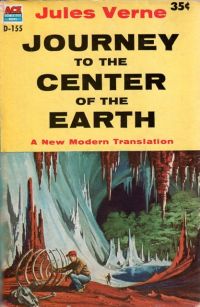
Get the Ace Bradley translation of Journey to the Center of the Earth
Out of print.
Available as a mass-market paperback (ISBN 9780441043972, 256 pages).
Who was IO Evans?
Idrisyn Oliver Evans was a British-South African editor, author, and translator who worked on many of Verne’s writings. He was a fellow of the Royal Geographical Society.
» More about I.O. Evans at SF Encyclopedia
» More about I.O. Evans at Verniana.org
» More about I.O. Evans at JulesVerne.ca
Quick facts about the Evans translation of Journey to the Center of the Earth
Title: Journey to the Centre of the Earth
Availability: Under copyright and out of print.
Completeness: Likely abridged.
More about the Evans translation of Journey to the Center of the Earth
Current opinions about I.O. Evans are mixed: He loved Verne and helped make available and popularize his works, and is thus an influential and respected figure; but many of his versions are abridged and/or edited in ways no longer considered best practice among Verne scholars.
There were dozens of books in the Fitzroy series the Evans helped to publish, and though the general strategy seems to be to make the works more accessible (and sometimes fit them into a predetermined length), the exact approach for different books varied. Sometimes Evans edited existing English translations down (with little if any reference to the original French versions), though this also entailed rewriting, while in other cases he translated the works from French himself.
In the case of the Evans/Fitzroy edition Journey to the Centre of the Earth, it seems to be the case that Evans translated it from French himself, according to Brian Taves’ article (see below), which refers to the translation as a new one.
Verniana: “Verne’s Best Friend and his Worst Enemy: I.O. Evans and the Fitzroy Edition of Jules Verne” by Brian Taves
Regarding Evans and Journey to the Centre of the Earth: “The only library within reach [of I.O. Evans during his childhood] was that of the village church’s Sunday school, from which two volumes, one sacred, another secular, could be borrowed each week; A Journey to the Centre of the Earth seemed to have found its way there by accident. ‘I borrowed it whenever it was available, read and re-read it, and almost got it by heart.’ […] He later became a member of several geological societies, and this gave him a special qualification when he had the occasion to translate Journey to the Centre of the Earth himself in 1961…. Given Evans’s long-standing interest in Journey to the Centre of the Earth, as well as his fascination with geology and spelunking, his new translation in 1961 was inevitable (although the book had been translated anew already in 1956, by Willis T. Bradley). It became only the second Fitzroy volume to exceed the standard 190 pages.”
Verniana: “Verne’s Best Friend and his Worst Enemy: I.O. Evans and the Fitzroy Edition of Jules Verne” by Brian Taves
Regarding Evans’ translations in general: “Evans recalled, ‘We naturally expected the task to be fairly simple, needing only omissions and corrections of printer’s errors and so forth. I soon learned our mistake: many of the existing versions—by no means all—were in such stilted language that they had to be largely rewritten. There were occasional gross errors in translation, and sometimes the translator had got so bogged down in the technical detail that it was impossible to see what he meant.’ Commencing with modified versions, Evans sometimes repeated them largely intact, but other times changed them so substantially that they are almost his own originals. From the evidence of retaining the translator’s changes in character names in such novels as The Mysterious Island and The Begum’s Fortune, he does not seem to have necessarily examined the English texts against the French. His view, as noted in Jules Verne: Master of Science Fiction, was that, ‘I have adhered to the original translations, for the form in which Verne reached the English speaking world is part of his literary history.’ Hence, the Fitzroy edition sought to reconcile the fundamentally inconsistent goals of perpetuating the liberties of past translations, while also attempting to make them more acceptable to a new generation. Beyond simply republishing older editions, once the Fitzroy series began to appear from Arco, Evans offered translations of books not previously in English. His original translations were in a more modern, readable, reasonably faithful style.”
The European Conservative: “Extraordinary Voyager: Jules Verne Endures” by Alberto M. Fernandez
“Evans, who was certainly aware of the poor translations of the late 19th and early 20th century, carried out his own heavy-handed editing of Verne’s work in order to meet the demands of the marketplace and to satisfy his own personal preferences. Although the Fitzroy Editions were intended to offer new versions— and in some cases, works were translated for the first time—they were also described as ‘modernized for uniform presentation.’ In practice, this meant that the publishing formula required each volume to be less than 200 pages long. Evans did whatever he needed to cut them down to size, rewriting, or even dropping chapters as needed…. Evans sometimes used old and inferior translations, sometimes used better ones, and sometimes even did the translations himself. His national pride led him to remove portions of the texts that seemed anti-British. Nevertheless, his chief priority was to make Verne more accessible to the modern public. He explained later that his new versions of Verne had been ‘stripped of their excessively long passages’ and that ‘long passages of geographical information, many of which are outdated’ had been deleted.”
Jules Verne’s English translations” by Arthur B. Evans
“I.O. Evans often abridged Verne’s texts and made other changes to ‘adapt’ them to an anglophone audience. In an essay published in the Bulletin de la Société Jules Verne in 1968, he defended himself, saying:
I have been chided for not publishing an unabridged version of Verne’s work and for having, in fact, subjected it to editorial cuts that were too extensive. I will only say that, if I had published it in its entirety, I would have risked discouraging the reader. Even during Verne’s time, certain parts of his narratives must have been considered off-putting. And the contemporary public, partly as a result of radio and television, no longer has the patience to assimilate long passages of geographical information, many of which are outdated.
Instead, I tried to remain faithful to the spirit of Verne, presenting him in a manner that would please today’s readers. And the fact that these corrected versions now number 60 volumes shows that I was not mistaken. Stripped of their excessively long passages, Verne’s stories take on a new life. They are more interesting than one might imagine, compared to their originals.
Jules Verne believed strongly in Providence, and I think that he himself would judge that I have been guided in my work by Providential inspiration.
Although the purist might view the ‘Fitzroy’ editions as a betrayal of Verne’s original texts, it must not be forgotten that an entire generation of Anglo-American readers have discovered Jules Verne through these popular editions-readers who probably would not have otherwise become familiar with Verne’s oeuvre.”
Extract from the Evans translation of Journey to the Center of the Earth
First ~300 words of Chapter 1 (from an Associated Press hardcover):
On Sunday, 24th May, 1863, my uncle, Professor Lidenbrock, hurried back to his little house, number 19 in the Königstrasse, one of the oldest streets in the Old Quarter of Hamburg.
Our servant, Marthe, must have thought she was very late, for dinner was hardly beginning to sizzle on the kitchen stove.
“That’s good,” I thought to myself; “Uncle is the least patient of men, and if he’s hungry he’ll howl with anguish.”
“Herr Lidenbrock already!” exclaimed Marthe in amazement, as she opened the dining-room door.
“Yes, Marthe; but he can’t expect dinner to be ready yet, for it isn’t two o’clock. It’s hardly struck half past one at St. Michael’s.”
“Then why is Herr Lidenbrock coming back ?”
“I expect he’ll tell us.”
“There he is, I must fly! Herr Axel, you must make him see reason.”
And Marthe went off to her culinary laboratory.
I was left alone. But to make the most irascible of professors see reason, that was just what my somewhat irresolute character wouldn’t let me do. I was getting ready to go back to my little room on the top floor when I heard the street-door creaking on its hinges; heavy footsteps resounded on the wooden stair, and after crossing the dining-room the master of the house hurled himself into his study.
But even as he entered he threw into a corner his walking- stick with the nut-cracker head, on to the table his broad-rimmed hat with its fur brushed the wrong way, and to his nephew these resounding words: “Axel, follow me!”
I hadn’t had time to move before the Professor was shouting impatiently: “What, aren’t you here yet?”
I dashed into the study of my formidable master.
Who was Robert Baldick?
Robert André Edouard Baldick was a British writer, translator, and professor of French language and literature at Oxford. He was also an editor of the Penguin Classics series. He was bilingual. He translated works by Diderot and Flaubert as well as Verne. He produced an acclaimed book on the French author Huysmans. He died in his forties in 1972.
Kieran O’Driscoll (on pages 139-163), highlights his accomplishments as a “gifted”, “outstanding,” “prolific”, and “influential” scholar of French literature with a “lifelong affinity with France, its culture, and above all its literature of the nineteenth century” who increased the prestige of literary translation.
“Obituary: Dr Robert Baldick, a versatile scholar of French literature.” The Times. April 25, 1972.
Subscription required. (Sorry, I can’t read it either.)
Translating Great Russian Literature: The Penguin Russian Classics by Cathy McAteer (page 122)
“In addition to scholarly rigour, Baldick is also remembered for bringing a professional awareness of the translator’s worth to Penguin Books. His obituary in the Times described him as making sure that translators were paid a proper fee for what is a specialist job (25 April 1972).”
Quick facts about the Baldick translation of Journey to the Center of the Earth
Title: Journey to the Center of the Earth
Availability: In print.
Completeness: Complete!
More about the Baldick translation of Journey to the Center of the Earth
Verne scholar Arthur B. Evans calls this translation “fine”.
Science Fiction Studies: “Superb Jules Verne Translations” by Arthur B. Evans
Evans calls Baldick’s translation the best until William Butcher’s translation was published.
“Journey Without End: On Translating Verne” by William Butcher
“[W]ith the honourable exception of Baldick’s Penguin version (1965), most ‘translations’ of JCE bear unmistakeable signs of haste, disrespect, and plain ignorance…. Verne describes Iceland as 90 miles away from Greenland, and its area as 14,000 square miles; and makes the polyglot Lidenbrock seem slightly incompetent in Italian. Baldick tinkers with some of Verne’s mistakes, but for some reason maintains these three. He also introduces a few mysteries of his own…. But Baldick should be commended for a generally fluent translation.”
Extract from the Baldick translation of Journey to the Center of the Earth
First ~300 words of Chapter 1 (from a copy of the 2008 Puffin edition, ISBN 9780141321042):
On 24 May 1863, which was a Sunday, my uncle, Professor Lidenbrock, came rushing back towards his little house, No. 19 Königstrasse, one of the oldest streets in the old quarter of Hamburg.
Martha must have thought she was very behindhand, for the dinner was only just beginning to sizzle on the kitchen stove.
‘Well,’ I said to myself, ‘if my uncle is hungry he’ll make a dreadful fuss, for he’s the most impatient of men.’
‘Professor Lidenbrock here already!’ cried poor Martha in astonishment, half opening the dining-room door.
‘Yes, Martha; but don’t worry if the dinner isn’t cooked, because it isn’t two o’clock yet. St Michael’s clock has only just struck half past one.’
‘Then why is Professor Lidenbrock coming home?’
‘He’ll probably tell us himself.’
‘Here he is! I’m off, Mr Axel. You’ll get him to see reason, won’t you?’
And our good Martha went back to her culinary laboratory.
I was left alone. But as for getting the most irascible of professors to see reason, that was a task beyond a man of my rather undecided character. So I was getting ready to beat a prudent retreat to my little room upstairs, when the street door creaked on its hinges, heavy footsteps shook the wooden staircase, and the master of the house, passing through the dining-room, rushed straight into his study.
But on his way he had found time to fling his stick with the nutcracker head into a corner, his broad- brimmed hat on to the table, and these emphatic words at his nephew:
‘Axel, follow me!’
Before I had time to move, the Professor called to me again in an impatient voice:
‘Well, haven’t you got here yet?’
I rushed into my formidable master’s study.
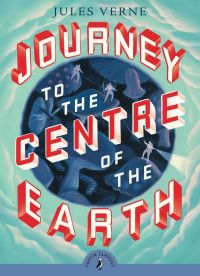
Get the Puffin Baldick translation of Journey to the Center of the Earth
Many Puffin Classics are abridged, but this one seems to be complete.
Available as a paperback (ISBN 9780141321042, 368 pages).
Who is Lowell Bair?
Lowell Bair is an American translator. He translated Madame Bovary, The Phantom of the Opera, The Count of Monte Cristo, Cyrano de Bergerac, Candide, The Three Musketeers, The Hunchback of Notre Dame, and The Red and the Black, among other works in French.
Quick facts about the Bair translation of Journey to the Center of the Earth
Title: Journey to the Center of the Earth
Availability: Under copyright but out of print.
Completeness: Unknown…
More about the Bair translation of Journey to the Center of the Earth
In some databases and bibliographies the translation is credited to “Lowell Blair” (rather than the correct name, “Lowell Bair”).
Bair’s translation of The Count of Monte Cristo is definitely abridged. Although I do not know for sure, I would guess that this translation of Journey to the Center of the Earth is not abridged, because the original work isn’t terribly long.
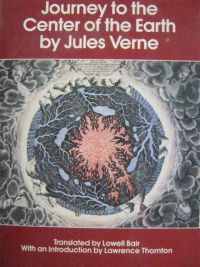
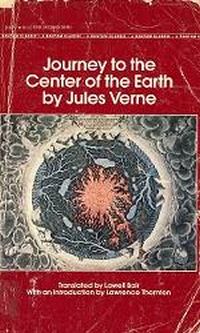
The 1991 Bantam edition with the Bair translation has an introduction by Lawrence Thornton. (See entry at ISFDB.) Unfortunately, the newer 2006 Bantam edition, which uses the Routledge translation and includes an introduction by Kim Stanley Robinson, has the same ISBN! (See entry at ISFDB.) Also, Bair’s name is still on the cover of some of the 2006 copies, even though the text is the Routledge translation! Oops!
Thus, if you want the actual Bair translation, you can’t search for it using the ISBN (ISBN 10: 0553213970 / ISBN 13: 9780553213973), which would normally serve as a unique identifier, but which in this case is shared by two different translations. You’ll need to look not just for Bair’s name, but for the old cover (which includes “center” in the title, whereas the newer edition spells it as “centre”), or a copy that includes the introduction by Lawrence Thornton. It is really really really hard to find any Bantam cover images that aren’t stock images depicting the new version; I could only find 2 on the whole internet, and they are both flawed:
Old Bantam cover, Bair translation:
New Bantam cover, I’m pretty sure it’s not actually the Bair translation:
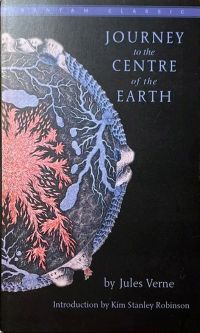
Interestingly, the new cover art is derived from the same original image, Systema ideale quo exprimitur, aquarum per canales hydragogos subterraneos ex mari et in montium hydrophylacia protrusio, aquarumq[ue] subterrestrium per pyragogos canales concoctus. From the treatise “Mundus Subterraneus.” by Athanasius Kircher (1665). Perplexity says the Latin title translates to “An ideal system showing the forcing of waters, through underground water‑carrying channels, out of the sea and into the water‑reservoirs of the mountains, and the distillation of subterranean waters through fire‑carrying channels.”
Extract from the Bair translation of Journey to the Center of the Earth
First two sentences (from the bibliography by Arthur B. Evans):
On May 24, 1863, a Sunday, my uncle, Professor Otto Lidenbrock, came hurrying back toward his little house at 19 Königstrasse, one of the oldest streets in the old quarter of Hamburg.
Our good Martha must have thought she had started cooking dinner very late, because it had only just begun sizzling on the kitchen stove.
Who is William Butcher?
William Butcher is an author, translator, and Verne scholar who lives in Hong Kong. He has also translated Verne’s Journey to the Center of the Earth, Around the World in Eighty Days, and The Adventures of Captain Hatteras. He has also published a biography of Verne.
Quick facts about the Butcher translation of Journey to the Center of the Earth
Title: Journey to the Centre of the Earth
Availability: In print.
Completeness: Complete!
More about the Butcher translation of Journey to the Center of the Earth
Science Fiction Studies: “Superb Jules Verne Translations” by Arthur B. Evans
“[A] true pearl of a book: the translation is accurate yet smoothly readable, the 23-page introduction is insightful and reflected very up-to-date scholarship, and the 12+ pages of explanatory notes at the end (annotations keyed to certain terms, places, or people cited in the text) are extremely useful…. His rendering of Verne’s stylistic idiocyncracies is more faithful to the original [than Baldick’s], he follows more closely the original published format of Voyage au centre de la Terre (e.g., the absence of chapter titles, the mock footnotes, etc.), and he retains the use of Axel’s present-tense first-person narration in the log-book portion of the text (when the three explorers are on the raft).”
“Journey Without End: On Translating Verne” by William Butcher
“The aim of the present piece is to provide a brief account of some of the problems and pitfalls of translating Voyage au centre de la Terre…. Verne constantly makes implicit and explicit reference to real-world events, and 40 pages of critical introduction and notes to Journey to the Centre of the Earth hardly scratch the surface of what could have been done. All the Extraordinary Journeys are minefields of connotations and denotations, ambiguities and metaphors, poetic effects and scientific arguments. If traditionally translation has been either literary or technical, in Verne’s case it really has to be both at the same time…. [H]ow should one translate JCE? Faithfully, I believe—if only in reaction to the liberties previously taken.… On the other hand, it would seem legitimate to reduce repetitious tics like the exclamation marks, the semi-colons in ternary sentences, and the superfluity of he said’s and he replied’s…. The complexities of Jules Verne should never be underestimated.”
Extract from the Butcher translation of Journey to the Center of the Earth
First ~300 words of Chapter 1 (preview at Amazon):
On 24 May 1863, a Sunday, my uncle, Professor Lidenbrock,* came rushing back towards his little house at No. 19 Königstrasse, one of the oldest streets in the historic part of Hamburg.
Martha the maid must have thought she was running very late, for dinner had hardly begun to simmer on the kitchen range.
‘H’m,’ I said to myself. ‘If my uncle is hungry, he’ll shout out his annoyance, for he is the most impatient of men.’
‘Professor Lidenbrock here already!’ Martha exclaimed in amazement, slightly opening the dining-room door.
‘Yes, indeed. But dinner has every right not to be cooked, for it’s not two o’clock yet. It’s only just struck the half-hour on St Michael’s.’
‘Then why has Professor Lidenbrock come back?’
‘Presumably he will tell us.’
‘Here he is: I’m off, Master Axel.* You will make him see reason, won’t you?’
And the good Martha disappeared back into her culinary laboratory.
I remained alone. But to make the worst-tempered of professors see reason did not seem possible, given my slightly indecisive character. So I was getting ready for a prudent retreat to my little bedroom at the top of the house, when the front-door groaned on its hinges. Large feet made the wooden staircase creak, and the master of the house came through the dining-room and burst into his study.
On his hurried way through, though, he had thrown his nutcracker-head cane in the corner, his broad hat brushed up the wrong way on the table, and the ringing words to his nephew:
‘Axel, I’m here!’
I hadn’t had time to move before the professor shouted again, in a most impatient voice:
‘We-ell? Are you not here yet?”
I rushed into my formidable master’s study.
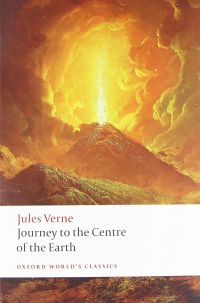
Get the Oxford Butcher translation of Journey to the Centre of the Earth
Includes an introduction by William Butcher, note on translation, bibliography, chronology, appendix, and explanatory notes. Ebook also available (ISBN 978-0191505867).
Available as a paperback (ISBN 9780199538072, 272 pages).
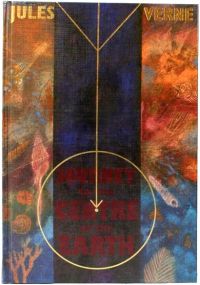
Get the Folio Society Butcher translation of Journey to the Centre of the Earth
2001. Updated version of Butcher translation. Introduction by Michael Crichton. Illustrations by Grahame Baker. Out of print.
Available as a slipcased hardcover.
Who is Frank Wynne?
Frank Wynne is an Irish writer and translator from French and Spanish.
Quick facts about the Wynne translation of Journey to the Center of the Earth
Title: Journey to the Centre of the Earth
Availability: In print.
Completeness: Complete.
More about the Wynne translation of Journey to the Center of the Earth
The Independent: “Review of Journey to the Centre of the Earth, By Jules Verne trs Frank Wynne” by Anita Sethi
“Newly and well translated by Frank Wynne, this classic feels resonant in the bicentenary of Darwin’s birth and sheds insight into what it means to make a journey at all – and why we are so gripped by reading about them.”
Extract from the Wynne translation of Journey to the Center of the Earth
First ~300 words of Chapter 1 (preview at Penguin):
It was on Sunday, the 24th of May, 1863, that my uncle, Professor Lidenbrock, came rushing suddenly back to his little house in the old part of Hamburg, No. 19, Königstrasse.
Our good Martha could not but think she was very much behindhand with the dinner, for the pot was scarcely beginning to simmer, and I said to myself:
“Now, then, we’ll have a fine outcry if my uncle is hungry, for he is the most impatient of mortals.”
“Mr. Lidenbrock, already!” cried the poor woman, in dismay, half opening the dining-room door.
“Yes, Martha; but of course dinner can’t be ready yet, for it is not two o’clock. It has only just struck the half-hour by St. Michael’s.”
“What brings Mr. Lidenbrock home, then?”
“He’ll probably tell us that himself.”
“Here he comes. I’ll be off, Mr. Axel; you must make him listen to reason.”
And forthwith she effected a safe retreat to her culinary laboratory.
I was left alone, but not feeling equal to the task of making the most irascible of professors listen to reason, was about to escape to my own little room upstairs, when the street-door creaked on its hinges, and the wooden stairs cracked beneath a hurried tread, and the master of the house came in and bolted across the dining-room, straight into his study. But, rapid as his flight was, he managed to fling his nutcracker-headed stick into a corner, and his wide-brimmed rough hat on the table, and to shout out to his nephew:
“Axel, follow me.”
Before I had time to stir he called out again, in the most impatient tone imaginable:
“What! Not here yet?”
In an instant I was on my feet and in the study of my dreadful master.
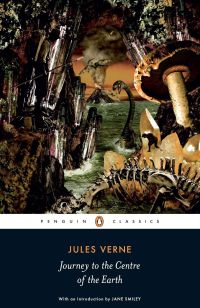
Get the Penguin Classics Wynne translation of Journey to the Centre of the Earth
Introduction by Jane Smiley. Notes by P. W. Gogman. Includes a chronology, suggestions for further reading, a note on the text, and endnotes.
Available as a paperback (ISBN 9780141441979, 252 pages).
Who was FP Walter?
Frederick (Rick) Paul Walter was an actor, writer, translator, and Verne scholar.
» Obituary of Frederick Paul Walter
SUNY Press says: “Frederick Paul Walter is a scriptwriter, broadcaster, librarian, and amateur paleontologist. A long-standing member of the North American Jules Verne Society, he served as its vice president from 2000 to 2009. Walter has produced many media programs, articles, reviews, and papers on aspects of Jules Verne and has translated many Verne novels, including Amazing Journeys: Five Visionary Classics and The Sphinx of the Ice Realm, both also published by SUNY Press. He lives in Albuquerque, New Mexico.”
Quick facts about the Walter translation of Journey to the Center of the Earth
Title: Journey to the Center of the Earth
Availability: In print.
Completeness: Complete.
More about the Walter translation of Journey to the Center of the Earth
Science and Showbiz: Going Places with Jules Verne (Introduction to Amazing Journeys) by F.P. Walter
“The book in your hands is… a handy omnibus volume of Verne’s best-loved novels in new, accurate, communicative translations. These five classics are more than household words, they’re joyous parts of our American heritage… So this volume is targeted to the American public: these are reader-friendly translations, translations complete down to the smallest substantive detail, translations that aim to convey the humor, theatricality, and scientific excitement this essay has been honoring…. [T]hese new translations benefit not only from current Verne scholarship but from today’s worldwide access to academic, institutional, and educational databases: it’s possible to compare and cross-check multiple versions of the original French…. Finally these translations work to suggest Verne’s style and tone—the stealthy wit, irreverent prankishness, tale-spinning virtuosity, and showbiz flamboyance of one of literature’s leading humorists and satirists. This is a Verne almost completely unknown to Americans… yet a Verne who has an uncannily American mindset. Specialists, educators, and students are encouraged to consult the Textual Notes starting on p. 657; these pinpoint the policies, priorities, and textual decisions underling the translations.”
Jules Verne Anthologies: “Review of Amazing Journeys: Five Visionary Classics” (“Rejuvenating the Old Storyteller”) by Arthur B. Evans
“Walter’s English renderings adhere to Verne’s original paragraphing; he does not add episodes or fabricate descriptions of his own, as one frequently discovers in some of the poorer Verne translations of these novels. And, as he explains in his extensive ‘Textual Notes’ at the end of the book, he has put considerable effort into making sure that his versions are both accurate and lucid…. attempts by Walter to spice up Verne’s prose do not necessarily constitute a betrayal of what Verne originally wrote. Literal translations are often worse than less literal ones: they are too “accurate” and not sufficiently ‘communicative.’ […] It is recommended for all English–language aficionados of Jules Verne, American or not.”
Extract from the Walter translation of Journey to the Center of the Earth
First ~300 words of Chapter 1 (from the Amazing Journeys omnibus):
On Sunday, May 24, 1863, Professor Lidenbrock, my uncle, came rushing back to his little house at 19 Königstrasse,’ one of the most venerable streets in Hamburg’s historical district.
Old Martha must have figured she was running well behind schedule, because our Sunday dinner had barely started to sizzle on the kitchen stove.
“Oh good,” I said to myself. “My uncle’s the most impatient man alive—if he’s hungry, he’ll howl in anguish.”
“Professor Lidenbrock already?” old Martha exclaimed in astonishment, half opening the dining room door.
“Yes, Martha. But dinner has every right not to be fixed, because it isn’t two o’clock yet. The bells at St. Michael’s just rang half past one.”
“Then why is Professor Lidenbrock back so soon?”
“Most likely he’ll tell us.”
“There he is! I’m staying out of it, Mr. Axel, you reason with him.”
And old Martha retreated to her culinary laboratory.
I was on my own. But reasoning with the world’s most cantankerous professor wasn’t an option for my less than decisive personality. Accordingly I was about to retire discreetly to my little bedroom upstairs, when the front door squealed on its hinges; wooden stairs creaked under big feet, and the master of the house shot through the dining room, rushing instantly into his study.
But during this speedy crossing, he’d tossed into a corner his cane with the nutcracker head, on the table his wide shaggy hat, and at his nephew these booming words:
“Axel, follow me!”
Before I had time to move a muscle, the professor was already calling me with a sharp note of impatience:
“Well, what’s taking you so long?”
I scooted into the study of my daunting overseer.
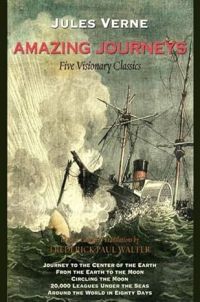
Get the SUNY Walter translation of Journey to the Center of the Earth
Amazing Journeys: Five Visionary Classics (includes four other Verne books translated by FP Walter). Ebook also available (ISBN 9781438432403).
Available as a paperback (ISBN 9781438432380, 678 pages).
Who is Ron Miller?
Ron Miller is a science and science-fiction illustrator with many books and awards to his name. More about Ron Miller:
» Ron Miller’s Black Cat Studios
» Ron Miller’s Black Cat Press
» Page about Ron Miller at the Encyclopedia of Science Fiction
Quick facts about the Miller translation of Journey to the Center of the Earth
Title: Journey to the Center of the Earth
Availability: Only available as an ebook.
Completeness: Probably complete.
More about the Miller translation of Journey to the Center of the Earth
This is an illustrated, annotated new translation from French.
Extract from the Miller translation of Journey to the Center of the Earth
First ~300 words of Chapter 1 (preview at Amazon):
On Sunday, 24 May 1863, my uncle, Professor Lidenbrock, hurried back to his little house at number 19, Königstrasse, one of the oldest streets in the Old Quarter of Hamburg.
Our servant, Marthe, must have thought she was very late, for dinner was hardly beginning to sizzle on the kitchen stove.
“Well” I thought to myself, “my uncle is the least patient of men, and if he’s hungry he’ll howl with anguish.”
“Herr Lidenbrock already!” exclaimed Marthe in amazement, as she opened the dining-room door.
“Yes, Marthe; but he can’t expect dinner to be ready yet, for it isn’t two o’clock. It’s only just struck half past one at St. Michael’s.”
“Then why is Herr Lidenbrock coming back?”
“I expect he’ll tell us.”
“There he is; I must fly! Herr Axel, you must make him see reason.”
And good Marthe returned to her culinary laboratory.
I was left alone. But to make the most irascible of professors see reason, that was just what my somewhat indecisive character’ wouldn’t let me do. I was getting ready to go back to my little room on the top floor when I heard the street-door creaking on its hinges: heavy footsteps resounded on the wooden stair, and after crossing the dining room the master of the house hurled himself into his study.
During this rapid transit he threw into a corner his walking-stick with the nutcracker head, on to the table his broadrimmed hat with its fur brushed the wrong way, and to his nephew these resounding words: “Axel, follow me!”2
I hadn’t had time to move before the professor was shouting impatiently: “What, aren’t you here yet?”
I dashed into the study of my formidable master.
Get the Baen Miller translation of Journey to the Center of the Earth
Includes more than 200 notes and annotations, full-page black-and-white illustrations, and an afterword by Ron Miller. Accompanied by special chapter heads and appendices. Includes Detailed maps. The paperback is out of print.
Available as an ebook (ISBN 9781625790408).
Who is Matthew G. Jonas?
Details are scarce, but you can learn about Birch Hill Farm, for which his publishing company Birch Hill Publishing, was named, at the website of Birch Hill Publishing.
Quick facts about the Jonas translation of Journey to the Center of the Earth
Title: Journey to the Center of the Earth
Availability: In print.
Completeness: Probably complete.
More about the Jonas translation of Journey to the Center of the Earth
Reddit: “I just finished Matthew Jonas’ translation of Journey to the Center of the Earth by Jules Verne”
“I got the translation done last year by Matthew Jonas and I couldn’t put it down. Read the whole book in two days. I really want to give Mr. Jonas some credit, his translation was very enjoyable to read.”
Extract from the Jonas translation of Journey to the Center of the Earth
First ~300 words of Chapter 1 (preview at Amazon):
On Sunday, May 24, 1863, my uncle, Professor Lidenbrock, returned in a hurry to his little house situated at number 19 Königstrasse, one of the oldest streets in the oldest part of Hamburg.
His housekeeper Martha thought that she must have lost track of the time, for she had just put his dinner in the oven.
“Well,” I thought, “if my impatient uncle is expecting dinner already, then he’s going to be disappointed.”
“Mr. Lidenbrock is home already?” exclaimed Martha, dumbfounded, through the half-open door to the dining room.
“Yes, Martha, and I’m sure that dinner isn’t even halfway done cooking. It’s not even two o’clock yet. The clock at St. Michael’s Church struck half past one not long ago.”
“Then why is Mr. Lidenbrock home?”
“He’ll probably tell us himself.”
“Here he comes! I’m going back into the kitchen, Mr. Axel, and you can find out why he’s home.”
At that, Martha retreated into her culinary laboratory.
I was on my own, but my indecisive nature would not allow me to talk sense into the short-tempered professor. I was preparing to carefully make my way back to my small room upstairs, when the door to the street creaked on its hinges. A large set of feet pounded up the wooden staircase, and the master of the house rushed across the dining room and into his study.
But as he hurried across the room, he had tossed his walking-stick with the head of a nutcracker for a handle into the corner, left his disheveled hat on the table, and yelled these words at his nephew:
“Axel! Come with me!”
I barely had time to move before the professor shouted again with an impatient tone of voice:
“What’s the matter? Why aren’t you coming?”
I entered my fearsome uncle’s study.
Get the Birch Hill Publishing Jonas translation of Journey to the Center of the Earth
Ebook also available (ISBN 9781957050034).
Available as a paperback (ISBN 9781957050027, 290 pages).
Who was Jessie Campbell?
She is the originally unnamed translator of the 1876 Routledge translation described above.
Who is Tad Davis?
Tad Davis is a writer, audiobook narrator, and member of the North American Jules Verne society.
Quick facts about the Campbell and Davis translation of Journey to the Center of the Earth
Title: Journey to the Centre of the Earth
Availability: In print.
Completeness: Presumably an improvement compared to the original Routledge version.
More about the Campbell and Davis translation of Journey to the Center of the Earth
Tad Davis revised the originally anonymous 1876 Routledge translation by Jessie Campbell for his audiobook version, and also published the text. This version includes illustrations by Edouard Rio from the 1867 French edition published by J. Hetzel.
Publisher’s promotional text:
“The translation was extensively revised. There have been many corrections and changes, but it remains substantially Campbell’s work, and this is the first edition of the novel that bears her name on the title page.”
Extract from the Campbell and Davis translation of Journey to the Center of the Earth
First ~300 words of Chapter 1 (preview at Amazon):
It was on Sunday, the 24th of May, 1863, that my uncle, Professor Lidenbrock, came rushing suddenly back to his little house in the old part of Hamburg, No. 19, Königstrasse.
Our good Martha could not but think she was very much behindhand with the dinner, for the pot was scarcely beginning to simmer, and I said to myself:
“Now, then, we’ll have a fine outcry if my uncle is hungry, for he is the most impatient of mortals.”
“Mr. Lidenbrock, already!” cried the poor woman, in dismay, half opening the dining-room door.
“Yes, Martha; but of course dinner can’t be ready yet, for it is not two o’clock. It has only just struck the half-hour by St. Michael’s.”
“What brings Mr. Lidenbrock home, then?”
“He’ll probably tell us that himself.”
“Here he comes. I’ll be off, Mr. Axel; you must make him listen to reason.”
And forthwith the good Martha effected a safe retreat to her culinary laboratory.
I was left alone, but not feeling equal to the task of making the most irascible of professors listen to reason, was about to escape to my own little room upstairs, when the street-door creaked on its hinges, and the wooden stairs cracked beneath a hurried tread, and the master of the house came in and bolted across the dining-room, straight into his study.
But, rapid as his flight was, he managed to fling his nutcracker-headed stick into a corner, and his wide-brimmed rough hat on the table, and to shout out to his nephew:
“Axel, follow me.”
Before I had time to stir he called out again, in the most impatient tone imaginable:
“What! Not here yet?”
In an instant I was on my feet and in the study of my dreadful master.

Get the BearManor Media Campbell and Davis translation of Journey to the Centre of the Earth
includes illustrations by Edouard Rio from the 1867 French edition published by J. Hetzel.
Available as a paperback (ISBN 9798887713038, 258 pages).
Repositories of Jules Verne knowledge
The Encyclopedia of Science Fiction: Jules Verne
Describes Jules Verne’s life and work and provides a bibliography of English versions of his books and books about him.
Zvi Har’El’s Jules Verne Collection
The original Jules Verne fan community website, online since 1995.
- Archive.org copy: https://web.archive.org/web/20250712041848/http://jv.gilead.org.il/
- Another mirror: https://www.julesverne.ca/jv.gilead.org.il/index.html
Verniana
A multilingual online open access journal dedicated to Jules Verne studies.
JulesVerne.ca
A resource for collecting books and ephemera related to Jules Verne.
The North American Jules Verne Society
A non-profit organization that exists to promote interest in Jules Verne and his writings, provide a forum for the interchange of information and materials about and/or relating to Jules Verne and his works, stimulate Jules Verne research, and publish a newsletter of Jules Verne and Society related issues.
Jules Verne Forum (on Google Groups)
A group for everyone who is interested in Jules Verne and his works.
Jules Verne Forum (on Boards.net)
Another group for everyone who is interested in Jules Verne and his works.
Retranslation through the Centuries: Jules Verne in English
A book by Kieran O’Driscoll, ISBN 9783034302364, 288 pages.
A Bibliography of Jules Verne’s English Translations by Arthur B. Evans
“[This] bibliography lists the most common English translations of Jules Verne’s Voyages Extraordinaires. The opening passages from Verne’s original French texts and their different English translations are provided for purposes of identification and comparison.”
Jules Verne in English: A Bibliography of Modern Editions and Scholarly Studies by Arthur B. Evans
“This chronological bibliography provides an overview of English-language editions and scholarship on Jules Verne from 1965 to 2007.”
Journey to the Center of the Earth: Original French Text
First ~300 words of Chapter 1 (from Project Gutenberg):
Le 24 mai 1863, un dimanche, mon oncle, le professeur Lidenbrock, revint précipitamment vers sa petite maison située au numéro 19 de König-strasse, l’une des plus anciennes rues du vieux quartier de Hambourg.
La bonne Marthe dut se croire fort en retard, car le dîner commençait à peine à chanter sur le fourneau de la cuisine.
«Bon, me dis-je, s’il a faim, mon oncle, qui est le plus impatient des hommes, va pousser des cris de détresse.
—Déja M. Lidenbrock! s’écria la bonne Marthe stupéfaite, en entre-bâillant la porte de la salle à manger.
—Oui, Marthe; mais le dîner a le droit de ne point être cuit, car il n’est pas deux heures. La demie vient à peine de sonner à Saint-Michel.
—Alors pourquoi M. Lidenbrock rentre-t-il?
—Il nous le dira vraisemblablement.
—Le voilà! je me sauve. Monsieur Axel, vous lui ferez entendre raison.»
Et la bonne Marthe regagna son laboratoire culinaire.
Je restai seul. Mais de faire entendre raison au plus irascible des professeurs, c’est ce que mon caractère un peu indécis ne me permettait pas. Aussi je me préparais à regagner prudemment ma petite chambre du haut, quand la porte de la rue cria sur ses gonds; de grands pieds firent craquer l’escalier de bois, et le maître de la maison, traversant la salle à manger, se précipite aussitôt dans son cabinet de travail.
Mais, pendant ce rapide passage, il avait jeté dans un coin sa canne à tête de casse-noisette, sur la table son large chapeau à poils rebroussés et à son neveu ces paroles retentissantes:
«Axel, suis-moi!»
Je n’avais pas eu le temps de bouger que le professeur me criait déjà avec un vif accent d’impatience:
«Eh bien! tu n’es pas encore ici?»
Je m’élançai dans le cabinet de mon redoutable maître.
I gather that Verne’s original manuscript resurfaced in the late 1990s (when it was sold to a private collector), as documented by William Butcher in “Long-Lost Manuscript: The True Antecedents of Professor Lidenbrock, His Nephew Axel and Their Glorious Adventure Underground”, but as far as I know, this manuscript has not been made available online.
Get Jules Verne: Four Novels by Jules Verne
"This revised, elegant book features the African exploration of Five Weeks in a Balloon; the story of Captain Nemo and his submarine in Twenty Thousand Leagues Under the Sea; Around the World in Eighty Days, the famous story of an incredible expedition; and the classic Journey to the Center of the Earth, which takes readers into our world’s geological past. With a genuine leather cover, printed endpapers, and a ribbon bookmark, as well as an introduction by an expert on Verne’s life and writing [Ernest Hilbert], it’s an excellent introduction to the work of this well-loved author." I'm not sure which translations these are, except that I expect they're all reprints of old public domain translations.
Available as a leather-bound hardcover (ISBN 9781607103172, 712 pages).
Get [3-novel omnibus] by Jules Verne
Journey to the Centre of the Earth (Anonymous Routledge), 20,000 Leagues Under The Sea (Frith), Round the World in Eighty Days (Frith).
Available as a hardcover (ISBN 9781841593517, 680 pages).
Get Jules Verne: Seven Novels by Jules Verne
Five Weeks in a Balloon, Around the World in Eighty Days, A Journey to the Center of the Earth, From the Earth to the Moon, Round the Moon, Twenty-Thousand Leagues Under the Sea and The Mysterious Island. Out of print. I'm not sure which translations these are, except that I expect they're all reprints of old public domain translations.
Available as a hardcover (ISBN 9781435122956, 1196 pages).

Get The Jules Verne Collection (7 volumes) by Jules Verne
Journey to the Center of the Earth (Malleson); Around the World in Eighty Days (Towle); In Search of the Castaways ("Charles Francis Horne"); Twenty Thousand Leagues Under the Sea ("Malleson" but actually Walter); The Mysterious Island (Kingston); From the Earth to the Moon and Around the Moon (Mercier and King); Off on a Comet (Frewer). Hardcover set also available (ISBN 9781665934398).
Available as a paperback box set (ISBN 9781665934381, 3520 pages).
Get The Best of Jules Verne (5 novels) by Jules Verne
Around the World in Eighty Days 9781853260902 (Desages), From the Earth to the Moon / Around the Moon 9781840226706 (Linklater), Journey to the Centre of the Earth 9781853262876 (Malleson), The Mysterious Island 9781840226249 (Kingston), Twenty Thousand Leagues Under the Sea 9781853260315 (Mercier).
Available as a paper back set (ISBN 9781848702226, 1824 pages).
Get Amazing Journeys (5 novels) by Jules Verne
Journey to the Center of the Earth, From the Earth to the Moon, Circling the Moon, 20,000 Leagues Under the Seas, Around the World in Eighty Days. All translated by Frederick Paul Walter. Ebook also available (ISBN 9781438432403).
Available as a paperback (ISBN 9781438432380, 678 pages).
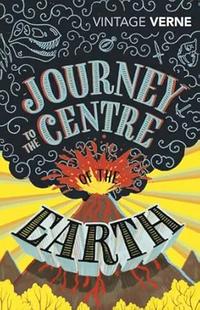
Get Journey to the Centre of the Earth (Vintage Classics) by Joyce Gard ("translator")
Abridged! See Travels and Travails with the Big Three. Actually adapted from a British children's edition published by Hutchinson in 1961.
Available as a paperback (ISBN 9780099528494, 184 pages).
Journey to the Center of the Earth best translation?
Avoid the anonymous Griffith and Farran “Hardwigg” translation!
- If you want an American translation, get the Walter translation.
- If you want a cheap translation, look for one of the many reprints of the Routledge translation or the Malleson translation, which are both in the public domain. (You can get an ebook of the Malleson translation free from Standard Ebooks.)
- If you want a scholarly British translation, get the Butcher translation.
- If you want a colloquial British translation, get the Baldick translation.
All of these are in print and widely respected among Verne scholars.
Let us know in the comments which one(s) you’ve read or plan to read!

![Systema ideale quo exprimitur, aquarum per canales hydragogos subterraneos ex mari et in montium hydrophylacia protrusio, aquarumq[ue] subterrestrium per pyragogos canales concoctus. From the treatise “Mundus Subterraneus.” by Athanasius Kircher (1665)](https://commons.wikimedia.org/wiki/File:Systema_ideale_quo_exprimitur,_aquarum_per_canales_hydragogos_subterraneos_ex_mari_et_in_montium_hydrophylacia_protrusio...,_by_Athanasius_Kircher,_1668%3F,_from_the_Digital_Commonwealth_-_commonwealth_n8710p88b_image.jpg)