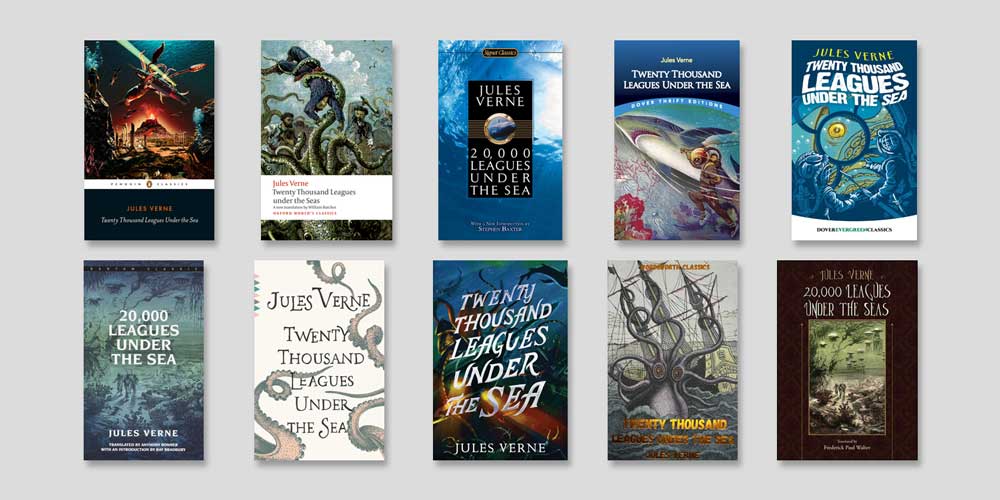
“Which English translation of Twenty Thousand Leagues under the Sea should I read?”
TL;DR? If you just want a quick-and-dirty recommendation, jump to the conclusion.
According to the introduction to the Coward translation, Twenty Thousand Leagues has “never been out of print”, and “has been translated 147 times into many languages”, and “in UNESCO’s Index translationum, Verne ranks one place below Agatha Christie and one place higher than William Shakespeare.” His name is being used to promote a 2025 series of French cars.
As you may know, Jules Verne has a massive and enthusiastic following. If you are an ardent fan, you already know that early Jules Verne translations were… not necessarily very careful with the source material.
Verniana: “Travels and Travails with the Big Three” by Alex Kirstukas
“In the English-speaking world, one can identify a ‘Big Three’ group of Verne novels—Journey to the Center of the Earth, Twenty Thousand Leagues under the Sea(s), and Around the World in Eighty Days—by the sheer number of sub-par editions available from major publishers. It isn’t hard to find reasons for this dubious distinction; all three novels, in addition to being longstanding favorites among readers and scholars, received high-profile Hollywood adaptations in the 1950s and have retained special familiarity since. If a modern Anglophone bookshop or omnibus edition boasts only three Verne titles, it’s likely to be these. But with great popularity comes great reliance on existing translations, usually poor-quality Victorian texts in the public domain.” Sadly, there are also innumerable abridgements and adaptations, including the 2011 Vintage Twenty Thousand Leagues under the Sea credited to James Reeves, an abridgement originally published in 1956, “now being passed off by a reputable international publisher as complete translations.”
“Why does the title sometimes have ‘seas’ instead of ‘sea’?”
The French original, serialized from 1869 to 1870, was published in 1871 as a complete book titled Vingt mille lieues sous les mers. That is, it used the plural ‘seas’. However, the earliest English translation, published in 1872, used the singular ‘sea’, and subsequent translations copied the title because it was famous. Some publishers have now switched back to ‘seas’.
(Other decisions aiming to increase authenticity, with varying degrees of success, include changing Les Miserables to The Wretched, Remembrance of Things Past to In Search of Lost Time, and The Dream of the Red Chamber to The Story of the Stone.)
A consequence of using singular “sea” in the title is that it is sometimes mistakenly understood as referring to a journey at a depth of twenty thousand leagues, rather than a journey of twenty thousand leagues in length that takes place underwater. (I admit I was fooled; after all, Verne also wrote A Journey to the Center of the Earth, so why wouldn’t I assume he wrote about a really really deep sea submarine expedition?)
So, um, how long is a league, anyway?
Definitions vary… it seems to be between 3 and 5 kilometers (2 or 3 miles).
Is Jules Verne the father of science fiction?
It depends on who you ask.
Science Fiction Studies: “Hidden Treasures: The Manuscripts of Twenty Thousand Leagues Under the Sea” by William Butcher (Article also available at JulesVerne.ca.)
“[Verne’s] reputation as father of science fiction is erroneous, I believe, being both anachronistic and based on a misunderstanding. It has, above all, distracted attention from serious literary study of his novels.”
Gizmodo: “Everything You Know About Jules Verne is Probably Wrong” by Ron Miller
“Of the 54 novels published in his lifetime, scarcely a dozen can be called ‘science fiction’—and at that by occasionally making a stretch. On the other hand, almost all of his books were about one science in particular, the one he was most fascinated with his entire life: geography. All of his novels are about places and every one of his four dozen novels takes his readers to a different location on earth. This is the reason the series was called ‘Extraordinary Voyages.’ So geography-based were Verne’s novels that I was once able to create an entire atlas of nearly 100 maps detailing all the journeys his characters undertook!”
Science Fiction Encyclopedia: Jules Verne
“Sadly, in their belated discovery of Verne, French critics have shown a tendency to ‘rescue’ him from being thought of as an sf writer in any significant sense, some going so far as to suggest that he should not be thought of as a ‘father of science fiction’ because so many of his novels stayed strictly within ‘realistic’ bounds and were not set in the future… even some English-language critics have followed suit, including William Butcher, who has claimed strangely that Verne did not write sf because ‘most of his books contain no innovative science’….. All these critics seem united in the generation of eccentrically restrictive definitions of sf in order to save Verne from the onus of having written the form…. In any case… it is easy to think of a substantial number of his works as being obviously science-fictional.”
Science and Showbiz: Going Places with Jules Verne (Introduction to Amazing Journeys) by F.P. Walter
“[T]he old labeling of Verne as ‘Father of Science Fiction’ has come in for backtalk. Of course the legitimacy of this title has always relied on what one means by ‘father’ and ‘science fiction’: for example, a good case can be made for the genre’s springing up in antiquity, in assorted creation myths or Plato’s utopias. Once again it depends on how you define SF, both the science part and the fiction part. To illustrate: if the science has to be a recognizable discipline, if the fiction has to be genuine narrative prose, and if both have to deal with some visionary or speculative development, then a plausible candidate for first SF novel might be Verne’s Journey to the Center of the Earth with its prehistoric monsters and time-travel motif…. Whether or not Verne ‘fathered’ the genre of science fiction, clearly he was the writer who first brought the form to world notice, the writer who first lionized science’s achievements and possibilities, and—most crucially—the writer who first produced a body of science fiction. Alone among those early authors, he was more than a one-shot wonder, he was an actual career professional: in his lifetime he wrote eighteen SF novels, including half a dozen of the genre’s best-known titles. As for their literary standing, one of his major modern successors (Asimov, xii) called Verne’s science fiction ‘the first truly successful tales of this type.’ And like Asimov himself, the Frenchman also produced a huge amount of engrossing and entertaining work in other genres: adventure, mystery, intrigue, even nonfiction.”
Twenty Thousand Leagues under the Sea: Translations in English
There have been about a dozen “different” translations in total. As usual, there are some interesting complications that make listing “different” translations less straightforward than one might expect…
So yeah, here’s a list of 15 “different” translations.
- 1872 – Lewis Page Mercier
- 1876 – Anonymous (Ward and Lock)
- 1876 – Henry Frith
- 1922 – Philip Schuyler Allen
- 1960 – I.O. Evans
- 1962 – Anthony Bonner (updated in 2003)
- 1965 – Walter James Miller
- 1969 – Mendor T. Brunetti
- 1976 – Lewis Page Mercier, Walter James Miller
- 1988 – Lewis Page Mercier, Ron Miller
- 1991 – Frederick Paul Walter
- 1992 – Emmanuel Mickel
- 1993 – Walter James Miller and Frederick Paul Walter
- 1998 – William Butcher (updated in 2019)
- 2017 – David Coward
In 2023, Matthew Jonas of Birch Hill Publishing said he was working on a translation.
Twenty Thousand Leagues under the Sea: What makes it hard to translate?
“Journey to the Centre of the Text: On translating Verne” by William Butcher
“All the Voyages extraordinaires are veritable minefields of connotations and denotations, ambiguities and metaphors, poetic effects and scientific arguments. If traditionally translation has been either literary or technical, in Verne’s case it really has to be both at the same time…. Another challenge in translating Verne are the plays on words and other sly tricks. Metaphors often run through the simplest vocabulary…. The complexities of Jules Verne should never be underestimated…. It is probable that the difficulties of transmuting Verne into English, although different, are as great as those of ‘transducing’ Poe or Proust into other languages.”
Twenty Thousand Leagues under the Sea: Translation comparison
Extracts have been included wherever possible so that you can compare how the different translations sound.
Twenty Thousand Leagues under the Sea: Collections, omnibus editions, and other resources
For listings of books or sets of multiple Verne titles, links to Jules Verne sites, and more, jump to Other Info and Resources.
Who was Lewis Page Mercier?
Lewis Page Mercier, a British man and native French speaker, was a chaplain and author of religious works who apparently accepted the offer of translation work due to strained financial circumstances.
» Lewis Page Mercier (Wikipedia)
Mercier was assisted in his translation work by Eleanor Elizabeth King, who is credited in his other two translations of Verne’s novels, From the Earth to the Moon and Around the Moon.
“How Lewis Mercier and Eleanor King Brought You Jules Verne” by Norman M. Wolcott
“Although Ms King is only listed as translator on the Moon novels, there is no doubt that Mercier’s physical and mental condition required her assistance for 20,000 Leagues as well.”
In the novels he translated, Mercier is credited as “Louis Mercier” or “Mercier Lewis.”
Walter James Miller’s foreword, titled “A New Look at Jules Verne,” to the 1976 annotated edition:
“He chose to confer his real name, Lewis Page Mercier, only on his classical and religious works…. I sometimes feel that he put the stamp of Louis Mercier on translations he himself had worked on directly, and the stamp of Mercier Lewis on translations he had farmed out, wholly or in part, to others. My annotations will show the reasons I have for thinking that Twenty Thousand Leagues, issued as a Mercier Lewis work, was done in collaboration: moreover, a collaboration very poorly coordinated.”
However, Wolcott’s detailed description of Mercier’s background and involvement with the publisher explains that Mercier used an altered version of his name because he was a government employee.
ibiblio: “The Victorian Translators of Verne: Mercier to Metcalfe (talk delivered at the Jules Verne Mondial 2005)” by Norman Wolcott
“To avoid a conflict of interest with his position as Chaplain, Mercier wrote under the pen names of ‘Mercier Lewis, M.A., Oxon.’ and ‘Louis Mercier’.”
Quick facts about the Mercier translation of Twenty Thousand Leagues under the Sea
Title: Twenty Thousand Leagues under the Sea
Availability: In the public domain and in print in several modern editions.
Completeness: Abridged by more than 20%.
More about the Mercier translation of Twenty Thousand Leagues under the Sea
There have been and still are many published variations of the Mercier translation. Some use British spelling and some use American spelling. Some publishers may have edited the text to correct the more obvious errors.
The Mercier translation is the one used in Volume 5 of the 15-volume Works of Jules Verne series edited by Charles Francis Horne and published in 1911 by Vincent Parke and Company. You can access the Horne version of the Mercier translation at Wikisource.
From Walter James Miller’s afterword, titled “Jules Verne, Rehabilitated,” to the 1976 annotated edition:
“[Mercier] cut 23 percent of Verne’s text and committed hundreds of errors in translation. Many of his cuts seem ideologically motivated. Such tendentious carelessness has subjected a great man to generations of neglect by adult readers and to unmerited scorn by Anglo-American critics…. [By examining his work] we can reconstruct the translator himself. He was a humorless pastor and censor; he was contemptuous of science and technology; self-righteously he refused to consider any criticism of colonialism or commerce. Precisely not the person to be trusted with translating Verne.”
“How Lewis Mercier and Eleanor King Brought You Jules Verne” by Norman M. Wolcott
“In view of Mercier’s desperate financial situation, it is highly unlikely that the cuts in the translations originated with him: after all if he were being paid by the word he would want to translate the entire books. More than likely the cuts were directed by [the publisher] Sampson Low, and either performed by their editors, or directed to Mercier…. We will never know this for sure as the offices of Sampson Low in Fleet Street were completely destroyed in the bombing of London in December, 1940.”
“How Lewis Mercier and Eleanor King Brought You Jules Verne” by Norman M. Wolcott
By examining Walter Miller’s annotated version, Wolcott makes the following inferences: “The procedure… was for Ms King to read a paragraph or two in French to Mercier, who would then recite the same paragraphs back to King in English, which she would then write down in a fair hand. Mercier became in fact a translating machine, much as a modern U.N. interpreter. There is even internal evidence that Mercier had no knowledge of the “context” of the paragraphs he was translating at all as opposed to the mere “word content”…. It is unlikely that Mercier ever read over what he had dictated; that would be pointless, as he had no memory of the details of the story. There is internal evidence that Mercier had no recollection of events which transpired only a few pages before the current page he was working on; the path was directly from Mercier to Ms King’s transcriptions then directly to Sampson Low and into print.” That explains a lot.
“How Lewis Mercier and Eleanor King Brought You Jules Verne” by Norman M. Wolcott
“Mercier was one of the few translators with a native fluency in French who was in addition a competent linguist; his translations have a pleasing flow.”
From the introduction by Butcher to the Oxford 2019 edition:
“Lewis Mercier’s 1872 translation was typical of the time: adequate on ‘style’ but extremely weak on details. also, about 22 per cent of the novel is missing! Since then, over half of the editions have reproduced Mercier, many of them making further minor changes without, unfortunately, referring back to the French.”
From the Translator’s Note in the Ron Miller translation:
“Mercier’s translation has become the ‘standard’ English version because for ninety years it was the main English translation, and thus, was the first edition to enter the public domain. Today, there are scores of editions of the Mercier translation available… as [it] is copyright-free. In the past century, there have been literally hundreds of reprints of the ‘standard’ translation. It has become so ubiquitous, in fact, that many people believe that Verne wrote in English! This misconception is bolstered by the fact that many publishers leave off the name of the old translator…. Mercier translated Verne very literally, changing word order only to the degree dictated by the differences in grammar. As a result, the style is very true to Verne’s own.”
As Verne Smiles by Walter Miller
“Some publishers still sell the Mercier Lewis intact, as we shall show in detail. Others correct his more obvious mistakes but ‘preserve’ major omissions. And here’s the secret: they reissue Mercier Lewis in bright newly illustrated editions, perfect for Auntie’s expensive graduation gift to her nephews.”
North American Jules Verne Society: “The Rehabilitation of Jules Verne in America: From Boy’s Author to Adult’s Author — 1960-2003” by Walter James Miller
“In 1963, Simon & Schuster asked me to write an introduction to their new edition of… the 1872 version by Mercier Lewis…. I came upon a strange sentence at the opening of Chapter 2, Part I. Professor Aronnax says: ‘I had just returned from a scientific research in the disagreeable territory of Nebraska.’ This so puzzled me that I resorted to the French. I found that Aronnax actually had come back from the badlands! … For a while it looked as if the anti-Lewis forces had won a major victory. But no. Most commercial publishers continued to put out expensive, handsome, beautifully illustrated gift editions of Mercier Lewis. In the Seventies there were fifteen such editions, many of them not identified as Mercier Lewis’ work, but all of them featuring that disagreeable territory of Nebraska!”
“Dreadful translation, unreliable notes” Amazon Review by F.P. Walter
Regarding Simon & Schuster’s “Enriched Classics” edition: “[T]he basic text is dreadful: though unidentified, it’s the long-discredited translation signed by ‘Mercier Lewis’… [and it is] politically censored, drastically abridged, couched in stilted Victorian prose, and riddled with hundreds of inane translating errors. Its clunky, antiquated English is something no American student could possibly enjoy (‘I own my heart beat,’ says the narrator, who actually means, ‘I admit my heart was pounding’). As for the translating blunders, some are asinine beyond belief — Verne’s characters start a fire with a lentil (Verne: lens) . . . loosen bolts with a key (Verne: wrench) . . . and claim iron is lighter than water (Verne: the opposite, of course)…. The ‘helpful notes’ and ‘insightful commentary’ can range from the useless to the ridiculous. On p. 425, the explanatory notes can only tell us that such sea creatures as tubipores, gorgones, and spondyles are ‘various kinds of marine life.’ Big help. (They’re corals, sea fans, and oysters, folks.)”
Extract from the Mercier translation of Twenty Thousand Leagues under the Sea
First paragraph of Chapter 1 (from Project Gutenberg 164):
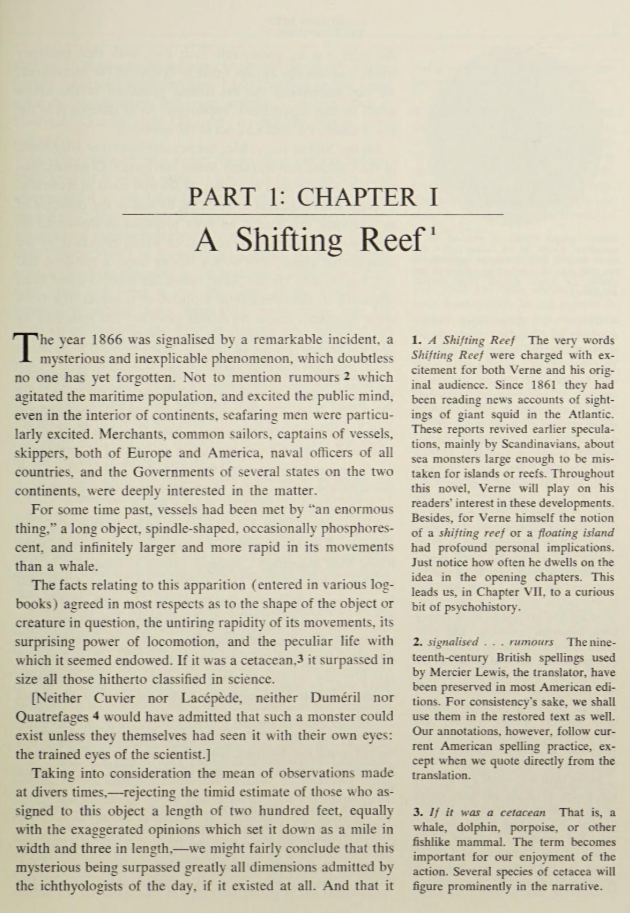
The year 1866 was signalised by a remarkable incident, a mysterious and puzzling phenomenon, which doubtless no one has yet forgotten. Not to mention rumours which agitated the maritime population and excited the public mind, even in the interior of continents, seafaring men were particularly excited. Merchants, common sailors, captains of vessels, skippers, both of Europe and America, naval officers of all countries, and the Governments of several states on the two continents, were deeply interested in the matter.
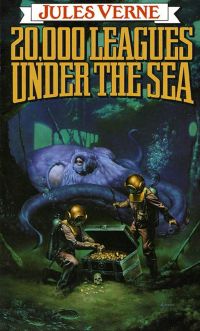

Get the Tor Classics Mercier translation of Twenty Thousand Leagues Under the Sea
Foreword and afterword by T. A. Barron.
Available as an ebook (ISBN 9781466803534).

Get the Chartwell Deluxe Editions Mercier translation of Twenty Thousand Leagues Under the Sea
An elegant faux-leather cover with foil-embossed designs; Introduction by English scholar and professor Allen Grove; Unabridged text; A timeline of the life and times of Jules Verne.
Available as a deluxe hardcover (ISBN 9780785847571, 296 pages).

Get the Chartwell Classics Mercier translation of Twenty Thousand Leagues Under the Sea
Available as a hardcover (ISBN 9780785839934, 296 pages).

Get the Word Cloud Classics Mercier translation of Twenty Thousand Leagues Under the Sea
This edition credits "Lewis Pager Mercer" for the translation. I believe this is a spelling mistake made by the current publisher.
Available as a flexibound book (ISBN 9781607105497, 296 pages).

Get the Wordsworth Classics Mercier translation of Twenty Thousand Leagues Under the Sea
With an exclusive introduction and notes by David Stuart Davies. Translation by Louis Mercier.
Available as a paperback (ISBN 9781853260315, 256 pages).

Get the Enriched Classics Mercier translation of Twenty Thousand Leagues Under the Sea
Introduction, author chronology, historical timeline, outline of themes and plot points, explanatory notes, critical analysis, discussion, recommended books and films. Supplementary material written by Harrison Solow.
Available as a paperback (ebook also available) (ISBN 9781416500209, 480 pages).

Get the AmazonClassics Mercier translation of Twenty Thousand Leagues Under the Sea
Includes editorial revisions.
Available as an ebook (ISBN 9781542023290).

Get the Gutenberg Mercier translation of Twenty Thousand Leagues Under the Sea
Available as an ebook.

Get the Heirloom Collection Mercier translation of Twenty Thousand Leagues Under the Sea
I don't really know if this is the Mercier translation. It doesn't credit any translator, and I can't find any extracts online to check the text. (If you have a copy, let me know!)
Available as a deluxe hardcover (ISBN 9781068996825, 272 pages).
Quick facts about the anonymous translation of Twenty Thousand Leagues under the Sea
Title: Twenty Thousand Leagues Under the Sea
Availability: Out of print. In the public domain. Scans are available (see below).
Completeness: Definitely abridged.
More about the anonymous translation of Twenty Thousand Leagues under the Sea
There may have been other anonymous translations, but this one is specifically listed in bibliographies I’ve seen. This is the 1876 edition issued by the publisher Ward and Lock (or Ward, Lock and Tyler, or Ward, Lock and Co.).
The copy whose scans are online at Hathi Trust has a color frontispiece but no other illustrations. There are 330 scanned pages in total, including the covers and endpapers etc. This copy uses British spelling.
This is an abridged version. The first paragraph is only two sentences rather than three; this seems typical throughout chapter 1. Whole sentences, sometimes several at a time, are completely dropped. The text seems to have been intentionally condensed.
The text does indeed appear to be quite different from the Mercier translation. It cannot be a condensation/rewriting of the Mercier translation: the third paragraph talks about Cuvier, Lacepede, Dumeril, and Quatrefages, whom Mercier does not mention (at least in the Gutenberg Mercier text I consulted).
Since this translation is anonymous and is in the public domain, there may be new reprints of it currently available. (I don’t specifically know of any.)
Get the anonymous Ward and Lock edition of Twenty Thousand Leagues under the Sea
This edition is out of print. You may be able to find a second-hand copy.
Extract from the Anonymous translation of Twenty Thousand Leagues under the Sea
First paragraph of Chapter 1 (from Hathi Trust):
In the year 1866 the whole maritime population of Europe and America was excited by an inexplicable phenomenon. This excitement was not confined to merchants, common sailors, sea-captains, shippers, and naval officers of all countries, but the governments of many states on the two continents were deeply interested.

Get the Hathi Trust Anonymous translation of Twenty Thousand Leagues Under the Sea
Abridged.
Available as an ebook.
Who was Henry Frith?
Henry Frith was an engineer, fiction and non-fiction writer, and translator. He is credited as translator for at least 7 of Jules Verne’s novels:
- A Floating City
- The Blockade Runners
- Twenty Thousand Leagues Under the Sea
- Adventures of Three Englishmen and Three Russians in Southern Africa
- Round the World in Eighty Days
- The Fur Country
- Kéraban the Inflexible
I recognize his name from a 1955 edition of his book King Arthur and His Knights.
Amazon: “Dover Thrift Edition of ‘Center of the Earth’ ISBN:0-486-44088-5” by Normon M. Wolcott
“Although [the 1876 Routledge text reprinted by Dover is an] anonymous translation, it may have been made by Henry Frith who translated other Verne books for Routledge.”
Quick facts about the Frith translation of Twenty Thousand Leagues under the Sea
Title: Twenty Thousand Leagues under the Sea
Availability: In print. In the public domain. Scans are available (see below).
Completeness: Complete text.
More about the Frith translation of Twenty Thousand Leagues under the Sea
Uses British spelling.
The copy whose scans are online at the University of Florida has a frontispiece for each of the two volumes, but no other illustrations. There are 550 scanned pages in total, including the covers and endpapers etc. You can view these online or download them as images or as a PDF, but as of mid-2025, there is no complete/polished transcription yet.
Based on a comparison of the first chapter with the first chapter of the FP Walter translation, this does not seem to be an abridgement. (No paragraphs are missing or noticeably shorter in the Frith translation.)
ibiblio: “The Victorian Translators of Verne: Mercier to Metcalfe (talk delivered at the Jules Verne Mondial 2005)” by Norman Wolcott
“One of [Frith’s] first literary efforts was the translation of Vingt mille lieues sur les mers (1876). With his scientific background he understood much of what Verne had written, and this translation has remained one of the best of the time with only minor deletions from the original text.”
Amazon: “EARLY TRANSLATIONS OF HISTORICAL INTEREST” by F.P. Walter
Frith’s translation is “fuller and less accident-prone” than Mercier’s, but not “reliable or responsible” because he “garbles” “condenses” and “omits substantive and poetic details on nearly every page.”
Victorian Popular Fictions Journal: “Jules Verne’s Routledge Translators” by Alex Kirstukas
“Particularly striking are the mixed reviews of Henry Frith’s translations. Wolcott’s comments, highlighting Frith’s training in engineering and his prolific writing career, tend to give him the benefit of the doubt, praising his Twenty Thousand Leagues…. However, more detailed assessments of Frith’s texts tend to indicate serious misgivings. Reviewing a modern volume containing two Frith translations, Walter notes that Frith “condenses … garbles … and omits substantive and poetic details on nearly every page” of Twenty Thousand Leagues…; my own review of the volume likewise cites stylistic and tonal shortcomings in both texts and concludes that both are ‘deeply disappointing’ (Kirstukas 2014: 111).”
Note that the translation of Twenty Thousand Leagues under the Sea in the Everyman’s Library edition (ISBN 9781841593517, which also contains Journey to the Center of the Earth and Round the World in Eighty Days) is Frith’s translation. The copyright page says it is, and Alex Kerstukas discusses the 2013 Everyman edition as containing Frith’s translation,
Verniana: “One Small Step for Everyman, One Giant Leap Backward for Verne Readers” by Alex Kirstukas
The Everyman’s Library 3-novel omnibus contains an anonymous Routledge translation of Journey to the Center of the Earth and Frith’s translations of Twenty Thousand Leagues Under the Sea and Round the World in Eighty Days. (Butcher said Everyman used the Mercier translation—at least in the case of the 1993 edition—so I checked the Everyman’s Library preview of the 2013 edition on Google Books. The text of the first paragraph matches Frith.) Kirstukas is disappointed with Everyman’s decision to reprint these 1870s translations: “[I]t is beyond question that there are enough [errors and omissions] to stop the translations from being reliable substitutes for the original works…. Frith’s idiosyncratic writing style sometimes makes for a reading experience vastly unlike that of Verne in the original French.”
Extract from the Frith translation of Twenty Thousand Leagues under the Sea
First paragraph of Chapter 1 (from the scan at University of Florida Digital Collections):
The year 1866 was marked by a very strange event, an inexplicable and unexplained phenomenon, which must still be in the recollection of our readers. Without mentioning rumours which agitated the population of the sea-ports, and extended to the interior of various countries, the maritime population were more particularly exercised in their minds. Merchants, ship-owners, ship-captains, skippers, and masters, both European and American, officers of the Marines of both countries, and, subsequently, the Governments of various States of these continents, were deeply engrossed respecting this phenomenon.
Get the Vintage Classics Frith translation of Twenty Thousand Leagues under the Sea
Contains only the text of the novel.
Available as a paperback (ISBN 9780593081518, 352 pages).
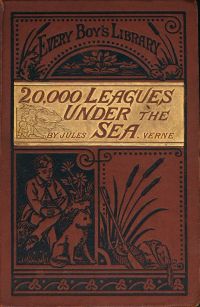
Get the Every Boy's Library Frith translation of Twenty Thousand Leagues under the Sea
There is a transcription project at Wikisource, but the text is not complete. Meanwhile, you can read the page scans or download a PDF of them.
Available as a collection of page scans.
Who was Philip Schuyler Allen?
Philip Schuyler Allen was an American professor and translator from German and French to English.
He translated Heidi. He also “translated and arranged” The Three Musketeers and Twenty Thousand Leagues Under the Sea for the same series, the Windemere Series (a children’s educational series).
More about Allen:
Quick facts about the Allen translation of Twenty Thousand Leagues under the Sea
Title: Twenty Thousand Leagues under the Sea
Availability: In print. In the public domain. Scans available (see below).
Completeness: Abridged.
More about the Allen translation of Twenty Thousand Leagues under the Sea
Originally part of the Windermere series, with illustrations by Milo Winter.
Uses American spelling.
The title page of the 1922 edition says “Translated and arranged by Philip Schuyler Allen”, which to me seems to indicate that the translation is not entirely complete. Moreover, the Windermere Series was an illustrated series for children.
Based on my reading of Chapter 1: The abridgement doesn’t seem very simplified or compressed. Still, the text is definitely incomplete compared to the FP Walter version. (For example, 2 paragraphs about the Cunard company are missing from Chapter 1.) The 1876 public domain Frith translation seems more complete.
The out-of-print 1990s Reader’s Digest edition (with an afterword by Clifton Fadiman) uses this translation, which it claims contains “the complete text of Jules Verne’s Twenty Thousand Leagues Under the Sea.”
From the Preface by Philip Schyuler Allen to his translation:
“It is with very real pleasure that I offer American youth a new edition of this immortal romance. in this volume I have done my utmost to correct the many (and often serous) mistakes which have marred previous translations.”
Extract from the Allen translation of Twenty Thousand Leagues under the Sea
First paragraph of Chapter 1 (preview at Amazon):
The year of grace 1866 was made memorable by a marvelous event which doubtless still lingers in men’s minds. No explanation for this strange occurrence was found, and it soon came to be generally regarded as inexplicable. A thousand rumors were current among the population of the seacoasts and stirred the imagination of those millions who dwelt inland far from the shores of an ocean. But of course it was the seafaring men who were most excited. And everyone in Europe or America that had to do with navigation was deeply interested in the matter—whether sailors or merchants, captains or pilots, naval officers or rulers of empire.
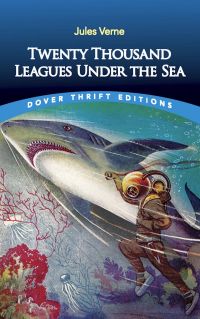
Get the Dover Thrift Editions Allen translation of Twenty Thousand Leagues under the Sea
Reprint of the Rand McNally & Company, New York, 1972 edition.
Available as a paperback (ebook also available) (ISBN 9780486448497, 288 pages).

Get the Dover Children's Evergreen Classics Allen translation of Twenty Thousand Leagues under the Sea
Reprint of the Rand McNally & Company, New York, 1922 edition.
Available as a paperback (ebook also available) (ISBN 9780486817941, 464 pages).
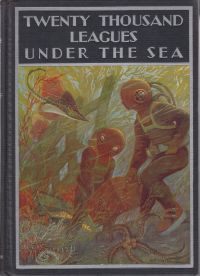
Get the Rand McNally Allen translation of Twenty Thousand Leagues under the Sea
From the Windermere Series. With illustrations by Milo Winter.
Available as an ebook.

Get the Barnes & Noble Collectible Editions Allen translation of Twenty Thousand Leagues under the Sea
Includes illustrations by Milo Winter.
Available as a bonded leather hardcover (ISBN 9781435162150, 480 pages).
Who was I.O. Evans?
Idrisyn Oliver Evans was a British-South African editor, author, and translator who worked on many of Verne’s writings.
» More about I.O. Evans at SF Encyclopedia
» More about I.O. Evans at Verniana.org
» More about I.O. Evans at JulesVerne.ca
Quick facts about the Evans translation of Twenty Thousand Leagues under the Sea
Title: Twenty Thousand Leagues Under the Sea
Availability: Still copyrighted but out of print.
Completeness: This is definitely an abridged version.
More about the Evans translation of Twenty Thousand Leagues under the Sea
From 1960 Associated Booksellers edition:
“Practical considerations have necessitated the omission of a number of passages from the present edition; may be, regrettable as these omissions, however, their absence does increase the excitement of what is first and foremost an acknowledged masterpiece of science fiction.”
Verniana: “ ‘Verne’s Best Friend and his Worst Enemy’: I.O. Evans and the Fitzroy Edition of Jules Verne” by Brian Taves
“[Evans] translated Twenty Thousand Leagues Under the Sea into a single book of merely 192 pages, only half of the original. Twenty Thousand Leagues Under the Sea… did not credit Evans as editor or translator.”
Verniana: “ ‘Verne’s Best Friend and his Worst Enemy’: I.O. Evans and the Fitzroy Edition of Jules Verne” by Brian Taves
“As a professional writer, [Evans] was sometimes too mindful of marketplace demands, which also allowed the Fitzroy series to permeate book stores and libraries and be sold in several paperback series and reprints. Ultimately comprising an impressive forty-eight separate stories in sixty-three volumes, the [Fitzroy] series dominated Verne publishing from the 1950s into the 1980s; even today, only fourteen of these books have been supplanted in terms of quality translations and critical commentary. At the same time, the shortcomings of the Fitzroy series made it a transition step from Anglophone Verne editions published during and shortly after the author’s lifetime, and the modern shift to more scholarly, annotated renderings. The verdict can only be mixed; despite Herculean labor, Evans did not take the few additional steps toward more rigorous scholarship that would have made him at least the grandfather of the modern Verne Anglophone renaissance–yet his achievement in the creation of such a major Verne series is unequaled.”
As Verne Smiles by Walter Miller
“On the one hand, Evans issued many titles Anglophone readers had never heard of. On the other, in an effort to make his translations more salable, he ‘decided to leave out the detail, for surely no author more repaid judicious skipping’! He slashed the longer volumes (e.g. Twenty Thousand Leagues) 25% or more. Worse yet, he imposed his own political and religious attitudes on what ‘Verne’ had said, actually regarding his own editing as ‘Providential inspiration.’ So in effect he was repeating the license that the 19th-century translators had arrogated to themselves.”
JulesVerne.ca: “Fitzroy Editions” by Andrew Nash
“I. O. Evans (Idrisyn Oliver Evans) love of science fiction and Jules Verne led him to envisage a series of Jules Verne books where he could re-introduce to the public the many works that were not commonly known. It was the publisher Bernard Hanison (a 29 year old) who signed a contract with I. O. Evans in 1958 for such a series. The address of the offices of Bernard Hanison was 10 Fitzroy Street, and hence the name of the series, Fitzroy Edition.”
Get the Evans translation of Twenty Thousand Leagues under the Sea
This edition is out of print. You may be able to find a second-hand copy, but it’s a bit tricky… Andrew Nash at JulesVerne.ca has more information on the Fitzroy editions.
Extract from the Evans translation of Twenty Thousand Leagues under the Sea
First paragraph of Chapter 1:
The year 1866 was remarkable for a mysterious and perplexing incident, which no one has yet forgotten; seafaring men were particularly excited.
Who is Anthony Bonner?
According to the Wikipedia page about him (which is in Catalan), he is a translator of works from Occitan, Catalan, Castilian (Spanish), and medieval and modern French to English.
Born in the US, he lives with his wife in Majorca, the largest of Spain’s Balearic islands in the Mediterranean, where he moved in the 1950s, attracted by the low cost of living.
Majorca Daily Bulletin: “Anthony struck right notes in translation: An American of note with a Majorcan accent” by Andrew Valente
“Although Anthony was born in New York City and was brought up in New Hampshire, his mother was Swiss and until the age of six the family lived mainly in France, so he learned French as a child and was bilingual.”
Quick facts about the Bonner translation of Twenty Thousand Leagues under the Sea
Title: 20,000 Leagues Under the Sea
Availability: In print.
Completeness: Complete.
More about the Bonner translation of Twenty Thousand Leagues under the Sea
Uses American spelling.
Introduction by Ray Bradbury.
Majorca Daily Bulletin: “Anthony struck right notes in translation: An American of note with a Majorcan accent” by Andrew Valente
“One of [Bonner’s] literary coups was the first complete English translation of Jules Verne’s Twenty Thousand Leagues Under The Sea, which he did in the early 70s [sic]. ‘When I started to do translations I looked to see what was around and there were no complete versions of Twenty Thousand Leagues in English. Until then they had done only abridged versions for the children’s market.’ ”
From the Translator’s Note in the Ron Miller translation:
“Bonner’s translation was a great improvement [over Mercier’s]; his language and style are close to Verne’s own. Unfortunately, there are still some things missing, and many of Mercier’s old mistakes are re-made.”
As Verne Smiles by Walter Miller
“99% complete in content but had serious new flaws. Whenever in doubt about what Verne meant, Bonner had simply fallen back on the Mercier Lewis version! For example, Nemo’s steel was still .7 to .8 the specific gravity of water! Worse yet—and this mistake surely delayed our mission for years—Bonner must certainly have noticed the awful omissions and errors in Mercier Lewis—since he used the clergyman as a backup—and told nobody about them!… Alas, Bonner’s own incorporation of Mercier’s shenanigans did not remain corrected until four decades later when Frederick Paul Walter helped Bantam put out an excellent new Bonner version.”
A Note on the Text:
“Anthony Bonner’s modern, colloquial translation of 20,000 Leagues Under the Sea was the first unabridged English edition of this classic novel. initially appearing in 1962, Bonner’s achievement was hailed for its exceptional readability and has since gone through a large number of printings. its text has been carefully reset for this new edition, which corrects printer errors and production irregularities in the initial publication and, in addition, adjusts some figures and details to better reflect Verne’s original. The editors wish to thank Rick Walter [Frederick Paul Walter], Vice President of the North American Jules Verne Society, for his advice and assistance.”
The update happened in 2003. The copyright page of the current edition says:
Publishing History:
A Bantam Book / August 1962
Bantam Classic edition / November 1981
Bantam Classic reissue / February 2003
North American Jules Verne Society: 2003 Review by Frederick Paul Walter
“[Bantam’s 20,000 Leagues Under the Sea], translated by New York linguist, naturalist, and medieval scholar Anthony Bonner, appeared in 1962 and had strong appeal for U.S. purchasers: the first unabridged English text, it was couched in vernacular American, converted metric to feet and pounds, substituted Fahrenheit for centigrade, replaced francs with dollars, found clear equivalents for many of the biological terms, and still remains one of the liveliest, most reader-friendly Verne translations we have. On the debit side… the original text featured a fair number of typos, production glitches, and even some fluffs by the translator himself. These slips have been meticulously corrected in a new, reset edition just out…. Bantam Classics has done the job thoroughly… and the published result hews to a high standard of accuracy and completeness…. [F]or younger students and your general American reader, this revised Bantam text, with its clarity, sparkle, and easy readability, is an obvious first choice.”
North American Jules Verne Society: 2001 Review by Frederick Paul Walter
“20,000 Leagues Under the Sea is just out in a generously illustrated, unabridged version for young people, the latest entry in this publisher’s Books of Wonder series (ISBN 0-688-10535-1; $21.95). This hardcover gift edition reprints the well-known Bantam paperback translation by Anthony Bonner, while two-time Caldecott medalists Leo and Diane Dillon are the illustrators. Despite the familiar ingredients, the edition is newsworthy on two counts: one, the illustrations are provocatively original; two, the translation has been reprinted with some notable modifications…. Again and again Bonner manages to make things baby-simple—for instance, when dazzled by flashing ice in Chap. 39, the narrator says: ‘We held our hands over our eyes and saw nothing but spots, as if we had been looking at the sun too long.’ (Compare another translator’s more erudite approach: ‘We put our hands over our eyes, still inundated with those concentric gleams which float in front of your retina when sunlight has struck it too violently.’) Such down-to-earth felicities place Bonner’s text among the most reader-friendly Verne translations we have…. in 1996 Grosset & Dunlap issued a young people’s reprint of Bonner’s 20,000 LEAGUES in their Illustrated Junior Library series (offering laminated board covers, recycled paper and six attractive paintings by Stephen Armes). Unfortunately, G & D’s printer corrected few of the original typos and instead perpetrated several dozen fresh ones…. I’ve now had a chance to go over the finished [Books of Wonder] product: to my amazement, my suggestions [for corrections] were taken seriously and a solid majority implemented…. The result is a significantly more reliable and useful edition of Bonner’s text…. All in all, then, it’s a book I’m glad to have and one I can gladly recommend for gift giving. As a way of introducing youngsters or even general readers to Verne’s most admired novel, it’s a crackerjack choice—a text that’s essentially complete, largely accurate, and exceptionally readable, plus elegant typography, handsome design, and, again, the Dillons’ eerily evocative illustrations.”
Extract from the Bonner translation of Twenty Thousand Leagues under the Sea
First paragraph of Chapter 1 (preview at Amazon):
The year 1866 was marked by a strange event, an unexplainable occurrence which is undoubtedly still fresh in everyone’s memory. Those living in coastal towns or in the interior of continents were aroused by all sorts of rumors; but it was seafaring people who were particularly excited. Merchants, shipowners, captains, skippers and masters of Europe and America, naval officers of all countries and the various governments of both continents were deeply concerned over the matter.
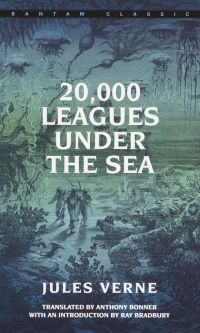
Get the Bantam Classics Bonner translation of 20,000 Leagues Under the Sea
Introduction by Ray Bradbury.
Available as a mass market paperback (ISBN 9780553212525, 448 pages).
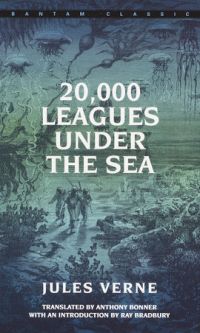
Get the Bantam Classics Bonner translation of 20,000 Leagues Under the Sea
Introduction by Ray Bradbury.
Available as an ebook (ISBN 9780553897418).
Who was Walter James Miller?
Walter James Miller was a prolific American writer and translator.
» NYT Obituary of Walter James Miller
» Verniana tribute to Walter James Miller
Quick facts about the Miller translation of Twenty Thousand Leagues under the Sea
Title: Twenty Thousand Leagues Under the Sea
Availability: Out of print and still under copyright.
Completeness: Complete new translation. Has illustrations.
More about the Miller translation of Twenty Thousand Leagues under the Sea
Uses American spelling.
Translation by Walter James Miller, assisted by Judith Ann Tirsch.
Published by Washington Square Press in hardcover in 1965 and in paperback in 1966 and 1970.
Illustrated by Walter Brooks. Afterword by Damon Knight. 22+389 pages.
Includes “Jules Verne in America: A Translator’s Preface” by Walter James Miller.
From the book’s jacket flap:
“This fresh, modern translation by Professor Walter James Miller is the first one based upon the entire French text of 1869. Besides restoring the cut passages—some of which throw new light on the characters of the novel, especially Captain Nemo—Professor Miller rigorously checked all the peculiar scientific errors that abound in the standard translations…. The work of months of difficult research and careful editing, this translation has truly been a labor of love.”
From the Translator’s Note in the Ron Miller translation:
“Miller’s [translation] is good, but I find it compressed; narration and dialogue are often paragraphed.”
As Verne Smiles by Walter Miller
“In 1963, I agreed to write for Washington Square Press an introduction to a new school edition of Twenty Thousand Leagues under the Sea. Although the title page gave no date or credit to any translator, I managed to find out that this version was published in 1872, it was by Mercier Lewis, and that that was one of the pseudonyms used by the Reverend Lewis Page Mercier…. My editor at Washington Square could easily have said, ‘Let’s just do what all the other publishers do. Put out Mercier Lewis.’ The problem of course was that a long-dead translator does not have to be paid, and I was still very much alive…. Ethics won the day.” Instead of merely writing an introduction, Miller made a new translation, which was published in 1965, with a ground-breaking introduction.
North American Jules Verne Society: “The Rehabilitation of Jules Verne in America: From Boy’s Author to Adult’s Author — 1960-2003” by Walter James Miller
“In 1963, Simon & Schuster asked me to write an introduction to their new edition of the ‘standard’ translation of Twenty Thousand Leagues. This was the 1872 version by Mercier Lewis, one of the pseudonyms of the Reverend Lewis Page Mercier, M.A. from Oxford. I came upon a strange sentence at the opening of Chapter 2, Part I. Professor Aronnax says: ‘I had just returned from a scientific research in the disagreeable territory of Nebraska.’ This so puzzled me that I resorted to the French. I found that Aronnax actually had come back from the badlands! … I finally calculated that 23% of Verne’s text had been junked. Lewis had omitted so much that by the time he reached the subject matter of Verne’s chapter 13 he just called it chapter 12. Ironically, Verne’s chapter 13, ‘The Nautilus,’ is missing entirely from Lewis’ table of contents! Of course, these cuts meant that not only Verne’s scientific and philosophical, but also his literary integrity had been destroyed. The ‘standard’ translation features a haphazard story line, shallow characterization, and an intellectual depth of near zero. We have been stuck with this version for five generations. At least five publishing houses still issue this version as authentic Verne…. My editor at Simon & Schuster agreed that we could not help perpetuate Mercier Lewis’ travesty. He assigned me to do a new translation…. The most valuable feature of my Simon & Schuster translation, which appeared in 1965, was that I did write an introduction—”Jules Verne in America’.”
North American Jules Verne Society: “Two Great Writers”
“In 1965, Walter James Miller published his revolutionary edition of Twenty Thousand Leagues under the Sea with his ‘Jules Verne in America: A Translator’s Preface.’ He exposed the ‘standard translations’ that had been rushed into print in the 19th century. They omitted many of Verne’s most intellectual, scientific, and political passages, and dashed off many crucial errors in words and numbers. Verne became known as ‘a boy’s author,’ and his critical reputation hit bottom. In one month after publication, Miller appeared on 27 radio and TV shows with his revelations. Several scholars were inspired to do their Ph.D. dissertations on Verne; many translators produced new, complete, reliable versions.”
Science Fiction Studies: “Two Titans Remembered: Walter James Miller (1918-2010) and E[verett] F[ranklin] Bleiler (1920-2010)” by Arthur B. Evans
“Miller was the first American academic to call attention to what he called the ‘two Jules Vernes,’ the European one and the American one. As Miller explains, European readers admire Verne for his attention to scientific method, his concern for technical accuracy, his ability to work wonders with authentic facts and figures. But American readers have the impression that Verne is somewhat casual with basic data and arithmetic, even with the details of plot and character. Condescendingly, they think of the Voyages Extraordinary as ‘children’s books.’ American science-fiction writers have clobbered Verne for his ‘vagueness’ and for the ‘gaps’ in his technical explanations…. Miller then goes on to give an extensive analysis of the poor English-language translation of Verne’s Twenty Thousand Leagues, comparing it with the French original and citing a host of textual examples to bolster his argument. This critical essay succeeded in popularizing the notion that there was a tangible cause-effect link between Verne’s less-than-literary reputation in Anglophone countries and the many abridged and bowdlerized translations that served as the ‘standard’ editions of Verne’s works in those same countries.”
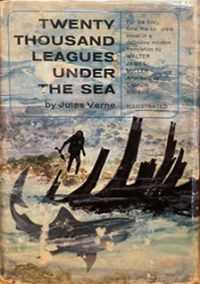
Get the Washington Square Press Miller translation of Twenty Thousand Leagues under the Sea: A Definitive Modern Translation
Out of print. You may be able to find a second-hand copy. LCCN 65-25245
Available as a hardcover.
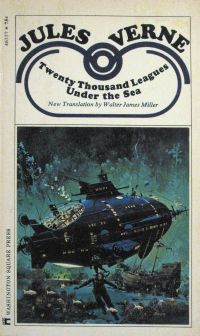
Get the Washington Square Press Miller translation of Twenty Thousand Leagues under the Sea: A Definitive Modern Translation
Out of print. You may be able to find a second-hand copy.
Available as a paperback (ISBN 0671465570, 390 pages).
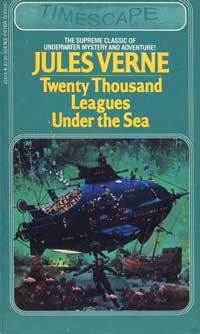
Get the Timescape Miller translation of Twenty Thousand Leagues under the Sea: A Definitive Modern Translation
Out of print. You may be able to find a second-hand copy.
Available as a paperback (ISBN 9780671434731, 386 pages).
Who was Mendor T. Brunetti?
Mendor T. Brunetti was a professor, author, and translator.
» NYT Obituary of Mendor T. Brunetti
Quick facts about the Brunetti translation of Twenty Thousand Leagues under the Sea
Title: 20,000 Leagues Under the Sea
Availability: In print.
Completeness: Complete.
More about the Brunetti translation of Twenty Thousand Leagues under the Sea
Uses American spelling.
An out-of-print Franklin Library edition uses this translation.
The current (2010) Signet edition includes an introduction by Stephen Baxter.
I obtained the extract below by tinkering with the scan of the Brunetti edition of Twenty Thousand Leagues Under the Sea that’s on Google Books. The scan does not allow browsing, only searching; I searched for words that appear in the first two paragraphs of Chapter 1 and retrieved several snippets that together contained the text of the whole first paragraph.
This translation is not missing the paragraphs that Mercier, Allen, and Evans are missing from Chapter 1.
From the Translator’s Note in the Ron Miller translation:
“Brunetti’s [translation] is extremely accurate so far as content is concerned, but he has heavily rewritten Verne; the style is very much Bruneti’s own.”
North American Jules Verne Society: “The Rehabilitation of Jules Verne in America: From Boy’s Author to Adult’s Author — 1960-2003” by Walter James Miller
“Across the hall from my office at New York University sat a distinguished Romance language teacher, Mendor Thomas Brunetti. I talked him into doing the NAL translation, and that gave me a chance to get into print some important improvements over my S&S edition. And in 2001, when NAL decided to put out a new edition of Brunetti’s book, I got to write an afterword in which I put into the record for the first time the story of our collaboration. Later Brian Taves told me that these early Miller-Brunetti efforts inspired him to become a Verne scholar. Now Verne became respectable in the academic world.”
Extract from the Brunetti translation of Twenty Thousand Leagues under the Sea
First paragraph of Chapter 1:
The year 1866 was marked by a strange occurrence, an unexplained and inexplicable phenomenon that surely no one has forgotten. People living along the coats, and even far inland, had been perturbed by certain rumors, while seafaring men had been especially alarmed. Merchants, shipowners, captains and skippers throughout Europe and America, naval officers of many nations, and governments on both continents—all were deeply concerned.
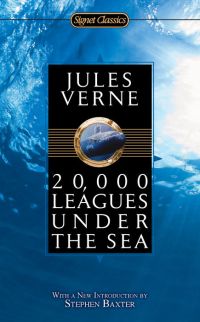
Get the Signet Classics Brunetti translation of 20,000 Leagues Under the Sea
Foreword by Brunetti, introduction by Stephen Baxter, and afterword by Walter James Miller.
Available as a mass market paperback (ISBN 9780451531698, 464 pages).
Who were Lewis Page Mercier and Walter James Miller?
See above for information on Lewis Page Mercier and Walter James Miller.
Quick facts about the Mercier and Miller edition of Twenty Thousand Leagues under the Sea
Title: The Annotated Jules Verne, Twenty Thousand Leagues under the Sea: The Only Completely Restored and Annotated Edition
Availability: Out of print and under copyright.
Completeness: Complete. Miller supplies the passages that were missing from the original Mercier translation. Has illustrations and marginal notes.
More about the Mercier and Miller edition of Twenty Thousand Leagues under the Sea
Uses British spelling.
Published by Thomas Y. Crowell in 1976 and New American Library in 1977.
This version is *not* a new translation. It is a version of the Mercier translation. Miller has supplemented the Mercier translation with his own translations of missing words, phrases, and passages and with notes explaining the novel’s scientific, literary, and historical context and flaws in the translation.
From the foreword:
“[In this volume,] I’ll present, as Exhibit A, the standard version of Twenty Thousand Leagues under the Sea—but in a new context. That is, I shall restore, in my own new translation [and in brackets like these], all the many passages omitted from the ‘standard’ version.”
The book is laid out in two columns on each page: the main column contains the English text with superscript numbers referring to the marginal notes, and the margins contain the notes.
The book has 150 illustrations, which illustrate the novel and also the factual notes.
It contains an 18-page foreword (“A New Look at Jules Verne”) and a 4-page afterword by Walter James Miller, and a 3-page bibliography of sources related to his preparation of the work.
JulesVerne.ca: “Books in review” by Arthur B. Evans
“[O]ne might wonder: what are the differences between Mickel’s “Complete” Twenty Thousand Leagues and the fine translation done by Walter Miller in 1976 which he called the “Annotated” Twenty Thousand Leagues (wherein he attempted—prior to Mickel—to reestablish the original)? Mickel explains: [Miller] provides the Mercier Lewis translation and supplements it with an original translation of the portions of Verne’s work which had been omitted. …Although it is interesting to read the Mercier Lewis translation and it was important to Miller in making his case against the shortened English version, the modern reader might have been better served by an entirely new translation of Verne’s novel. (63)”
From the Translator’s Note in the Ron Miller translation:
“[M]any of Mercier’s translating errors are left unexplained, and many of the missing parts are still missing.”
From Hollywood Presents Jules Verne, by Brian Taves, page 144:
“[T]he 1965 translator’s preface by Walter James Miller for his new edition of Twenty Thousand Leagues under the Seas published by Washington Square Press, revealed the extent of the damage done by earlier translators. Miller, a New York University professor with a background in both engineering and literature, was uniquely qualified to challenge the decades of misreadings of Verne. He delineated in a clear, unmistakable manner the typical textual problems that had plagued translations of this and other Verne novels. Miller was not the first new translator of Twenty Thousand Leagues under the Seas, but previous revisions did not indicate the problems with the 1873 Mercier version.”
Extract from the Mercier and Miller translation of Twenty Thousand Leagues under the Sea
See an image of page 1 showing two-column format.
First paragraph of Chapter 1:
Part 1: Chapter I: A Shifting Reef [1]
The year 1866 was signalised by a remarkable incident, a mysterious and inexplicable phenomenon, which doubtless no one has yet forgotten. Not to mention rumours[2] which agitated the maritime population, and excited the public mind, even in the interior of continents, seafaring men were particularly excited. Merchants, common sailors, captains of vessels, skippers, both of Europe and America, naval officers of all countries, and the Governments of several states on the two continents, were deeply interested in the matter.
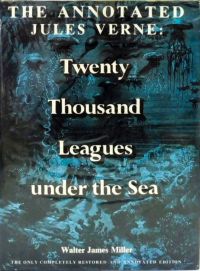
Get the Thomas Y. Crowell Mercier and WJ Miller translation of The Annotated Jules Verne, Twenty Thousand Leagues under the Sea: The Only Completely Restored and Annotated Edition
Out of print. You may be able to find a second-hand copy. 1976.
Available as a hardcover (ISBN 9780690011517, 362 pages).
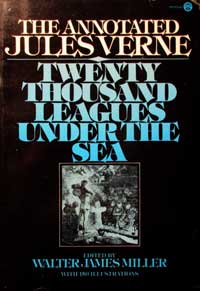
Get the New American Library Mercier and WJ Miller translation of The Annotated Jules Verne, Twenty Thousand Leagues under the Sea: The Only Completely Restored and Annotated Edition
Out of print. You may be able to find a second-hand copy. 1977.
Available as a paperback (ISBN 9780452004740, 362 pages).
Who is Ron Miller?
Ron Miller is a science and science-fiction illustrator with many books and awards to his name. More about Ron Miller:
» Ron Miller’s Black Cat Studios
» Ron Miller’s Black Cat Press
» Page about Ron Miller at the Encyclopedia of Science Fiction
Quick facts about the Ron Miller translation of Twenty Thousand Leagues under the Sea
Title: Twenty Thousand Leagues under the Seas
Availability: Out of print.
Completeness: Complete. Includes color and black-and-white illustrations. Includes a few chapter endnotes.
More about the Ron Miller translation of Twenty Thousand Leagues under the Sea
Uses American spelling.
Includes numerous illustrations by Ron Miller. Also includes a few explanatory chapter endnotes.
Vernian Era: “The Novel in the Vernian Era: Twenty Thousand Leagues under the Sea” by Michael and Karen Crisafulli
“Ron Miller published a complete and corrected translation, built on Lewis, in 1988. That version is out of print, but Ron has made it available as a print-on-demand book at lulu.com. This version is a smaller format than the original Unicorn edition, but contains all the text with typos corrected. He has produced new black and white illustrations based on the original illustrations and added some new ones.” (Note: it is not available on Lulu anymore.)
Vernian Era: “The Novel in the Vernian Era: Twenty Thousand Leagues under the Sea” by Michael and Karen Crisafulli
“Ron Miller also provides the story for the excellent 1998 Eyewitness Classics edition, illustrated by Paul Wright. Paul has taken some liberties with the Ron’s Nautilus design but the illustrations are very good. One of the things I like about this version is its updating of Verne’s didacticism about science and engineering. It is no longer in the text but in accompanying sidebars and photographs. A child who reads this book will learn a lot about the sea and about submarines.” (Note: this book says “retold” by Ron Miller, so the Eyewitness Classics version is a retelling, not a translation.)
From the Translator’s Note:
“I started with [the old Mercier translation] because Mercier translated Verne very literally, changing word order only to the degree dictated by the differences in grammar. As a result, the style is very true to Verne’s own…. Errors in translation and scientific errors (Mercier’s not Verne’s…) were all fixed. This amounted to literally several thousand corrections…. [T]he missing text was replaced. More than three hundred passages were restored, ranging from individual paragraphs to several pages. Eventually, the finished manuscript was more than one-fifth longer than the ‘standard’ text!”
Extract from the Ron Miller translation of Twenty Thousand Leagues under the Sea
First paragraph of Chapter 1:
The year 1866 was signalized by a bizarre incident, a mysterious and inexplicable phenomenon, which doubtless no one has yet forgotten. Not to mention rumors which agitated the maritime population and excited the public mind, even in the interior of continents, seafaring men were particularly excited. Merchants, common sailors, captains of vessels, skippers and masters both of Europe and America, naval officers of all countries, and the Governments of several states on the two continents, were deeply interested in the matter.
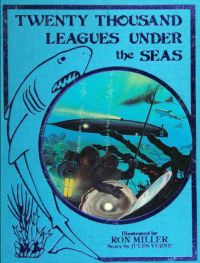
Get the Unicorn Mercier and R Miller translation of Twenty Thousand Leagues under the Seas
Out of print. You may be able to find a second-hand copy.
Available as a hardcover (ISBN 9780881010855, 270 pages).
Who was Frederick Paul Walter?
Frederick (Rick) Paul Walter was an actor, writer, translator, and Verne scholar.
» Obituary of Frederick Paul Walter
SUNY Press says: “Frederick Paul Walter is a scriptwriter, broadcaster, librarian, and amateur paleontologist. A long-standing member of the North American Jules Verne Society, he served as its vice president from 2000 to 2009. Walter has produced many media programs, articles, reviews, and papers on aspects of Jules Verne and has translated many Verne novels, including Amazing Journeys: Five Visionary Classics and The Sphinx of the Ice Realm, both also published by SUNY Press. He lives in Albuquerque, New Mexico.”
Quick facts about the Walter translation of Twenty Thousand Leagues under the Sea
Title: 20,000 Leagues Under the Seas: A World Tour Underwater
Availability: Strangely, this text seems to be in the public domain and is available online and in several printed editions. Simultaneously, it *also* seems to be copyrighted. Hm.
Completeness: Complete.
More about the Walter translation of Twenty Thousand Leagues under the Sea
Uses American spelling.
FP Walter apparently released his 1991 translation for free, but this decision seems to have been backpedaled a bit…
- There used to be a Standard Ebooks edition using this “public domain” translation, but it has been taken down. Here’s a discussion group among Standard Ebooks contributors talking about this issue.
- Wikisource also used to have a copy, but it’s gone.
- There is still a “copyright 1999” version of this translation available on Project Gutenberg (book 2488). Older links on the internet say PG 2488 is the 1991 version, but it’s not labeled as 1991 now.
Maybe the reason the public domain versions have been (largely) taken down is that the 1993 Miller/Walter edition is based on this translation. It could also be because SUNY published a multi-novel omnibus in 2010 and a single-title volume in 2013.
Tumblr via Reddit: “The best translation of 20000 Leagues Under The Sea and the man behind it”
“Librarian? President of the Jules Verne Society? *Amateur* paleontologist?? Definitely sounds like the kind of guy who’d make the century’s best translation of 20,000 Leagues because he thinks it’s Fun, and would afterwards say, ‘Money? Oh yeah, that exists, thanks for reminding me … anyway look how I translated this passage! I know it’s different, but I think it’s what Jules Verne meant because -‘ and he’d give you a copy so you’d know what he was talking about.” Someone replied: “You fools. That is Jules Verne.”
Verniana: “Triumphant Translating: It’s a Matter of Style” Review 2 (by William Butcher)
Regarding the 2010 SUNY edition: “Walter is consistently more faithful than previous American editions…. The register, above all, strikes a near-perfect balance between Mercier-style convolutions and the over-modernised, unliterary and informal style that has marked many previous attempts, between the archaic and the anachronistic, between the obscure and the over-amplified…. The novel above all reads beautifully, and could generally pass as a text originally written in English…. Walter benefits from his scientific background to put some order into the extensive biological terminology and is excellent on nautical terms…. Overall, then, this recent translation by Walter must surely count as the best American version, ahead even of Brunetti. The effort of producing more than 140,000 words of fluent, idiomatic and accurate text is almost unfathomable. If only as much attention was devoted to textual issues in Verne’s homeland!”
Science and Showbiz: Going Places with Jules Verne (Introduction to Amazing Journeys) by F.P. Walter
“The book in your hands is… a handy omnibus volume of Verne’s best-loved novels in new, accurate, communicative translations. These five classics are more than household words, they’re joyous parts of our American heritage… So this volume is targeted to the American public: these are reader-friendly translations, translations complete down to the smallest substantive detail, translations that aim to convey the humor, theatricality, and scientific excitement this essay has been honoring…. [T]hese new translations benefit not only from current Verne scholarship but from today’s worldwide access to academic, institutional, and educational databases: it’s possible to compare and cross-check multiple versions of the original French…. Finally these translations work to suggest Verne’s style and tone—the stealthy wit, irreverent prankishness, tale-spinning virtuosity, and showbiz flamboyance of one of literature’s leading humorists and satirists. This is a Verne almost completely unknown to Americans… yet a Verne who has an uncannily American mindset. Specialists, educators, and students are encouraged to consult the Textual Notes starting on p. 657; these pinpoint the policies, priorities, and textual decisions underling the translations.”
Extract from the Walter translation of Twenty Thousand Leagues under the Sea
First paragraph of Chapter 1 (from Gutenberg 2488):
The year 1866 was marked by a bizarre development, an unexplained and downright inexplicable phenomenon that surely no one has forgotten. Without getting into those rumors that upset civilians in the seaports and deranged the public mind even far inland, it must be said that professional seamen were especially alarmed. Traders, shipowners, captains of vessels, skippers, and master mariners from Europe and America, naval officers from every country, and at their heels the various national governments on these two continents, were all extremely disturbed by the business.

Get the Macmillan Collector's Library Walter translation of Twenty Thousand Leagues Under the Seas
Illustrated by Edouard Riou, with an Afterword by David Stuart Davies. Or Ned Halley. I'm not too sure.
Available as a hardcover (ISBN 9781509827879, 563 pages).

Get the Aladdin Walter translation of Twenty Thousand Leagues Under the Seas
The copyright page attributes the translation to "Frederick Amadeus Malleson". I believe this is a mistake; as far as I know, Malleson never translated this novel; he translated Journey to the Center of the Earth. The text in this edition matches the F.P. Walter translation. This edition includes editorial revisions.
Available as a paperback (ISBN 9781665934268, 592 pages).

Get the Aladdin Walter translation of Twenty Thousand Leagues Under the Seas
The copyright page attributes the translation to "Frederick Amadeus Malleson". I believe this is a mistake; as far as I know, Malleson never translated this novel; he translated Journey to the Center of the Earth. The text in this edition matches the F.P. Walter translation. This edition includes editorial revisions.
Available as a hardcover (ISBN 9781665934275, 592 pages).

Get the Aladdin Walter translation of Twenty Thousand Leagues Under the Seas
The copyright page attributes the translation to "Frederick Amadeus Malleson". I believe this is a mistake; as far as I know, Malleson never translated this novel; he translated Journey to the Center of the Earth. The text in this edition matches the F.P. Walter translation. This edition includes editorial revisions.
Available as an ebook (ISBN 9781665934282).
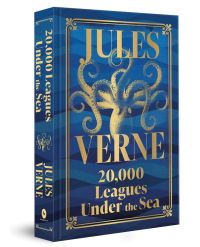
Get the Fingerprint Classics Walter translation of Twenty Thousand Leagues Under the Seas
Gold edges, decorated endpapers, ribbon bookmark.
Available as a hardcover (ISBN 9789362141699, 448 pages).

Get the SUNY Walter translation of Twenty Thousand Leagues Under the Seas
Available as a paperback (ISBN 9781438446646, 419 pages).

Get the SUNY Walter translation of Twenty Thousand Leagues Under the Seas
Available as a hardcover (ISBN 9781438446639, 419 pages).

Get the SUNY Walter translation of Twenty Thousand Leagues Under the Seas
Available as an ebook.
Get the Gutenberg Walter translation of Twenty Thousand Leagues Under the Seas
Copyright 1999. With illustrations by Milo Winter. Translation is "based on the original French texts published in Paris by J. Hetzel et Cie. over the period 1869-71."
Available as an ebook.
Get the Conversation Tree Press Walter translation of Twenty Thousand Leagues Under the Seas
Three different amazing editions! See website for details.
Available as a limited-edition hardcover.
Who is Emmanuel Mickel?
Emmanuel Mickel is an emeritus professor of French Language and Literature.
» Indiana University Bloomington faculty page for Emmanuel Mickel
Quick facts about the Mickel translation of Twenty Thousand Leagues under the Sea
Title: The Complete Twenty Thousand Leagues Under the Sea: A New Translation of Jules Verne’s Science Fiction Classic
Availability: Out of print and under copyright.
Completeness: Complete and has notes. And illustrations.
More about the Mickel translation of Twenty Thousand Leagues under the Sea
Uses American spelling.
Contains an introduction and notes by Emmanuel Mickel.
Science Fiction Studies: “New and Recycled Translations of Jules Verne” by Arthur B. Evans
“Mickel’s version must be recognized as truly professional in its scope and its integrity. What Mickel has done is to use the original Hetzel (1869, 1870, 1871) French texts as his point of departure, instead of the hackneyed and much-abridged 1928 Hachette text (used by many 20th century translators)…. In addition to his re-translation of the text itself, Mickel is generous with explanatory footnotes (a very Vernian trait). And he also includes a lengthy introduction which discusses a wide variety of biographical, thematic, and critical issues pertinent to Jules Verne’s life and work…. Mickel’s critical introduction is one of the most informed (i.e., the best) that I have seen in English. The book also provides a chronology of the events portrayed in Vingt mille lieues sous les mers, a relatively up-to-date critical bibliography, and reprints of many (though not all) of those now-famous Riou, Neuville, and Hildibrand lithographs found in the original. All in all, this Indiana UP publication of The Complete Twenty Thousand Leagues Under the Sea proves to be an excellent translation and a fine piece of scholarship.”
From the Select Bibliography in the 2019 Oxford/Butcher edition:
“[T]hin introduction, strongly criticizing Mercier, although the translation is in fact mainly Mercier’s; most of the 482 notes are uninformative.”
There really isn’t much online commentary about Mickel’s version, but a couple of other sources indicate that the translation does rely on Mercier’s:
Collecting Science Fiction Books: “A Fan’s View” by John Hertz
“Butcher says the 1991 version by Emanuel Mickel is Mercier’s word-for-word, although Mickel restores Mercier’s cuts.”
Vernian Era: Reviews
“[Regarding the Mickel translation:] This volume also includes explanatory notes and woodcut illustrations, but the translation seems spotty, likely just a modernerzation [sic] of Lewis’ words rather than a new translation. For example there is a Lewis mistranslation in the chapter ‘Some Figures’ that confuses the second hull with the keel. The misstatement is maintained in this translation, although the metric units have been restored…. The translation notes, however, avoid some of the modern day slant found in Miller’s notes.”
Extract from the Mickel translation of Twenty Thousand Leagues under the Sea
First paragraph of Chapter 1:
The year 1866 was marked by a strange incident, an unexplained and inexplicable phenomenon, which doubtless no one has yet forgotten. Not to mention rumors which disturbed the maritime population and excited the public mind in the interior of continents, but even seafaring men were excited. Merchants, common sailors, ship captains, skippers, of both Europe and America, naval officers of all countries, and the governments of several states on the two continents were keenly interested in the matter.

Get the Indiana University Press Mickel translation of The Complete Twenty Thousand Leagues Under the Sea: A New Translation of Jules Verne's Science Fiction Classic
Out of print. You may be able to find a second-hand copy. (Good luck.)
Available as a hardcover (ISBN 9780253338105, 499 pages).
Who are Walter James Miller and Frederick Paul Walter?
See above for information about Walter James Miller and Frederick Paul Walter.
Quick facts about the Miller and Walter translation of Twenty Thousand Leagues under the Sea
Title: Jules Verne’s Twenty Thousand Leagues under the Sea: The Completely Restored and Annotated Edition
Availability: Out of print and under copyright.
Completeness: Complete and has footnotes. And illustrations.
More about the Miller and Walter translation of Twenty Thousand Leagues under the Sea
Uses American spelling.
Published by the Naval Institute Press. “Newly translated and annotated by Walter James Miller and Frederick Paul Walter.”
Contains an introduction titled “Jules Verne: Man of the Twenty-first Century.”
As Verne Smiles by Walter Miller
“One third through—slowed down by the desire this time to put out the lists of fishes as they are properly called in America—I asked NIP to take Rick Walter on board. He is well-versed in marine biology and technology and actually had his own translation in progress. We joined our efforts.”
North American Jules Verne Society: “The Rehabilitation of Jules Verne in America: From Boy’s Author to Adult’s Author — 1960-2003” by Walter James Miller
“United States Naval Institute Press asked Brian Taves at the Library of Congress to nominate someone to do a special deluxe annotated translation of Twenty Thousand Leagues. After I was one-third through I got the bright idea to take aboard Frederick Paul Walter, whose translation for Random House had run afoul of anti-Verne prejudice. I especially wanted Rick as a collaborator because he is well-versed in marine biology and technology and has done exhaustive research on the proper American names for the thousands of species of fish that Verne describes. NIP produced our edition in 1993 and our editor there claims that it’s their longest title still in print; it’s now in its fourth printing; it’s due for a second edition in 2005, the centennial of Verne’s death.”
Extract from the Miller and Walter translation of Twenty Thousand Leagues under the Sea
First paragraph of Chapter 1:
The year 1866 was marked by a bizarre situation, a phenomenon unexplained and inexplicable that probably no one has yet forgotten. Putting aside those rumors that upset people in the seaports and excited the public mind far inland, the significant fact is that seafaring men were especially agitated. merchants, shipowners, ships’ captains, skippers and masters from Europe and America, naval offices of all nations, and finally the various governments on those two continents, all became deeply concerned.

Get the Naval Institute WJ Miller and Walter translation of Jules Verne's Twenty Thousand Leagues under the Sea: The Completely Restored and Annotated Edition
Out of print. You may be able to find a second-hand copy.
Available as a hardcover (ISBN 9780870216787, 424 pages).
Who is William Butcher?
William Butcher is an author, translator, and Verne scholar who lives in Hong Kong. He has also translated Verne’s Journey to the Center of the Earth, Around the World in Eighty Days, and The Adventures of Captain Hatteras. He has also published a biography of Verne.
Quick facts about the Butcher translation of Twenty Thousand Leagues under the Sea
Title: Twenty Thousand Leagues under the Seas
Availability: In print.
Completeness: Complete and has footnotes.
More about the Butcher translation of Twenty Thousand Leagues under the Sea
Uses British spelling.
Originally published in 1998. 2nd edition published in 2019. 2nd edition includes Acknowledgements, List of Abbreviations, Introduction, Note on the Text and Translation, Select Bibliography, Chronology, two Appendixes (Inception, Sources) and explanatory endnotes. Endnotes include material from Verne’s original manuscript drafts.
New in the 2nd edition, according to the publisher:
“As well as a line-by-line revision of the translation, addition of material about Verne’s life, the literary and scientific context, and the sections cut from the two manuscripts.”
From Note on the Text and Translation (Google Books preview):
“For this edition the translation has been systematically revised. The Introduction, Note on the Text and Translation, and many of the Explanatory Notes in the original 1998 edition have largely been retained; but the Chronology, Select Bibliography, and Appendices have been updated or replaced.
From the “Note on the Text and Translation: The Present Translation” in the Butcher/Oxford edition:
“The text used here is the Presses Pocket one (1991), which generally follows the 1871 edition. This translation is an entirely original one, benefiting from the most recent scholarship on Verne and closely following the French text.”
Science Fiction Studies: Review [of three Oxford/Butcher editions] by Arthur B. Evans
“Butcher’s versions are ‘critical editions.’ In addition to informative documentation on sources and/or critics’ responses in the Appendix, each volume features an up-to-date scholarly Introduction and a veritable treasure-trove of Explanatory Notes on the text itself (manuscript variants, nineteenth-century references, biographical notes, etc.). This very valuable critical apparatus—unique to the ‘Oxford World’s Classics’—makes them stand head and shoulders above the other English translations of Verne I have seen…. for classroom use or scholarly research, these Oxford UP translations of Jules Verne are definitely the ones to buy.”
Verniana: “Triumphant Translating: It’s a Matter of Style” Review 2 (by William Butcher)
Butcher describes the problem he is addressing: “The text, as generally known in the English-speaking world, is triply faulty.” Briefly, he means: the serialization altered Verne’s intent; there is no canonical French text; the English translations are inadequate. “Perhaps as a result of these infidelities, the public reputation of the novel is, I believe, grossly inaccurate. The main protagonist has been misunderstood, his nationality distorted, and the conceptual core of the book, its aim according to the author himself, has been falsified.”
French Quest: “Comments on ‘Hidden Treasures: The Manuscripts of Twenty Thousand Leagues Under the Sea’ by William Butcher” by Robyn Lowrie
“William Butcher, a scholar who was able to examine two manuscripts of Vingt Mille and compare them with the final publication… found many discrepancies between Verne’s manuscript and Hetzel’s final publication of Vingt Mille; many which he feels betray the vision that Verne had for his protagonist, Captain Nemo, his relationship with his guest Dr. Arronax, and the voyage of the Nautilus. In fact, Butcher proposes to republish Verne’s novel using a mixture of the original text by Verne with the current publication…. Is it advisable to ‘mix and match’ earlier, edited versions with the present version? Could one still attach Verne’s name to this new version? Hetzel’s text can no longer be accepted as accurate or authentic, Butchers claims.”
Science Fiction Studies: “Hidden Treasures: The Manuscripts of Twenty Thousand Leagues Under the Sea” by William Butcher (Article also available at depauw.edu.)
“It is clearly important to determine (a) what [Verne’s publisher] Hetzel did not appreciate [about Twenty Thousand Leagues under the Seas] and (b) what Verne did about it, questions not considered to date.” Butcher examines two manuscripts and also Verne’s correspondence to shed light on mysteries hitherto mysterious. “Verne is forced to take on board most of the publisher’s ideas…. All is not irremediably lost, though, for the novelist kept the evidence, just in case posterity might be interested…. Would it be better, then, to publish the novel by reinstating the passages lost due to the publisher’s pressure? The answer must take into account the stylistic improvements Verne made, of his own free will, over the successive drafts. Some of the substantive changes may also fall into the category of spontaneous changes of mind. Some of Hetzel’s suggestions may actually be beneficial—and often Verne adapts them to his own ends. But we shall probably never know which of the categories most of these changes fall into.”
Complete Review: Review of Oxford/Butcher edition by M.A. Orthofer
“Even in English, Verne is a popular and well-known author, but Butcher is correct that he is not taken as seriously or valued as highly as his work warrants, with the versions on offer — often also edited and marketed for a younger-readers’ market — too often confirming the opinion that the work is just not that good. So, if the originals are out of reach, it is important to be aware of what translation one is reading…. Butcher’s Introduction to this Oxford World’s Classics edition is also a notch above the usual classics-introduction…. [Butcher] suggests a number of interpretations and approaches to the novel in a jaunty manner; his Introduction is ‘scholarly’ but not too dry or dense or long. He also is critical where appropriate, including in his Notes on the Text and Translation, where he points out some of the novel’s numerous implausibilities. The fairly extensive endnotes — Explanatory Notes — also both usefully explain and comment on the text, and are of particular interest in also pointing out the textual variants, as there are two extant manuscript versions of the novel, with the occasional interesting variation…. Even for those familiar with the story, from childhood reading or the movie versions, Twenty Thousand Leagues under the Seas remains good fun and a good read.”
In the Select Bibliography in the 2019 edition, Butcher lists and briefly describes several translations:
- Regarding the 1872 Mercier translation: “[T]he first English-language version, translated by Lewis Mercier, still the most reprinted; cuts more than 20 per cent and contains howlers.”
- Regarding the 1991 Mickel translation: “[T]hin introduction, strongly criticizing Mercier, although the translation is in fact mainly Mercier’s; most of the 482 notes are uninformative.”
- Regarding the 1966 Miller translation: “[U]seful introduction on the problems of translation; although called ‘New’ and “definitive’, and castigating previous editions, especially Mercier, the translation omits portions of Verne’s text).
- Regarding the 1993 Miller and Walter translation: “[I]nteresting introduction on the problems of translation; very good translation; often informative notes.”
Verniana: “Triumphant Translating: It’s a Matter of Style” Review 1 (by Frederick Paul Walter)
Regarding the 1998 Oxford translation by Butcher, which Walter characterizes as “sculpted and economical”: “Butcher not only translated the novel, he clarified it in over a hundred pages of front and end matter…. [His] research included an exploration of the novel’s development, plot, themes, structure, and characters. It also weighed the physical evidence: two manuscripts at the Bibliothèque nationale, the Magasin serialization, softcover in-18 edition, and clothbound octavo edition. Lastly the book provided a thorough critical framework: translating policies, a generous bibliography, a full chronology of Verne’s life, an appendix on submersibles, and sixty pages of explanatory notes that not only dealt with textual issues but offered dozens of manuscript variants, all deftly translated…. Using the Presses Pocket reprint (1991) as his working text, he limited himself to amending ‘clear spelling mistakes in real-world names and words found in dictionaries, normally indicating such changes.’ Elsewhere, as in Anthony Bonner’s 1962 Bantam translation, Butcher couches Verne’s miles as knots, also disclosing that ‘indications of interlocutors, ellipses, and exclamation marks have been slightly reduced, and very long sentences broken up.’ Which points to a prime feature of his translating: an air of speed and economy…. Because his publisher is Oxford University Press and he himself hails from the UK, it’s also likely that he sees Britons as his primary readership. Certainly his renderings have an unmistakable British accent, from idioms to cultural perspectives to units of measure…. Possibly the most likable aspect of Butcher’s work is its vernacular flavor…. Butcher is faithful to the spirit as much as the letter, going for sense, feeling, and English as we speak it…. Butcher’s renderings boast an unexpected extra value: sometimes he furnishes valid alternate readings for lines that have been rendered quite convincingly by earlier translators. The result? Bonus examples of Verne’s wordplay.”
Verniana: “Triumphant Translating: It’s a Matter of Style” by Frederick Paul Walter
Regarding the 2014 Folio Society edition, which contains an updated version of the Butcher translation, an introduction by Margaret Drabble, and illustrations by Jillian Tamaki: “Folio’s reissue offers merely an updated excerpt from his original introduction, a tiny fraction of his scholarly apparatus….[T]he Folio version is a reading edition rather than a scholarly one…. [Butcher] reveals (xxi) in his Note on the Text and Translation: ‘This Folio Society edition represents a full revision [of the OUP text]. In addition to the correction of a few misprints, it has undergone a systematic stylistic revision, aiming to smooth out the rough edges, increase the flow, and generally make the text more readable, while attempting to retain a high level of fidelity to the original.’ He makes a few substantive changes…. More significant are his thousands of stylistic tweaks, and since this is a reading edition, aimed even more directly at a general audience, it’s not surprising that his revisions have a still greater vernacular flavor, are even jauntier and more conversational than before…. In the final analysis Butcher’s revisions often produce wordings more communicative than his originals or almost any literal rendering. His secret: aim for meaning rather than surface fidelity…. this is a British publication, intended particularly for UK readers.’
Extract from the Butcher translation of Twenty Thousand Leagues under the Sea
First paragraph of Chapter 1 (preview at Amazon):
The year 1866 was marked by a strange event, an unexplained and inexplicable occurrence that doubtless no one has yet forgotten. Without mentioning the rumours which agitated the denizens of the ports and whipped up the public’s imagination on every continent, seafaring men felt particularly disturbed. The merchants, shipowners, sea-captains, skippers, and master-mariners of Europe and America, the naval officers of every country, and eventually the various national governments on both continents—all became extremely worried about this matter.

Get the Oxford Classics Butcher translation of Twenty Thousand Leagues under the Seas
2nd edition. Acknowledgements, List of Abbreviations, Introduction, Note on the Text and Translation, Select Bibliography, Chronology, Appendix: Sources of ideas on submarine navigation, Explanatory footnotes.
Available as a paperback (ISBN 9780198818649, 464 pages).

Get the Oxford Classics Butcher translation of Twenty Thousand Leagues under the Seas
2nd edition. Acknowledgements, List of Abbreviations, Introduction, Note on the Text and Translation, Select Bibliography, Chronology, Appendix: Sources of ideas on submarine navigation, Explanatory footnotes.
Available as an ebook (ISBN 9780192550644).
Who is David Coward?
David Coward is a translator and emeritus professor of French literature. He has translated works by Alexandre Dumas, Jules Verne, Pierre Choderlos de Laclos, Marquis de Sade, Georges Simenon, Gaston Leroux, and Denis Diderot.
Artellus Literary Agency: ” ‘How do you translate bread?’ An interview with Prof. David Coward”
In talking about his translation of A Maigret Christmas by Georges Simenon, Coward explains how he got into translation, what he likes, and what makes it hard.
Quick facts about the Coward translation of Twenty Thousand Leagues under the Sea
Title: Twenty Thousand Leagues Under the Sea
Availability: In print.
Completeness: Complete and has endnotes. And illustrations.
More about the Coward translation of Twenty Thousand Leagues under the Sea
Uses British spelling.
Includes a note on the text and illustrations, an introduction, endnotes, a chronology, and a list of works for further reading.
According to the note on the text and illustrations, Coward’s translation is based on a 1990 French reprint of the text of the illustrated 1871 edition. This edition came after the serialization, which ended in June 1870, and after a two-volume version whose volumes appeared in October 1869 and June 1870. The illustrations are from the two-volume version.
Institute of Translation and Interpreting: “New worlds of Jules Verne” by Gillian Robin
“To be fair, the translator’s task was not always easy. For example, the 1872 translation Twenty Thousand Leagues Under the Seas by Lewis Page Mercier omits many descriptive lists of marine life observed by the passengers on the Nautilus. This is fairly understandable when you realise that the original Vingt mille lieues sous les mers contains several long lists of obscure inhabitants of the deep – passages which, as David Coward ruefully says in the introduction to his 2017 translation, ‘the reader can skip, but which sorely try the translator’s patience’. How important is Verne’s wealth of detail, and what is lost by omitting it? Mid-century translator IO Evans argued that the long descriptive passages would have been off-putting even to the author’s contemporaries, let alone modern readers. Yet Coward suggests that 19th-century readers would have found the ‘fish lists’ interesting because they revealed new-found knowledge about life in the oceans, while Timothy A Unwin even describes them as having a certain ‘poetic and incantatory’ quality.”
Extract from the Coward translation of Twenty Thousand Leagues under the Sea
First paragraph of Chapter 1 (preview at Amazon):
The year 1866 was marked by a strange occurrence, an unexplained and indeed inexplicable phenomenon which surely no one can have forgotten. Though rumours abounded which alarmed the populations of ports and inflamed public sentiment in the interior of every continent, it was seafaring folk who felt the most afraid. Merchants, shipping companies, the captains of vessels, the skippers of boats and the marine commanders of Europe and America, officers of the navies of every nation and, in their wake, the governments of various countries of both continents, all gave their whole attention to the question and allocated it the highest priority.

Get the Penguin Classics Coward translation of Twenty Thousand Leagues Under the Sea
Includes a note on the text and illustrations, an introduction, endnotes, a chronology, and a list of works for further reading.
Available as a paperback (ISBN 9780141394930, 528 pages).

Get the Penguin Clothbound Classics Coward translation of Twenty Thousand Leagues Under the Sea
Cover Design or Artwork by Coralie Bickford-Smith. Includes a note on the text and illustrations, an introduction, endnotes, a chronology, and a list of works for further reading.
Available as a clothbound hardcover (ISBN 9780241198773, 528 pages).

Get the Penguin Classics Coward translation of Twenty Thousand Leagues Under the Sea
Includes a note on the text and illustrations, an introduction, endnotes, a chronology, and a list of works for further reading.
Available as an ebook.
Repositories of Jules Verne knowledge
The Encyclopedia of Science Fiction: Jules Verne
Describes Jules Verne’s life and work and provides a bibliography of English versions of his books and books about him.
Zvi Har’El’s Jules Verne Collection
The original Jules Verne fan community website, online since 1995.
- Archive.org copy: https://web.archive.org/web/20250712041848/http://jv.gilead.org.il/
- Another mirror: https://www.julesverne.ca/jv.gilead.org.il/index.html
Verniana
A multilingual online open access journal dedicated to Jules Verne studies.
JulesVerne.ca
A resource for collecting books and ephemera related to Jules Verne.
The North American Jules Verne Society
A non-profit organization that exists to promote interest in Jules Verne and his writings, provide a forum for the interchange of information and materials about and/or relating to Jules Verne and his works, stimulate Jules Verne research, and publish a newsletter of Jules Verne and Society related issues.
Jules Verne Forum (on Google Groups)
A group for everyone who is interested in Jules Verne and his works.
Jules Verne Forum (on Boards.net)
Another group for everyone who is interested in Jules Verne and his works.
Retranslation through the Centuries: Jules Verne in English
A book by Kieran O’Driscoll, ISBN 9783034302364, 288 pages.
A Bibliography of Jules Verne’s English Translations by Arthur B. Evans
“[This] bibliography lists the most common English translations of Jules Verne’s Voyages Extraordinaires. The opening passages from Verne’s original French texts and their different English translations are provided for purposes of identification and comparison.”
Jules Verne in English: A Bibliography of Modern Editions and Scholarly Studies by Arthur B. Evans
“This chronological bibliography provides an overview of English-language editions and scholarship on Jules Verne from 1965 to 2007.”
Related to Twenty Thousand Leagues under the Sea
A fun Reddit thread I enjoyed and maybe you will too.
“You won’t believe how far this submarine travelled! The answer will shock you!”
I didn’t know it, but there is a 2024 prequel TV series called Nautilus.
(Cancelled because flawed.)
Twenty Thousand Leagues under the Sea: Original French Text
First paragraph of Chapter 1 in the original French (from Project Gutenberg):
L’année 1866 fut marquée par un événement bizarre, un phénomène inexpliqué et inexplicable que personne n’a sans doute oublié. Sans parler des rumeurs qui agitaient les populations des ports et surexcitaient l’esprit public à l’intérieur des continents les gens de mer furent particulièrement émus. Les négociants, armateurs, capitaines de navires, skippers et masters de l’Europe et de l’Amérique, officiers des marines militaires de tous pays, et, après eux, les gouvernements des divers États des deux continents, se préoccupèrent de ce fait au plus haut point.
This version of Vingt Mille Lieues Sous Les Mers is illustrated by Alphonse Marie de Neuville and Edouard Riou:
Scans of two actual manuscript drafts written by Jules Verne are online at:
https://gallica.bnf.fr/ark:/12148/btv1b53067298j/
https://gallica.bnf.fr/ark:/12148/btv1b530672973/

Get Jules Verne: Four Novels by Jules Verne
"This revised, elegant book features the African exploration of Five Weeks in a Balloon; the story of Captain Nemo and his submarine in Twenty Thousand Leagues Under the Sea; Around the World in Eighty Days, the famous story of an incredible expedition; and the classic Journey to the Center of the Earth, which takes readers into our world’s geological past. With a genuine leather cover, printed endpapers, and a ribbon bookmark, as well as an introduction by an expert on Verne’s life and writing [Ernest Hilbert], it’s an excellent introduction to the work of this well-loved author." I'm not sure which translations these are, except that I expect they're all reprints of old public domain translations.
Available as a leather-bound hardcover (ISBN 9781607103172, 712 pages).

Get [3-novel omnibus] by Jules Verne
Journey to the Centre of the Earth (Anonymous Routledge), 20,000 Leagues Under The Sea (Frith), Round the World in Eighty Days (Frith).
Available as a hardcover (ISBN 9781841593517, 680 pages).
Get Jules Verne: Seven Novels by Jules Verne
Five Weeks in a Balloon, Around the World in Eighty Days, A Journey to the Center of the Earth, From the Earth to the Moon, Round the Moon, Twenty-Thousand Leagues Under the Sea and The Mysterious Island. Out of print. I'm not sure which translations these are, except that I expect they're all reprints of old public domain translations.
Available as a hardcover (ISBN 9781435122956, 1196 pages).

Get The Jules Verne Collection (7 volumes) by Jules Verne
Journey to the Center of the Earth (Malleson); Around the World in Eighty Days (Towle); In Search of the Castaways ("Charles Francis Horne"); Twenty Thousand Leagues Under the Sea ("Malleson" but actually Walter); The Mysterious Island (Kingston); From the Earth to the Moon and Around the Moon (Mercier and King); Off on a Comet (Frewer). Hardcover set also available (ISBN 9781665934398).
Available as a paperback box set (ISBN 9781665934381, 3520 pages).

Get The Best of Jules Verne (5 novels) by Jules Verne
Around the World in Eighty Days 9781853260902 (Desages), From the Earth to the Moon / Around the Moon 9781840226706 (Linklater), Journey to the Centre of the Earth 9781853262876 (Malleson), The Mysterious Island 9781840226249 (Kingston), Twenty Thousand Leagues Under the Sea 9781853260315 (Mercier).
Available as a paper back set (ISBN 9781848702226, 1824 pages).

Get Amazing Journeys (5 novels) by Jules Verne
Journey to the Center of the Earth, From the Earth to the Moon, Circling the Moon, 20,000 Leagues Under the Seas, Around the World in Eighty Days. All translated by Frederick Paul Walter. Ebook also available (ISBN 9781438432403).
Available as a paperback (ISBN 9781438432380, 678 pages).
If you want to read The Real Jules Verne™, it’s best to avoid reprints of the original Mercier translation because of the errors (which may or may not be corrected in reprints) and because of how much text is missing. (The persistence of these reprints really upsets some of the serious Jules Verne fans.)
Of the two other old translations that remain in print, the Frith (Vintage) translation is more complete than the Allen (Dover) translation. There’s not a good free ebook transcription of the Frith translation, but there is a PDF of pagescans, and there’s a good free ebook transcription for the Allen translation.
There are three in-print modern American translations. Versions of the 1990s FP Walter translation, which is copyrighted but is being treated as if it isn’t, are available from several publishers. The FP Walter translation is associated with the widely respected (but out-of-print) annotated Naval Institute Press edition by Miller and Walter, so I’d choose it over the 1960s Bonner (Bantam) and Brunetti (Signet) translations.
There are two in-print modern British translations. The Butcher (Oxford) translation contains a lot of extra material about Butcher’s research on the French manuscripts, but I don’t think I’m interested in that level of scholarly detail. Therefore, I’d choose the illustrated Coward (Penguin) translation.
Let us know in the comments which one(s) you’ve read or plan to read!