
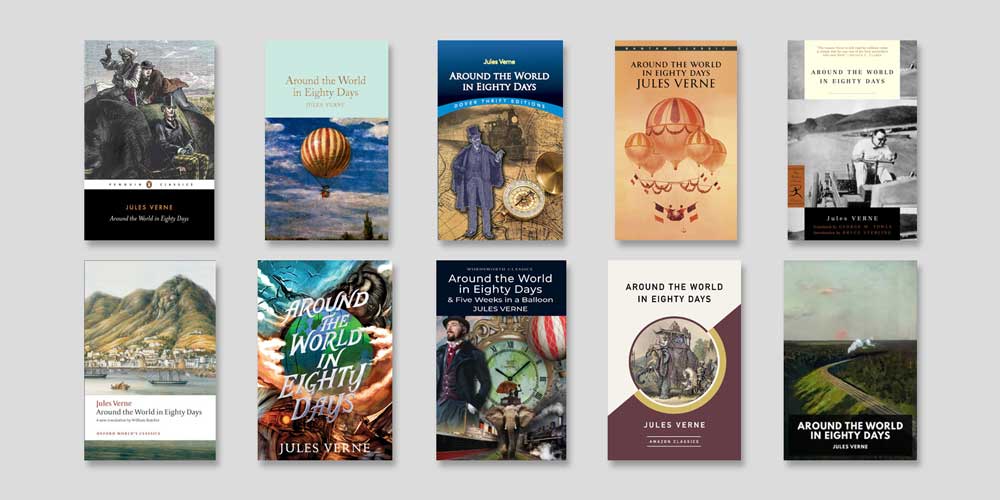
“Which English translation of Around the World in Eighty Days should I read?”
TL;DR? If you just want a quick-and-dirty recommendation, jump to the conclusion.
Kieran O’Driscoll says (on page 33 of a thesis on translations of Around the World in Eighty Days): “One continuing obstacle to the attainment of unanimous agreement, in the present day, on Verne’s literary gifts, is the fact that many of the older, inaccurate translations of his works are still available, and a further factor contributing to the perception of Verne as essentially a popular writer of lightweight adventure stories, is the continuing adaptations of his work to other popular media such as film.” There’s even a 2004 film adaptation starring Jackie Chan.
Verniana: “Travels and Travails with the Big Three” by Alex Kirstukas
“In the English-speaking world, one can identify a ‘Big Three’ group of Verne novels—Journey to the Center of the Earth, Twenty Thousand Leagues Under the Sea(s), and Around the World in Eighty Days—by the sheer number of sub-par editions available from major publishers. It isn’t hard to find reasons for this dubious distinction; all three novels, in addition to being longstanding favorites among readers and scholars, received high-profile Hollywood adaptations in the 1950s and have retained special familiarity since. If a modern Anglophone bookshop or omnibus edition boasts only three Verne titles, it’s likely to be these.”
So, Around the World in Eighty Days, a non-sci-fi story among Verne’s “Extraordinary Voyages” stories, is one of Jules Verne’s top three novels in terms of lasting fame. And its early translations are not as bad as the early translations of the other two!
Verniana: “As Verne Smiles” by Walter James Miller
“[T]he only Verne novel to escape such mistreatment [the publication in the United States of ‘incomplete and ersatz’ translations] was Around the World in Eighty Days. How come? By then Verne had become so famous that as each chapter was serialized in a leading French newspaper, foreign correspondents were cabling summaries back home! So when translators got to work on American book versions, they could certainly not wreak their usual irresponsible havoc and [they left out] less than was their wont.
Around the World in Eighty Days: Translations in English
There are 14 different translations.
- 1873 – George M. Towle
- 1874 – Stephen W. White
- 1876 – Anonymous (Hutchinson)
- 1877 – Henry Frith (Routledge)
- 1879 – Anonymous (Ward, Lock & Co)
- 1926 – P. Desages
- 1965 – K.E. Lichtenecker
- 1966 – I.O. Evans (Fitzroy)
- 1968 – Jacqueline and Robert Baldick
- 1995 – William Butcher (Oxford)
- 2004 – Michael Glencross (Penguin)
- 2010 – F.P. Walter
- 2022 – Matthew G. Jonas (Birch Hill)
- 2024 – Andrew Brown (Alma)
I’m omitting one, actually… It’s called Round the World on a Wager, and apparently it was an early American translation made from a corrupted American serialization in French. (Publishing is complicated, y’all!) If you want to know more, you can read the 2019 article “How Phileas Fogg Reached America: Two Early American Versions of Le Tour du monde en quatre-vingts jours” by Verne scholar Alex Kirstukas.
Around the World in Eighty Days: About the title
The original title in French is Le tour du monde en quatre-vingts jours. This literally means, “the tour of-the world in four-twenties days.” So yeah, if you weren’t aware, the French way of saying “eighty” is actually “four twenties”! (Ninety five is “four-twenties-fifteen”.)
Some books write the title as Around the World in 80 Days. My understanding is that it’s considered best practice to spell the number. The numerals, which look better in terms of graphic design, are often used on covers.
The possible variations of the English title you might see are:
- The Tour of the World in Eighty Days / The Tour of the World in 80 Days
- A Tour of the World in Eighty Days / A Tour of the World in 80 Days
- Tour of the World in Eighty Days / Tour of the World in 80 Days
- Round the World in Eighty Days / Round the World in 80 Days
- Around the World in Eighty Days / Around the World in 80 Days
Around the World in Eighty Days: Translation comparison
Extracts have been included wherever possible so that you can compare how the different translations sound.
Around the World in Eighty Days: Collections, omnibus editions, and other resources
For listings of books or sets of multiple Verne titles, links to Jules Verne sites, and more, jump to Other Info and Resources.
Who was George M. Towle?
According to Wikipedia, George Makepeace Towle was an American lawyer, politician, and author, and is mainly known today for this translation, although he translated other less well-known works by Verne too (Dr. Ox and Other Stories; The Wreck of the Chancellor; Martin Paz).
“The Victorian Translators of Verne: Mercier to Metcalfe” by Norman Wolcott
“In 1866 he was appointed United States Consul at Nantes, France. After serving there for two years he was transferred to the consulate in Bradford, England. While in Europe he acquired a command of French that he utilized as a translator of Jules Verne and other popular writers in that language, and gained a knowledge of European politics of which he made literary use…. Towle continued to translate the Verne novels for James Osgood, until the bankruptcy of the firm in 1876. The translations are of a uniformly high quality, though he does use rather florid Victorian language (such as ‘Teutons’ for ‘Germans’).”
Quick facts about the Towle translation of Around the World in Eighty Days
Title: Originally, The Tour of the World in Eighty Days. Reprinted as Around the World in Eighty Days.
Availability: In the public domain and in print.
Completeness: Not considered complete and accurate by today’s standards.
More about the Towle translation of Around the World in Eighty Days
Towle’s translation was first published by Sampson Low, Verne’s authorized publisher in the UK.
This is the translation most commonly reprinted by modern publishers. It appears or has appeared under the brands Bantam, Reader’s Digest, Puffin, Signet, Penguin Popular Classics, Viking, Dover, etc. Different publishers have made various corrections and changes, so these texts are not all identical.
“The Victorian Translators of Verne: Mercier to Metcalfe” by Norman Wolcott
Some editions credit N. d’Anvers as a translator alongside Towle. Verne scholar Normon Wolcott says this N. d’Anvers is Nancy Regina Emily Meugens, also known as Mrs. Arthur Bell, and she was born in Belgium; “hence her pseudonym ‘N. D’anvers = Nancy from Antwerp.” She translated other Verne titles (The Fur Country, The Great Navigators of the XIX’th Century, and The Blockade Runners) for Sampson Low, but Around the World in Eighty Days “is almost certainly the sole work of George Towle.”
“Around the World in Eighty Changes” by Kieran O’Driscoll (pages 65-103)
O’Driscoll characterizes Towle’s style as “florid,” meaning he has “an excessively ornate prose style.” This style is also characterized as a “rich, Victorian literary prose style” reminiscent of Dickens. This style “often took precedence” over the goal of imitating Verne’s form and voice. In addition, it seems that due to an aggressive publishing timeline, the highest level of fidelity/accuracy to the original was not possible, and not attempted. The translation overall is characterized as oriented towards the target culture; that is, it is “idiomatic” in English. It is nonetheless “for the most part, an accurate rendering… a semantically faithful, complete representation” of the source that is, moreover, “stylistically and aesthetically pleasing,” and sounds “natural.” Towle uses a “formal, literary” type of English that is “often seemingly archaic.”
Verniana: “Travels and Travails with the Big Three” by Alex Kirstukas
About the out-of-print Usborne Illustrated Originals children’s gift edition (ISBN 9781474922562, 445 pages), advertised as a new and “complete and unabridged” translation by Jerome Martin: “There are full-color illustrations by Daniele Dickmann on almost every page, as well as several wordless double-page spreads allowing a single dramatic image to take full attention.” However, regarding the text, it’s not a reprint of the Towle translation, but it’s greatly indebted to it: “Though no explanation is given in the volume, it seems possible that Martin initially intended a light revision of Towle—but then doubled down for a major stylistic overhaul, with much reference to the French original, when Towle’s tendency for turgid prose became clear…. In completeness and accuracy, it makes for a less reliable English translation of Around the World than any since the mid-1960s [Kirstukas seems to be referring to the Lichtenecker translation]. On the other hand, in a series where one might expect a straightforward reprint of Towle, it’s nice to see a different text that’s about as accurate and considerably more readable. But a note explaining the Towle connection would have been good form.”
Extract from the Towle translation of Around the World in Eighty Days
First ~300 words of Chapter 1 (full book available free at Standard Ebooks):
Mr. Phileas Fogg lived, in 1872, at No. 7, Saville Row, Burlington Gardens, the house in which Sheridan died in 1814. He was one of the most noticeable members of the Reform Club, though he seemed always to avoid attracting attention; an enigmatical personage, about whom little was known, except that he was a polished man of the world. People said that he resembled Byron—at least that his head was Byronic; but he was a bearded, tranquil Byron, who might live on a thousand years without growing old.
Certainly an Englishman, it was more doubtful whether Phileas Fogg was a Londoner. He was never seen on ’Change, nor at the Bank, nor in the counting-rooms of the “City”; no ships ever came into London docks of which he was the owner; he had no public employment; he had never been entered at any of the Inns of Court, either at the Temple, or Lincoln’s Inn, or Gray’s Inn; nor had his voice ever resounded in the Court of Chancery, or in the Exchequer, or the Queen’s Bench, or the Ecclesiastical Courts. He certainly was not a manufacturer; nor was he a merchant or a gentleman farmer. His name was strange to the scientific and learned societies, and he never was known to take part in the sage deliberations of the Royal Institution or the London Institution, the Artisan’s Association, or the Institution of Arts and Sciences. He belonged, in fact, to none of the numerous societies which swarm in the English capital, from the Harmonic to that of the Entomologists, founded mainly for the purpose of abolishing pernicious insects.

Get the Modern Library Towle translation of The Tour of the World in Eighty Days / Around the World in Eighty Days
Includes a biographical note, an introduction by Bruce Sterling, the introduction by Adrien Marx from the first English edition, and a reading group guide. Reading guide at https://www.penguinrandomhouse.com/books/183627/around-the-world-in-eighty-days-by-jules-verne-translated-by-george-m-towle/readers-guide/. Ebook also available (ISBN 9781588363664).
Available as a paperback (ISBN 9780812968569, 224 pages).

Get the Puffin Towle translation of The Tour of the World in Eighty Days / Around the World in Eighty Days
Introduction by Bear Grylls
Available as a paperback (ISBN 9780141366296, 292 pages).

Get the Dover Towle translation of The Tour of the World in Eighty Days / Around the World in Eighty Days
"This is an unabridged republication of the 1873 translation from the original French by George Makepeace Towle."
Available as a paperback (ISBN 9780486814315, 272 pages).

Get the Dover Towle translation of The Tour of the World in Eighty Days / Around the World in Eighty Days
Includes an introductory note.
Available as a paperback (ISBN 9780486411118, 176 pages).

Get the Bantam Towle translation of The Tour of the World in Eighty Days / Around the World in Eighty Days
Ebook also available (ISBN 9780553902211).
Available as a mass market paperback (ISBN 9780553213560, 208 pages).

Get the Enriched Towle translation of The Tour of the World in Eighty Days / Around the World in Eighty Days
Introduction, author chronology, historical timeline, outline of themes and plot points, explanatory notes, critical analysis, discussion, recommended books and films. Ebook also available (ISBN 9781416561576). Doesn't credit Towle, but the first 2 sentences match.
Available as a mass market paperback (ISBN 9781416534723, 288 pages).
Get the Word Cloud Towle translation of The Tour of the World in Eighty Days / Around the World in Eighty Days
"Word Cloud Classics have pretty edges, along with heat-burnished covers with foil stamping." Towle is not credited, but the first two sentences match.
Available as a flexibound book (ISBN 9781667202129, 240 pages).
Get the Aladdin Towle translation of The Tour of the World in Eighty Days / Around the World in Eighty Days
Includes a foreword by Laurence Yep and a reading group guide.
Available as a paperback (ISBN 9781416939368, 336 pages).

Get the Aladdin Towle translation of The Tour of the World in Eighty Days / Around the World in Eighty Days
Hardcover (ISBN 9781665934220), ebook (ISBN 9781442457959) available.
Available as a paperback (ISBN 9781665934213, 320 pages).

Get the Chiltern Towle translation of The Tour of the World in Eighty Days / Around the World in Eighty Days
gilt edges, creamy pages, and stitched binding
Available as a hardcover (ISBN 9781914602498, 240 pages).

Get the Flame Tree Towle translation of The Tour of the World in Eighty Days / Around the World in Eighty Days
"Each stunning, gift edition features deluxe cover treatments, ribbon markers, luxury endpapers and gilded edges. The unabridged text is accompanied by a Glossary of Victorian and Literary terms produced for the modern reader." (The translator is Towle, according to the Blackwell's product page.)
Available as a deluxe hardcover (ISBN 9781839649684, 288 pages).

Get the Signet Towle translation of The Tour of the World in Eighty Days / Around the World in Eighty Days
Includes an introduction by Herbert Lottman and an afterword by Karen J. Renner. Ebook also available (ISBN 9780698198272).
Available as a mass market paperback (ISBN 9780451474285, 272 pages).


Get the AmazonClassics Towle translation of The Tour of the World in Eighty Days / Around the World in Eighty Days
Available as an ebook (ISBN 9781542099547).

Get the Standard Ebooks Towle translation of The Tour of the World in Eighty Days / Around the World in Eighty Days
This is an improved version of the Gutenberg Project book 103.
Available as an ebook.

Get the Usborne Illustrated Towle translation of The Tour of the World in Eighty Days / Around the World in Eighty Days
Claims to be "newly translated" and "complete and unabridged", but is considered a kind of adaptation of the Towle translation (see above). Nice illustrations! Out of print.
Available as (ISBN 9781474922562, 445 pages).
Who was Stephen W. White?
According to Wikipedia, Stephen William White was an American who worked for railway companies in Pennsylvania, and today is best known for this translation.
His other Jules Verne translations were: A Fancy of Doctor Ox; A Journey to the Centre of the Earth; A Winter’s Sojourn in the Ice; The Mysterious Island. His translations were serialized in the Philadelphia Evening Telegraph before being reprinted in book form.
“Victorian Translators: Stephen W. White and William Struthers Revealed” by Normal Wolcott and Kieran O’Driscoll
White’s translations are characterized by “. . .his ‘problem-solving’ approach to translating Verne, his straight-forward language transfer of Verne’s French without the creative, literary, and non-imitative embellishments of other translators such as Desages, Towle, or Glencross.” From a biography in the Pennsylvania Railroad History: “His writings are all clean and terse, displaying careful study and methodical arrangement, resultants of his early training in stenography, in which science he is not only an expert but an accomplished devotee.” Wolcott and O’Driscoll conclude from their biographical discoveries that White, like other Verne translators, “entered the translation business out of financial necessity.” According to his educational background at an unusual high school: “Clearly not a hack writer, he was a literate product of the American public schools capable of comparison and perhaps superior to many of the translators employed by Sampson Low in England. His training in phonography [shorthand] gave him an excellent ear for languages, supplementing his academic achievements.”
Quick facts about the White translation of Around the World in Eighty Days
Title: Originally, The Tour of the World in Eighty Days, but reprinted as Round the World in Eighty Days.
Availability: In the public domain. Available as a print-on-demand book or free ebook, but seemingly not republished by major publishers.
Completeness: Some omissions (at least partly due to cuts made after serialization).
More about the White translation of Around the World in Eighty Days
Verne bibliographies indicate that the White translation was used for, among other reprints, the 1911 Works of Jules Verne multivolume set edited by Charles F. Horne. Round the World in Eighty Days is in Volume 7. The extract below is from a digitized copy of the Horne text.
The Scholastic edition credits Edward Roth as translator. The slightly modified Blackie edition credits Irene R. Gibbons as translator. These are considered (by Butcher and Evans) as copies of the White translation.
The print-on-demand version available at Lulu was created by Verne scholars Norman Wolcott and Kieran O’Driscoll: “This translation by Stephen W. White, 1874, is one of the earliest and best translations. The text is fully illustrated with all of the original Victorian engravings, complemented by an extensive introduction to the publication history by Norman Wolcott, a lexical analysis by Kieran O’Driscoll, D.Phil., a biography of the translator, and the last published work by Stephen W. White, a lecture to the Central High School Class of Philadelphia in 1905 on the benefits of the study of phonography. This is the only fully illustrated edition of this most popular work of Jules Verne. An errata section contains several recently discovered paragraphs which were deleted from all 19th century reprint editions of the book.” The book probably includes an introduction and the essay “Putting White to rights: Reinstating the reputation of the Victorian Verne translator, Stephen W. White” by Kieran O’Driscoll.
“Around the World in Eighty Changes” by Kieran O’Driscoll (pages 104-123 and 254)
O’Driscoll says White has an “imitative, literal approach” that can even be seen from his choice of using “tour” in the title. This type of source-oriented accuracy is attributable to habits developed in the course of his professional work as a translator of legal documents. The literal approach involves the use of some cognates (English words that are related to the French words that Verne used), which sometimes results in an archaic tone. Some omissions in the book version of the White translation are due to editing by the publisher of the book version. O’Driscoll found it “surprising to discover that White’s (1874) translation was so accurate, and that therefore, the consignment to virtual oblivion of the accurate Verne translations of White [sic] in the U.S., was unjust.” Therefore, he wishes Verne scholars to reconsider ranking White with the other Victorian translators, whose translations are generally of “inferior” quality.
Extract from the White translation of Around the World in Eighty Days
First ~300 words of Chapter 1 (full book available free from Wikisource):
In the year 1872, the house No. 7, Saville Row, Burlington Gardens—the house in which Sheridan died, in 1814—was inhabited by Phileas Fogg, Esq., one of the most singular and most noticed members of the Reform Club of London, although he seemed to take care to do nothing which might attract attention.
This Phileas Fogg, then, an enigmatic personage, of whom nothing was known but that he was a very polite man, and one of the most perfect gentlemen of good English society, succeeded one of the greatest orators that honor England.
An Englishman Phileas Fogg was surely, but perhaps not a Londoner. He was never seen on ‘Change, at the bank, or in any of the counting-rooms of the “City.” The docks of London had never received a vessel fitted out by Phileas Fogg. This gentleman did not figure in any public body. His name had never sounded in any Inns of Court. He never pleaded in the Court of Chancery, nor the Queen’s Bench. He was neither a manufacturer, nor a merchant, nor a gentleman farmer. He was not a member of the Royal Institution of Great Britain, or the London Institution, or the Literary Institution of the West, or the Law Institute, or that Institute of the Arts and Sciences, placed under the direct patronage of her gracious majesty. In fact, he belonged to none of the numerous societies that swarm in the capital of England, from the Harmonic to the Entomological Society, founded principally for the purpose of destroying hurtful insects. Phileas Fogg was a member of the Reform Club, and that was all.
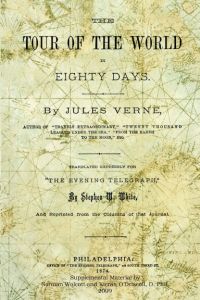
Get the Lulu White translation of The Tour of the World in Eighty Days
Illustrated. Includes an "introduction to the publication history by Norman Wolcott, a lexical analysis by Kieran O'Driscoll, D.Phil., a biography of the translator."
Available as a paperback.
Get the Wikisource White translation of The Tour of the World in Eighty Days
From Volume 7 of the Works of Jules Verne edited by Charles F. Horne, published by Vincent Parke in 1911.
Available as an ebook.
Quick facts about the Anonymous (Hutchinson) translation of Around the World in Eighty Days
Title: Round the World in Eighty Days
Availability: In the public domain, out of print. Seemingly not available as an online scan or transcription.
Completeness: Complete.
More about the Anonymous (Hutchinson) translation of Around the World in Eighty Days
I’m not sure about the date. Butcher and Evans list the Hutchinson translation as having no particular date; Kieran O’Driscoll (on page 27) lists a Hutchinson translation as being from 1876. So let’s go with that.
Hutchinson, a publisher in the UK, was not authorized to produce Verne translations.
Meteor House: The Full Account
Meteor House has published a book titled The Full Account, which combines Jules Verne’s Around the World in Eighty Days with The Other Log of Phileas Fogg, a 1973 science-fiction novel by author Philip José Farmer involving aliens. “One of Meteor House’s most ambitious projects yet is The Full Account, a unique, one-of-a-kind edition wherein both classic books are woven together, allowing the reader to peruse the original exploits as described by Verne, followed by, in alternating fashion, Farmer’s revelatory account of what was actually occurring ‘behind the scenes.’ Upon the recommendation of Verne expert Henry G. Franke III, we have utilized the Hutchinson text of Around the World in Eighty Days. The alternating texts of each novel have been set slightly differently in order to enhance readability.” Here’s a detailed review/description of The Full Account.
Extract from the Anonymous (Hutchinson) translation of Around the World in Eighty Days
This translation is in the public domain, but I have not been able to find any digitization online.
The extracts below are from “THE CURATE’S EGG: THE TRANSLATIONS OF (A)ROUND/A TOUR OF THE WORLD IN EIGHTY DAYS” by William Butcher and Arthur Evans, published in 2002 in Extraordinary Voyages, the news magazine of the North American Jules Verne Society.
Beginning of Chapter 1:
In the year 1872, No. 7 in Saville Row, Burlington Gardens, the house in which Sheridan died in 1814, was inhabited by Phileas Fog, Esq., one of the most eccentric, and noticeable members of the Reform Club, although he seemed to be especially careful to do nothing which could attract any one’s attention.
Beginning of Chapter 2:
“Assuredly,” said Passepartout to himself, though rather startled at first, “I have seen people at Madam Tussaud’s quite as lively as my new master.”
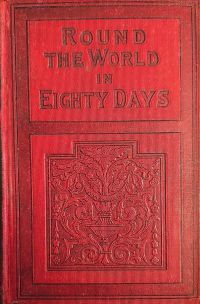
Get the Anonymous (Hutchinson) translation of Round the World in Eighty Days
This translation is in the public domain, but I don’t know of any modern reprints or online scans or transcriptions. You may be able to find a second-hand copy. (If not on Abebooks, try Ebay.)
Available as a hardcover.

Get the Meteor House Anonymous (Hutchinson) translation of Round the World in Eighty Days
Combines Jules Verne’s Around the World in Eighty Days with The Other Log of Phileas Fogg, a 1973 science-fiction novel by author Philip José Farmer involving aliens. Uses the Hutchinson translation.
Available as a paperback (ISBN 9781945427299, 528 pages).
Who was Henry Frith?
Henry Frith was an engineer, fiction and non-fiction writer, and translator. He is credited as translator for at least 7 of Jules Verne’s novels:
- A Floating City
- The Blockade Runners
- Twenty Thousand Leagues under the Sea
- Adventures of Three Englishmen and Three Russians in Southern Africa
- Round the World in Eighty Days
- The Fur Country
- Kéraban the Inflexible
I recognize his name from a 1955 edition of his book King Arthur and His Knights.
Quick facts about the Frith translation of Around the World in Eighty Days
Title: Round the World in Eighty Days
Availability: In the public domain and available as a free ebook. Included in the Everyman’s Library omnibus hardcover with two other Verne novels.
Completeness: Condensed.
More about the Frith translation of Around the World in Eighty Days
Uses British spelling.
Frith’s translation was first published by Routledge, a publisher in the UK not authorized to produce Verne translations.
Opinions are mixed, but seem slanted negative.
Extraordinary Voyages: “THE CURATE’S EGG: THE TRANSLATIONS OF (A)ROUND/A TOUR OF THE WORLD IN EIGHTY DAYS” by William Butcher and Arthur Evans
“[A]lthough the style is dated, this is a reasonably faithful translation.”
Verniana: “One Small Step for Everyman, One Giant Leap Backward for Verne Readers” by Alex Kirstukas
Kirstukas is disappointed with Everyman’s decision to reprint these 1870s translations: “[I]t is beyond question that there are enough [errors and omissions] to stop the translations from being reliable substitutes for the original works. Worse yet, in the case of Round the World it is blatant falsehood to claim that the text has undergone only ‘occasional…omissions’: fully one-fifth of the book is missing, a condensation process carried out mainly by omitting as much of Verne’s geographical research as possible [and] every passage of the book that could be construed as the slightest critique of the British Empire and its policies…. Frith’s idiosyncratic writing style sometimes makes for a reading experience vastly unlike that of Verne in the original French.”
Amazon: “EARLY TRANSLATIONS OF HISTORICAL INTEREST” by F.P. Walter
“[J]uvenile author/adaptor Henry Frith… reworks Verne’s French into idiomatic Victorian English but streamlines specifics: when Fogg dines, Frith leaves out the condiments … if Verne describes Japan’s military in 70 words, Frith cuts them in half … during a rollicking acrobatic performance, Frith skips the climax of the warm-up act. Yes, the work remains intact and entertaining, but its textures are thinner and its depths shallower.”
Extract from the Frith translation of Around the World in Eighty Days
First ~300 words of Chapter 1 (full book available free from Gutenberg.org):
In the year of grace One thousand eight hundred and seventy-two, the house in which Sheridan died in 1816—viz. No. 7, Saville Row, Burlington Gardens—was occupied by Phileas Fogg, Esq., one of the most eccentric members of the Reform Club, though it always appeared as if he were very anxious to avoid remark. Phileas had succeeded to the house of one of England’s greatest orators, but, unlike his predecessor, no one knew anything of Fogg, who was impenetrable, though a brave man and moving in the best society. Some people declared that he resembled Byron—merely in appearance, for he was irreproachable in tone—but still a Byron with whiskers and moustache: an impassible Byron, who might live a thousand years and not get old.
A thorough Briton was Phileas Fogg, though perhaps not a Londoner. He was never seen on the Stock Exchange, nor at the Bank of England, nor at any of the great City houses. No vessel with a cargo consigned to Phileas Fogg ever entered the port of London. He held no Government appointment. He had never been entered at any of the Inns of Court. He had never pleaded at the Chancery Bar, the Queen’s Bench, the Exchequer, or the Ecclesiastical Courts. He was not a merchant, a manufacturer, a farmer, nor a man of business of any kind. He was not in the habit of frequenting the Royal Institution or any other of the learned societies of the metropolis. He was simply a member of the “Reform,” and that was all!

Get the Gutenberg Frith translation of Round the World in Eighty Days
Available as an ebook.
Quick facts about the Anonymous (Ward, Lock & Tyler) translation of Around the World in Eighty Days
Title: Around the World in Eighty Days
Availability: In the public domain, but seemingly not available online or in current print editions.
Completeness: Mostly complete.
More about the Anonymous (Ward, Lock & Tyler) translation of Around the World in Eighty Days
This edition was part of a series called “Youth’s Library of Wonder and Adventure.”
Ward, Lock & Tyler, a publisher in the UK, was not authorized to produce Verne translations.
Extraordinary Voyages: “THE CURATE’S EGG: THE TRANSLATIONS OF (A)ROUND/A TOUR OF THE WORLD IN EIGHTY DAYS” by William Butcher and Arthur Evans
William Butcher and Arthur B. Evans speculate that this translation was done by Frederick Amadeus Malleson, who translated Journey to the Center of the Earth (for example) for this publisher.
Kieran O’Driscoll says (page 98) that this translation is “error-ridden” and “justly consigned to oblivion.”
Extract from the Anonymous (Ward, Lock & Tyler) translation of Around the World in Eighty Days
This translation is in the public domain, but I have not been able to find any online scan or transcription. The extracts below are from “THE CURATE’S EGG: THE TRANSLATIONS OF (A)ROUND/A TOUR OF THE WORLD IN EIGHTY DAYS” by William Butcher and Arthur Evans, published in 2002 in Extraordinary Voyages, the news magazine of the North American Jules Verne Society.
Beginning of Chapter 1:
In the year 1872 the house, No. 7, Savile Row, Burlington Gardens, in which Sheridan died in 1816, was occupied by Phileas Fogg, Esquire, one of the most remarkable members of the Reform Club, though he always appeared very anxious to avoid remark.
Beginning of Chapter 2:
“Egad,” said Passepartout, who was rather flurried for the minute, “I have seen figures at Madame Tussaud’s quite as cheerful as my new master.”
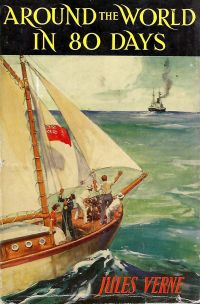
Get the Ward/Lock Anonymous (Ward, Lock & Tyler) translation of Around the World in Eighty Days
I don’t know of any modern reprints or online scans or transcriptions. You can probably find a second-hand copy.
Available as a hardcover.
Who was P. Desages?
According to Kieran O’Driscoll (page 124), Paul Desages was (probably) a bilingual English professor or teacher of languages.
According to Alex Kirstukas, he was a French expert at Oxford.
Quick facts about the Desages translation of Around the World in Eighty Days
Title: Around the World in Eighty Days
Availability: In the public domain and still in print.
Completeness: Complete.
More about the Desages translation of Around the World in Eighty Days
Uses British spelling.
Originally part of the Everyman series, which now uses the 1877 Frith translation for some reason.
“Around the World in Eighty Changes” by Kieran O’Driscoll (pages 104-138)
O’Driscoll says Desages’ translation is “accurate, idiomatic, and ornate” and has “high semantic fidelity.” One reason for the accuracy of the translation is Desages’ knowledge of French; another is the fact that this re-translation was commissioned by the “Jules Verne Confederacy,” a Verne appreciation society in the UK, composed of English-speaking people who likely also knew French, and were apparently not satisfied with previous translations. Two members provided a “critically acclaimed” introduction to the translation.
Verniana: “One Small Step for Everyman, One Giant Leap Backward for Verne Readers” by Alex Kirstukas
This translation is characterized by “impressive completeness and accuracy.” The 1994 reprint includes “a wealth of critical material by Peter Costello.”
Extract from the Desages translation of Around the World in Eighty Days
First ~300 words of Chapter 1 (preview Wordsworth edition on Amazon):
In the year 1872, No. 7 Savile Row, Burlington Gardens, the house in which Sheridan died in 1816, was occupied by Phileas Fogg, Esq. Of the members of the Reform Club in London few, if any, were more peculiar or more specially noticed than Phileas Fogg, although he seemed to make a point of doing nothing that could draw attention.
So one of the greatest orators who honour England had for a successor this man, Phileas Fogg, a sphinx-like person, of whom nothing was known except that he was a thorough gentleman and one of the handsomest men in English high society.
He was said to be like Byron—his head, at least, was supposed to be like Byron’s for his feet were faultless—a Byron with moustache and whiskers, a phlegmatic Byron, who would have lived a thousand years without getting any older.
English Phileas Fogg certainly was, though perhaps not a Londoner. No one had ever seen him at the Stock Exchange or the Bank, or at any of the offices in the City.
No ship owned by Phileas Fogg had ever been berthed in the basins or docks of London. He was not to be found on any board of directors. His name had never been heard among the barristers of the Temple, Lincoln’s Inn or Gray’s Inn. He was never known to plead in the Court of Chancery or of Queen’s Bench, in the Court of Exchequer or in an Ecclesiastical Court. He was neither manufacturer nor merchant, tradesman nor farmer. The Royal Society of Great Britain, the London Society, the Workmen’s Society, the Russell Society, the Western Literary Society, the Law Society, the Society of United Arts and Sciences, which is under the patronage of Her Gracious Majesty—he belonged to none of these. In a word, he was not a member of a single one of the many associations that swarm in the English capital, from the Armonica Society to the Entomological Society, founded chiefly for the object of destroying noxious insects.

Get the Wordsworth Desages translation of Around the World in Eighty Days
Also includes "Five Weeks in a Balloon." With an Introduction and Notes by Professor Roger Cardinal. University of Kent at Canterbury. Translations are by Paul Desages (Around the World in Eighty Days) and Arthur Chambers (Five Weeks in a Balloon).
Available as a paperback (ISBN 9781853260902, 384 pages).

Get the Macmillan Collector's Library Desages translation of Around the World in Eighty Days
With an Afterword by John Grant. No translator mentioned, but the first sentences match Desages.
Available as a hardcover (ISBN 9781509827855, 280 pages).
Who was K.E. Lichtenecker?
“Journal for Intelligence, Propaganda and Security Studies: “The ‘spy’ Karl Erwin Lichtenecker: Victim or Perpetrator? A Tale of Ambivalence” by Siegfried Beer
Dr. Karl Erwin Lichtenecker (born in 1929) was a “Viennese journalist, translator and adult educator” who studied at the School of Journalism of Ohio University in Athens, earned a doctorate in Media Sciences in Vienna, and spent a few years in Washington DC. He did translation for PRO ARTIA, “a foreign cultural trade company located in Prague” that “cooperated with western publishers like Paul Hamlyn and Spring Books.” Apparently in 1971 he was accused by the Austrian State Police of being a spy; Siegfried Beer interviewed him in 2008 and 2009.
Quick facts about the Lichtenecker translation of Around the World in Eighty Days
Title: Around the World in Eighty Days
Availability: Out of print but still under copyright.
Completeness: Abridged!
More about the Lichtenecker translation of Around the World in Eighty Days
Published by Paul Hamlyn. Jacket flap: “The illustrations, an ingenious combination of graphic techniques and collages from contemporary sources, are the delightful work of Adolf Hoffmeister.”
Verniana: “Travels and Travails with the Big Three” by Alex Kirstukas
“The 1960s saw the release of K.E. Lichtenecker’s poor translation.”
Extraordinary Voyages: “THE CURATE’S EGG: THE TRANSLATIONS OF (A)ROUND/A TOUR OF THE WORLD IN EIGHTY DAYS” by William Butcher and Arthur Evans
“[T]he omission of the reference to Sheridan [in the first sentence of the book] is indicative of the liberties and shortcuts in this version, which has only twenty chapters, instead of Verne’s thirty-seven.”
Extract from the Lichtenecker translation of Around the World in Eighty Days
The extracts below are from “THE CURATE’S EGG: THE TRANSLATIONS OF (A)ROUND/A TOUR OF THE WORLD IN EIGHTY DAYS” by William Butcher and Arthur Evans, published in 2002 in Extraordinary Voyages, the news magazine of the North American Jules Verne Society.
Beginning of Chapter 1:
In 1872, the house at Number Seven, Saville Row was occupied by Phileas Fogg, Esquire, one of the most remarkable and unusual members of the London Reform Club. It was his habit to avoid everything which could arouse attention.
Text normally appearing at the beginning of Chapter 2, but in this case appearing in Chapter 1:
Passepartout was alone. He dropped into a chair in blank amazement. The wax models in Madame Tussaud’s were, he thought, at least as spirited and high-strung as his new employer.

Get the Hamlyn Lichtenecker translation of Around the World in Eighty Days
I don’t know of any modern reprints. You may be able to find a second-hand copy. (If not on Abebooks, try Ebay.)
Available as a hardcover.
Idrisyn Oliver Evans was a British-South African editor, author, and translator who worked on many of Verne’s writings.
» More about I.O. Evans at SF Encyclopedia
» More about I.O. Evans at Verniana.org
» More about I.O. Evans at JulesVerne.ca
Quick facts about the Evans translation of Around the World in Eighty Days
Title: Around the World in Eighty Days
Availability: Out of print, under copyright, hard to find.
Completeness: Condensed.
More about the Evans translation of Around the World in Eighty Days
ISFDB: The Fitzroy series
The Fitzroy series, consisting of books edited, translated, or abridged by I.O. Evans, were published in the UK by “Bernard Hanison” or “Arco”. They were published in the US by “Associated Booksellers” and reprinted by Ace.
Verniana: “ ‘Verne’s Best Friend and his Worst Enemy’: I.O. Evans and the Fitzroy Edition of Jules Verne” by Brian Taves
“As a professional writer, [Evans] was sometimes too mindful of marketplace demands, which also allowed the Fitzroy series to permeate book stores and libraries and be sold in several paperback series and reprints. Ultimately comprising an impressive forty-eight separate stories in sixty-three volumes, the [Fitzroy] series dominated Verne publishing from the 1950s into the 1980s; even today, only fourteen of these books have been supplanted in terms of quality translations and critical commentary. At the same time, the shortcomings of the Fitzroy series made it a transition step from Anglophone Verne editions published during and shortly after the author’s lifetime, and the modern shift to more scholarly, annotated renderings. The verdict can only be mixed; despite Herculean labor, Evans did not take the few additional steps toward more rigorous scholarship that would have made him at least the grandfather of the modern Verne Anglophone renaissance–yet his achievement in the creation of such a major Verne series is unequaled.”
As Verne Smiles by Walter Miller
“On the one hand, Evans issued many titles Anglophone readers had never heard of. On the other, in an effort to make his translations more salable, he ‘decided to leave out the detail, for surely no author more repaid judicious skipping’! He slashed the longer volumes (e.g. Twenty Thousand Leagues) 25% or more. Worse yet, he imposed his own political and religious attitudes on what ‘Verne’ had said, actually regarding his own editing as ‘Providential inspiration.’ So in effect he was repeating the license that the 19th-century translators had arrogated to themselves.”
JulesVerne.ca: “Fitzroy Editions” by Andrew Nash
“I. O. Evans (Idrisyn Oliver Evans) love of science fiction and Jules Verne led him to envisage a series of Jules Verne books where he could re-introduce to the public the many works that were not commonly known. It was the publisher Bernard Hanison (a 29 year old) who signed a contract with I. O. Evans in 1958 for such a series. The address of the offices of Bernard Hanison was 10 Fitzroy Street, and hence the name of the series, Fitzroy Edition.”
Extraordinary Voyages: “THE CURATE’S EGG: THE TRANSLATIONS OF (A)ROUND/A TOUR OF THE WORLD IN EIGHTY DAYS” by William Butcher and Arthur Evans
“[G]enerally condensed rather than translated, with many of the historical and geographical passages deleted and descriptions truncated.”
Extract from the Evans translation of Around the World in Eighty Days
The extracts below are from “THE CURATE’S EGG: THE TRANSLATIONS OF (A)ROUND/A TOUR OF THE WORLD IN EIGHTY DAYS” by William Butcher and Arthur Evans, published in 2002 in Extraordinary Voyages, the news magazine of the North American Jules Verne Society.
Beginning of Chapter 1:
In 1872 No. 7, Savile Row, Burlington Gardens, the former home of Sheridan, was occupied by Mr Phileas Fogg. He belonged to the Reform Club of London, and although he never did anything to attract attention, he was one of its most unusual and conspicuous members.
Beginning of Chapter 2:
“My word!” reflected Passepartout, feeling somewhat overwhelmed, “I’ve seen people in Madame Tussaud’s who are quite as much alive as my new master!”
Who were Jacqueline and Robert Baldick?
Robert André Edouard Baldick was a British writer, translator, and professor of French language and literature at Oxford. He was also an editor of the Penguin Classics series. He was bilingual. He translated works by Diderot and Flaubert as well as Verne. He produced an acclaimed book on the French author Huysmans. He died in his forties in 1972. This Verne translation also credits his wife Jacqueline Baldick (Jacqueline Harrison-Baldick), who died in 2015.
Kieran O’Driscoll (on pages 139-163), highlights his accomplishments as a “gifted”, “outstanding,” “prolific”, and “influential” scholar of French literature with a “lifelong affinity with France, its culture, and above all its literature of the nineteenth century” who increased the prestige of literary translation.
“Obituary: Dr Robert Baldick, a versatile scholar of French literature.” The Times. April 25, 1972.
Subscription required. (Sorry, I can’t read it either.)
Translating Great Russian Literature: The Penguin Russian Classics by Cathy McAteer (page 122)
“In addition to scholarly rigour, Baldick is also remembered for bringing a professional awareness of the translator’s worth to Penguin Books. His obituary in the Times described him as making sure that translators were paid a proper fee for what is a specialist job (25 April 1972).”
Quick facts about the Baldick translation of Around the World in Eighty Days
Title: Around the World in Eighty Days
Availability: Out of print and under copyright.
Completeness: Complete.
More about the Baldick translation of Around the World in Eighty Days
“Around the World in Eighty Changes” by Kieran O’Driscoll (pages 138-163)
“Baldick strongly approved of norms of accurate, faithful renderings of literary source texts, which were simultaneously couched in modern, idiomatic target language expression.” This is “a meticulously accurate and complete translation which remains scrupulously semantically close to Verne’s original.” It is written in a formal style like the original, but it uses “clear, modern, idiomatic” English. In short, it is “semantically accurate and linguistically modernizing” and because of the quality of the translation and Robert Baldick’s profession and reputation, “makes a significant contribution to the rehabilitation of Verne’s literary reputation.”
Extract from the Baldick translation of Around the World in Eighty Days
First ~300 words of Chapter 1 (from a first edition hardcover copy):
In 1872 No. 7 Savile Row, Burlington Gardens—the house in which Sheridan died in 1816—was occupied by Phileas Fogg, Esq. He belonged to the Reform Club of London, and although he seemed to take care never to do anything which might attract attention, he was one of its strangest and most conspicuous members.
Thus one of England’s greatest orators had been followed by this Phileas Fogg, an enigmatic personage about whom nothing was known except that he was a man of honour and one of the finest gentlemen in English high society.
It was said that he bore a certain resemblance to Byron—in his looks, for his feet were irreproachable—but he was a Byron with a moustache and side-whiskers, an impassive Byron who could have lived a thousand years without growing old.
Undoubtedly an Englishman, Phileas Fogg might not have been a Londoner. He had never been seen at the Stock Exchange, nor at the Bank, no in any of the offices in the City. No ship owned by Phileas Fogg had ever entered the London docks. The gentleman was not on any board of directors. His name never echoed round the Temple, or Lincoln’s Inn, or Gray’s Inn. He never pleaded in the Court of Chancery, the Court of Queen’s Bench, the Court of Exchequer or an Ecclesiastical Court. He was neither manufacturer nor trader, neither merchant nor gentleman farmer. He belonged neither to the Royal Society of Great Britain, nor the London Society, nor the Workmen’s Society, nor the Russell Society, nor the Western Literary Society, nor the Law Society, nor that Society of United Arts and Sciences which enjoys the patronage of Her Gracious Majesty. In short, he belonged to none of the countless associations which pullulate in the English capital, from the Harmonica Society to the Entomological Society, founded with the principal aim of destroying harmful insects.

Get the Dent, Dutton Baldick translation of Around the World in Eighty Days
I don’t know of any modern reprints. You may be able to find a second-hand copy. With four color plates and line drawings in the text by W.F. Phillipps. SBN: 460050826. 201 pages.
Available as a hardcover.
Who is William Butcher?
William Butcher is an author, translator, and Verne scholar who lives in Hong Kong. He has also translated Verne’s Journey to the Center of the Earth, Twenty Thousand Leagues Under the Seas, and The Adventures of Captain Hatteras, and, with David Coward, Journey to the Moon. He has also published a biography of Verne.
» William Butcher’s collection of Jules Verne pages at ibiblio
Quick facts about the Butcher translation of Around the World in Eighty Days
Title: Around the World in Eighty Days
Availability: In print.
Completeness: Complete.
More about the Butcher translation of Around the World in Eighty Days
Uses British spelling.
Includes a note on the text and translation, an introduction, a select bibliography, a chronology, and three appendices: Principal Sources, a description of a theatrical adaptation, and a collection of critical commentary, and endnotes.
Note on the Text and Translation by Butcher:
“The text used for the present edition is based on the illustrated 1873 one reprinted in all the modern French editions…. The present translation is an entirely new one, benefiting from the most recent scholarship on Verne and aiming to be faithful to the text. However, the use of phrases like ‘he said’ and ‘she replied’, of ellipses and exclamation marks, and of very long sentences has been slightly reduced.”
DePauw University: “Superb Jules Verne Translations” by Arthur B. Evans
“Since the original English translation of this novel done in 1873 was of good quality, the merit of Butcher’s work on this text comes less from his translation—excellent though it is—than from his close examination of the original manuscripts and his first-rate analysis of how this famous novel came to be what it is.”
Washington Post: “Around the World in Eighty Days – about to get a reboot – is the perfect Christmas Tale” by Michael Dirda
“Of the novel’s modern English versions, the best has long been the Oxford World’s Classics edition by Verne biographer and scholar William Butcher. His endnotes point to its undercurrent of ribaldry and double-entendre, and he argues for Verne as artistically innovative in his use of temporal shifts, elisions and flashbacks. Butcher persuasively demonstrates that there’s more in the book than a mixture of farce, manhunt, suspense and romance, though it is doubtless these that have made “Around the World in Eighty Days” the most popular novel by one of the most popular novelists of all time.”
“Around the World in Eighty Changes” by Kieran O’Driscoll (pages 164-207)
- About the cover: The cover illustration is a reproduction of a painting depicting Hong Kong, which is where Butcher lives; thus O’Driscoll speculates that the cover reflects “the personal choice of Butcher for the cover of his [translation].”
- Characterization of the translation: O’Driscoll says, “Butcher’s translations appear to be generally categorized by commentators as being meticulously accurate and thus welcome, scholarly retranslations of the literature of Jules Verne, and are regarded as capturing the quintessential Verne.” His word choices are characterized as “neutral and non-colloquial” in an attempt to achieve timelessness or at least long-lasting currency. His approach is “literal” and “imitative” (but still “natural” and “coherent”) in the service of Verne scholarship and because in East Asia, where he lives, it is generally (although certainly not universally) preferred for translations to “carry some of the flavour of the original.” In the field of translation, this style can be called “foreignizing,” in contrast to translations that seek to sound natural in the target language.
- Butcher’s apparent goals for this translation: Butcher is vocal and emphatic in denouncing translations he believes are inadequate, even criticizing Verne’s original publisher for interfering with Verne’s work, producing versions that were “twisted and corrupted.” Thus, important goals for Butcher are “to contribute to the literary rehabilitation of Verne, and to simultaneously make an important contribution to Verne literary scholarship.”
- Butcher’s interpretation: Butcher claims there is “a sexual, and often specifically homosexual, subtext” that runs throughout the novel, and this “unique” interpretation guided some translation choices; moreover, Butcher’s Verne biography explores the question of “whether Verne was homosexual.” (O’Driscoll characterizes such interpretations as “important” but “potentially controversial.”)
“Around the World in Eighty Gays: Retranslating Jules Verne from a Queer perspective” by Kieran O’Driscoll
“The translator Butcher has reinterpreted Around the World in Eighty Days (1873/1995) in the context of its author Jules Verne’s life history, original manuscripts of the French novel in question, prior to subsequent expurgation by their publisher Hetzel, and textual clues themselves. Butcher’s Queer Studies readings have had an important influence on his translation decisions. Examples of his translation solutions throughout this Verne novel are discussed, and are seen to purposively accentuate perceived sexual and sometimes specifically gay subtexts.”
Extract from the Butcher translation of Around the World in Eighty Days
First ~300 words of Chapter 1 (preview at Google Books):
In the year 1872, No. 7 Savile Row, Burlington Gardens*—the house where Sheridan* died in 1814—was occupied by Phileas Fogg,* Esq. This gentleman was one of the most remarkable, and indeed most remarked upon, members of the Reform Club,* although he seemed to go out of his way to do nothing that might attract any attention.
One of the greatest public speakers to honour his country had thus been replaced by the aforesaid Phileas Fogg. The latter was an enigmatic figure about whom nothing was known, except that he was a thorough gentleman and one of the most handsome figures in the whole of high society.
He was said to look like Byron:* his head at least, for his feet were beyond reproach—but a mustachioed and bewhiskered Byron, an impassive Byron, one who might have lived for a thousand years without ever growing old.
Although clearly British, Mr Fogg might not have been a Londoner. He had never been spotted in the Stock Exchange, the Bank, or the City. The basins and docks of London had never berthed a ship for an owner called Phileas Fogg. This gentleman was not on any board of directors. His name had never rung out in a barristers’ chambers, whether at the Temple, Lincoln’s Inn, or Gray’s Inn. He had never pleaded in the Courts of Chancery, Queen’s Bench, or Exchequer, nor in an Ecclesiastical Court.* He was not engaged in industry, business, commerce, or agriculture. He did not belong to the Royal Institution of Great Britain, the London Institution, the Artizan Society, the Russell Institution, the Western Literary Institution, the Law Society, nor even that Society for the Combined Arts and Sciences* which enjoys the direct patronage of Her Gracious Majesty. In sum, he was not a member of any of the associations that breed so prolifically in the capital of the United Kingdom, from the Harmonic Union* to the Entomological Society, founded chiefly with the aim of exterminating harmful insects.*

Get the Oxford Butcher translation of Around the World in Eighty Days
Includes an introduction and explanatory endnotes by William Butcher. Also includes a note on the text and translation, a bibliography, and three appendixes: principal sources, the play, and 'Around the World' as Seen by the Critics.
Available as a paperback (ISBN 9780199552511, 304 pages).

Get the Oxford Butcher translation of Around the World in Eighty Days
Includes an introduction and explanatory endnotes by William Butcher. Also includes a note on the text and translation, a bibliography, and three appendixes: principal sources, the play, and 'Around the World' as Seen by the Critics.
Available as an ebook (ISBN 9780191605963).
Who is Michael Glencross?
Penguin says: “Michael Glencross has written widely on nineteenth-century French literature and culture.” Also, Penguin says he was born in South Wales and lives in France where he works as a translator. He is a former student of Robert Baldick (above).
Quick facts about the Glencross translation of Around the World in Eighty Days
Title: Around the World in Eighty Days
Availability: In print.
Completeness: Complete.
More about the Glencross translation of Around the World in Eighty Days
Includes an introduction by accomplished science-fiction author Brian Aldiss, a note on the translation, a chronology, suggestions for further reading, and explanatory notes. No illustrations.
This Penguin translation has been around for over 20 years, but I can’t find much commentary about it online. This is the only “book review” I’m aware of that even mentions Glencross:
The Guardian Books Blog:
“I started on the Penguin edition, with a translation by Michael Glencross. The reading experience dragged on without generating any momentum… but rather than abandoning the book, I started over again with a Wordsworth edition featuring an uncredited translation [probably the 1926 Desages translation]. This went better – the older translation had more of the flow of Victorian tale-spinning that I’ve grown to like from reading British detective and ghost stories from the period.”
However, the Glencross translation is one of six extensively analyzed in the thesis by Kieran O’Driscoll:
“Around the World in Eighty Changes” by Kieran O’Driscoll (pages 208 to 238)
Glencross was “somewhat influenced by his former professor of French [Robert Baldick, above] in his translation approaches, especially in his accurate and idiomatic choice of target language.” His translation is “modern, idiomatic and indeed often colloquial,” perhaps due in part to an effort to align with the goal of Penguin Classics to create “accessible,” “lively, clear and thus non-archaic” translations that are both popular and academically respectable. According to Glencross, the chosen style is largely due to the desire for contrast with Butcher’s translation, and in fact contrary to Penguin’s subsequent copyediting suggestions. This translation served as a movie tie-in, scheduled to be released in the US alongside the (ultimately “ill-fated”) 2004 Jackie Chan movie adaptation.
Extract from the Glencross translation of Around the World in Eighty Days
First ~300 words of Chapter 1 (preview on Amazon):
In the year 1872, the house at number 7 Savile Row,1 Burlington Gardens—the house in which Sheridan2 died in 1814—was lived in by Phileas Fogg, Esq., one of the oddest and most striking members of the Reform Club,3 even though he seemed determined to avoid doing anything that might draw attention to himself.
And so one of the nation’s most brilliant parliamentary speakers had been replaced by the enigmatic figure of Phileas Fogg, about whom nothing was known except that he was the most courteous of men and one of the most handsome gentlemen in English high society.
People compared him to Byron—because of his good looks, certainly not because of a limp—but a Byron with a moustache and whiskers, an impassive-looking Byron, who could have lived for a thousand years without showing the signs of age.
Though he was undoubtedly English, Phileas Fogg was not necessarily a Londoner. He had never been seen at the Stock Exchange or the Bank of England, or in any of the financial institutions of the City. No dock or basin in London had ever handled a ship whose owner was called Phileas Fogg. The gentleman in question did not figure on any list of board of directors. His name had never echoed through an Inn of Court,4 either the Temple, Lincoln’s Inn or Gray’s Inn. He had never pleaded in the Court of Chancery, nor on the Queen’s Bench, nor in the Court of Exchequer, nor in the Ecclesiastical Court.5 He was neither a factory owner, nor a businessman, nor a merchant, nor a landowner. He was not a member of the Royal Institution, nor of the London Institution, nor of the Artisan Club, nor of the Russell Institution, nor of the Literary Society of the West of England, nor of the Law Society, nor of the Combined Society for the Arts and Sciences, which enjoys the direct patronage of her Gracious Majesty. He belonged to none of those numerous societies that proliferate in the English capital, from the Harmonic Society down to the Entomological Society,6 whose main purpose is the destruction of harmful insects.

Get the Penguin Glencross translation of Around the World in Eighty Days
Includes an introduction by Brian Aldiss and notes by Michael Glencross.
Available as a paperback (ISBN 9780140449068, 288 pages).

Get the Penguin Clothbound Glencross translation of Around the World in Eighty Days
Includes an introduction by Brian Aldiss and notes by Michael Glencross. Cover design by Coralie Bickford-Smith.
Available as a clothbound hardcover (ISBN 9780241468654, 288 pages).

Get the Penguin UK Glencross translation of Around the World in Eighty Days
Includes an introduction by Brian Aldiss and notes by Michael Glencross.
Available as a paperback (ISBN 9780141035871, 288 pages).
Who was F.P. Walter?
Frederick (Rick) Paul Walter was an actor, writer, translator, and Verne scholar.
» Obituary of Frederick Paul Walter
SUNY Press says: “Frederick Paul Walter is a scriptwriter, broadcaster, librarian, and amateur paleontologist. A long-standing member of the North American Jules Verne Society, he served as its vice president from 2000 to 2009. Walter has produced many media programs, articles, reviews, and papers on aspects of Jules Verne and has translated many Verne novels, including Amazing Journeys: Five Visionary Classics and The Sphinx of the Ice Realm, both also published by SUNY Press. He lives in Albuquerque, New Mexico.”
Quick facts about the Walter translation of Around the World in Eighty Days
Title: Around the World in Eighty Days
Availability: In print.
Completeness: Complete.
More about the Walter translation of Around the World in Eighty Days
Uses American spelling. Also uses American units.
DePauw University: “Rejuvenating the Old Storyteller” by Arthur B. Evans
“[C]ompleteness… has been achieved to an admirable degree…. [T]he translator is very scrupulous about including the entirety of Verne’s text. He even reproduces the various “meta” components such as Verne’s many editorial footnotes (some, explaining US customs and weights and measures, have been moved to endnotes) as well as the chapter headings in the table-of-contents pages that originally accompanied most of these novels. Walter’s English renderings adhere to Verne’s original paragraphing; he does not add episodes or fabricate descriptions of his own [and] he has put considerable effort into making sure that his versions are both accurate and lucid…. To convey, in translation, the intricacies and effects of an author’s narrative style is a real challenge for any translator. In my opinion, Walter’s bold new translations of Verne achieve this goal better than most. But some purists might argue that he too often crosses the line between faithfulness and creativity. For example, the very title of the omnibus is Amazing Journeys—referring, one assumes, to Verne’s own collection title Voyages Extraordinaires. But ‘amazing’ (suggesting the reader/observer’s reaction to something) is not really the same thing as ‘extraordinary’ (an attribute of the thing itself)…. [Walter’s use in Around the World in Eighty Days] of the American colloquialism ‘right down my alley’ by a Victorian-period character of French background may seem to some readers a bit anachronistic or culturally suspect. And, although I personally find it hilarious, some might also view Phileas Fogg’s transformation from a ‘machine’ to a ‘domestic appliance’ to be a clear case of excessive translator license. Such attempts by Walter to spice up Verne’s prose do not necessarily constitute a betrayal of what Verne originally wrote. Literal translations are often worse than less literal ones: they are too ‘accurate’ and not sufficiently ‘communicative.’… [Walter’s collection of Verne translations] gives new life to some of the old storyteller’s most famous tales. It is recommended for all English-language aficionados of Jules Verne, American or not.”
Translator’s Preface by F.P. Walter
“My translation is based on the Liver de Poche red-cover reissue of the French original, double-checked against the many available online texts as well as early Hetzel and Hachette editions.”
“Science and Showbiz: Going Places with Jules Verne” (Introduction to Amazing Journeys) by F.P. Walter
“[T]his volume is targeted to the American public: these are reader-friendly translations, translations complete down to the smallest substantive detail, translations that aim to convey the humor, theatricality, and scientific excitement this essay has been honoring. For American purchasers, then, the texts convert metric figures to feet, miles, pounds, and other U.S. equivalents….[T]hese translations work to suggest Verne’s style and tone—the stealthy wit, irreverent prankishness, tale-spinning virtuosity, and showbiz flamboyance of one of literature’s leading humorists and satirists. This is a Verne almost completely unknown to Americans… yet a Verne who has an uncannily American mindset. Specialists, educators, and students are encouraged to consult the Textual Notes starting on p. 657; these pinpoint the policies, priorities, and textual decisions underling the translations.”
Extract from the Walter translation of Around the World in Eighty Days
First ~300 pages of Chapter 1 (preview on Amazon):
In the year 1872 the house at 7 Savile Row in Burlington Gardens—the house where Sheridan died in 1816—was the residence of Phileas Fogg, Esq., one of the most distinctive and noteworthy members of the Reform Club in London, though he seemed to shrink from doing anything that might attract attention.
One of England’s greatest orators had been replaced, then, by this Phileas Fogg, a mystifying individual nobody knew anything about, except that he was quite well bred and one of the finest gentlemen in English high society.
He was said to resemble Byron—though he didn’t have a clubfoot, at least his profile was Byronic—but a Byron with mustache and side-whiskers, an unemotional Byron who could have lived to a thousand without showing his age.
Though definitely English, Phileas Fogg may not have been a Londoner. You never saw him at the stock exchange, the Bank of England, or any of the financial establishments in the business district. London’s docks and shipyards had never berthed a vessel owned by Phileas Fogg. The gentleman wasn’t listed on any board of directors. His name never rang out in any college of lawyers, not the Temple, Lincoln’s Inn, or Gray’s Inn. Hed’ never pleaded a case in the Courts of Chancery, Queen’s Bench, or Exchequer, nor in the Ecclesiastical Court. He wasn’t a manufacturer, wholesaler, shopkeeper, or farmer. He didn’t belong to the Royal Institution of Great Britain, the London Institution, the Artisan Society, the Russell Institution, The Western Literary Institution, the Law Society, or the Combined Society for the Arts and Sciences, which is under the direct patronage of Her Gracious Majesty. In short, he hadn’t joined any of the many societies that teem in England’s capital, from the Harmonic Union to the Entomological Society, which had been formed chiefly for the purpose of exterminating pesky insects.
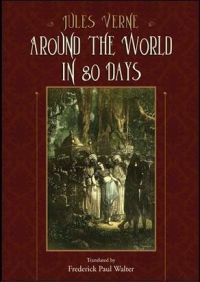
Get the Excelsior (SUNY) Walter translation of Around the World in Eighty Days
With 59 illustrations from the 1873 French edition. Includes a translator's preface, endnotes, and recommended reading. Hardcover (ISBN 9781438446790) and ebook (ISBN 9781438446806) also available.
Available as a paperback (ISBN 9781438446783, 232 pages).
Who is Matthew G. Jonas?
Matthew G. Jonas is the proprietor of Birch Hill Publishing in Chattaroy, Washington, USA. He has also published a translation of Journey to the Center of the Earth.
“About Birch Hill Publishing” by Matthew G. Jonas
“My goal is to provide modern translations of the 19th and early 20th century European genre fiction. These are books that I enjoyed reading when I was younger in older translations, and then again later in the original languages. In all of these cases, I felt like I was reading a different book when I read the original. This doesn’t have to be the case. A well-done, modern translation can provide a reader with the sense and the feeling of the original writing, but rendered into their own language. I’ve started with Jules Verne, because he’s a favorite of mine, and some of his lesser-known novels in particular have suffered from very poor English translations.”
Quick facts about the Jonas translation of Around the World in Eighty Days
Title: Around the World in Eighty Days
Availability: In print.
Completeness: (No expert assessment available.)
More about the Jonas translation of Around the World in Eighty Days
From the back cover: “Most editions Around the World in Eighty Days currently available are simply reprints of older English translations. While many of these were acceptable when they were first published 150 years ago, they were translated with a Victorian British audience in mind. Their style is now very dated, and much of Verne’s criticism of British imperialism was either softened or completely censored. This new translation attempts to preserve the sparkling, often parenthetical style of the original French prose, its use of terse dialog to move the plot forward, its precise scientific descriptions, and its subtle satire of 19th century colonialism — all while providing a text that is accessible and readable to a modern American audience.”
Birch Hill Publishing: “Translating Around the World in Eighty Days” by Matthew G. Jonas
“My overall goal when I started the translation was to be faithful to Verne’s text as much as possible, but not in an overly literal fashion that would obscure the meaning or make it difficult to read. Or, to state this in a positive form — I wanted to render the text in a way that was readable and understandable to modern, educated American readers, but also maintained the ‘feel’ of the nineteenth century original. I wanted something that sounded the way that modern readers expect a novel from that time period to sound, but with a more conversational tone…. Those who are not familiar with translational theory or methodology might simply assume that two different translators would generally translate the same text the same way. Hopefully, this post has helped to explain why this is not at all the case.”
Extract from the Jonas translation of Around the World in Eighty Days
First ~300 words of Chapter 1 (preview on Amazon):
In the year 1872, the house at number 7 Savile Row Burlington Gardens—the one in which Sheridan had died in 1814—was the home of Phileas Fogg, esq., one of the most exceptional and remarkable members of the Reform Club of London, though he had so far managed to avoid attracting any attention.
Although Phileas Fogg shared this connection to one of the greatest orators to honor England, he was an enigmatic person, whom we know almost nothing about, except that he was a very gallant man and one of the finest gentlemen in English high society.
They say he resembled Byron—or at least that his head did. For, unlike Byron, his feet were not at all deformed, he had a mustache and sideburns, he was entirely unemotional, and he seemed like he could continue on for a thousand years and not age at all.
Though he was certainly English, he may not have been a true London gentleman. No one ever saw him at the London Stock Exchange, nor the Bank of England, nor any of the other financial institutions in the City. No ships owned by Phileas Fogg ever came to the docks in London. He did not serve on the board of directors for nay company. His name had never been mentioned at any law school, nor among any of the bar associations in the legal district—not at the Temple, Lincoln’s Inn, nor Gray’s Inn. He had never argued a case in the Court of Chancery, the Queen’s Bench, The Exchequer of Please, nor in ecclesiastical court. He was not involved in industry, trade, retail, or agriculture. He was not part of the Royal Institution of Great Britain, the London Institution, the Association of Artisans, the Russell Institution, the Western Literary Institution, the Institution of Law, nor the Institution of Arts and Sciences Reunified, which was placed under the direct patronage of her gracious majesty the Queen. In fact, he did not belong to any of the numerous societies that practically swarm around the capital of England, ranging from the Musical Glass Society to the Entomological Society, which was founded primarily with the goal of destroying harmful insects.

Get the Birch Hill Jonas translation of Around the World in Eighty Days
Ebook also available (ISBN 9781957050010).
Available as a paperback (ISBN 9781957050003, 276 pages).
Who is Andrew Brown?
Andrew Brown is a translator of works in French.
Andrew Brown taught French at the University of Cambridge. According to this list, he has translated French, Italian, and German writings by Stendhal, Dumas, Voltaire, Cyrano de Bergerac, Marquis de Sade, Zola, Flaubert, Proust, Machiavelli, Maupassant, Stendhal, Jules Verne, Baudelaire, and Kafka.
In particular, he has translated Pantagruel and Gargantua by Francois Rabelais and A Fantasy of Dr. Ox by Jules Verne.
Quick facts about the Brown translation of Around the World in Eighty Days
Title: Around the World in Eighty Days
Availability: In print.
Completeness: Complete.
More about the Brown translation of Around the World in Eighty Days
Uses British spelling.
Extract from the Brown translation of Around the World in Eighty Days
First ~300 words of Chapter 1 (preview at Alma):
In the year 1872, No. 7 Savile Row, Burlington Gardens – the house in which Sheridan had died in 1814* – was inhabited by Phileas Fogg, Esq.,* one of the most noteworthy and notable members of the Reform Club in London,* in spite of his seeming intention to do nothing that might attract attention.
Thus it was that one of the greatest orators to honour England had now been succeeded by this same Phileas Fogg, an enigmatic character of whom nothing was known, except that he was a very gallant man and one of the handsomest gentlemen in British high society.
It was said that he resembled Byron – in his face, for his feet were beyond reproach* – but a Byron with moustaches and side whiskers, an impassive Byron who might have lived for a thousand years without growing old.
British he certainly was, but Phileas Fogg may not have been a Londoner. He had never been seen either at the Stock Exchange or at the Bank, or at any of the trade counters in the City. Neither the basins nor the docks of London had ever harboured a ship owned by Phileas Fogg. This gentleman was not on any board of directors. His name had never echoed in any college of lawyers – not in the Temple, nor in Lincoln’s Inn, nor in Gray’s Inn. He never pleaded either at the Courts of Chancery, or the Queen’s Bench, or the Exchequer, or the Ecclesiastical Court.* He was neither an industrialist, nor a trader, nor a merchant, nor involved in agriculture. He belonged neither to the Royal Institution of Great Britain, nor the London Institution, nor the Artisan Society, nor the Russell Institution, nor the Western Literary Institution, nor the Law Society, nor even the Society for the Combined Arts and Sciences, which is placed under the direct patronage of Her Gracious Majesty.* In short, he belonged to none of the many societies that proliferate in the capital of Great Britain, from the Harmonic Union* to the Entomological Society, founded mainly for the purpose of destroying harmful insects.*

Get the Alma Brown translation of Around the World in Eighty Days
Illustrated by Ross Collins. This edition contains extra material for young readers, including a glossary and a test-yourself quiz.
Available as a paperback (ISBN 9781847499202, 288 pages).
Repositories of Jules Verne knowledge:
The Encyclopedia of Science Fiction: Jules Verne
Describes Jules Verne’s life and work and provides a bibliography of English versions of his books and books about him.
Zvi Har’El’s Jules Verne Collection
The original Jules Verne fan community website, online since 1995.
- org copy: https://web.archive.org/web/20250712041848/http://jv.gilead.org.il/
- Another mirror: https://www.julesverne.ca/jv.gilead.org.il/index.html
Verniana
A multilingual online open access journal dedicated to Jules Verne studies.
JulesVerne.ca
A resource for collecting books and ephemera related to Jules Verne.
The North American Jules Verne Society
A non-profit organization that exists to promote interest in Jules Verne and his writings, provide a forum for the interchange of information and materials about and/or relating to Jules Verne and his works, stimulate Jules Verne research, and publish a newsletter of Jules Verne and Society related issues.
Jules Verne Forum (on Google Groups)
A group for everyone who is interested in Jules Verne and his works.
Jules Verne Forum (on Boards.net)
Another group for everyone who is interested in Jules Verne and his works.
Retranslation through the Centuries: Jules Verne in English
A book by Kieran O’Driscoll, ISBN 9783034302364, 288 pages.
Jules Verne in English: A Bibliography of Modern Editions and Scholarly Studies by Arthur B. Evans
“This chronological bibliography provides an overview of English-language editions and scholarship on Jules Verne from 1965 to 2007.”
Around the World in Eighty Days: Original French text
First ~300 words of Chapter 1 (from Gutenberg):
En l’année 1872, la maison portant le numéro 7 de Saville-row, Burlington Gardens — maison dans laquelle Sheridan mourut en 1814 —, était habitée par Phileas Fogg, esq., l’un des membres les plus singuliers et les plus remarqués du Reform-Club de Londres, bien qu’il semblât prendre à tâche de ne rien faire qui pût attirer l’attention.
A l’un des plus grands orateurs qui honorent l’Angleterre, succédait donc ce Phileas Fogg, personnage énigmatique, dont on ne savait rien, sinon que c’était un fort galant homme et l’un des plus beaux gentlemen de la haute société anglaise.
On disait qu’il ressemblait à Byron — par la tête, car il était irréprochable quant aux pieds —, mais un Byron à moustaches et à favoris, un Byron impassible, qui aurait vécu mille ans sans vieillir.
Anglais, à coup sûr, Phileas Fogg n’était peut-être pas Londonner. On ne l’avait jamais vu ni à la Bourse, ni à la Banque, ni dans aucun des comptoirs de la Cité. Ni les bassins ni les docks de Londres n’avaient jamais reçu un navire ayant pour armateur Phileas Fogg. Ce gentleman ne figurait dans aucun comité d’administration. Son nom n’avait jamais retenti dans un collège d’avocats, ni au Temple, ni à Lincoln’s-inn, ni à Gray’s-inn. Jamais il ne plaida ni à la Cour du chancelier, ni au Banc de la Reine, ni à l’Échiquier, ni en Cour ecclésiastique. Il n’était ni industriel, ni négociant, ni marchand, ni agriculteur. Il ne faisait partie ni de l’Institution royale de la Grande-Bretagne, ni de l’Institution de Londres, ni de l’Institution des Artisans, ni de l’Institution Russell, ni de l’Institution littéraire de l’Ouest, ni de l’Institution du Droit, ni de cette Institution des Arts et des Sciences réunis, qui est placée sous le patronage direct de Sa Gracieuse Majesté. Il n’appartenait enfin à aucune des nombreuses sociétés qui pullulent dans la capitale de l’Angleterre, depuis la Société de l’Armonica jusqu’à la Société entomologique, fondée principalement dans le but de détruire les insectes nuisibles.
The complete text of Le tour du monde en quatre-vingts jours is available free from Project Gutenberg:
https://www.gutenberg.org/ebooks/3456
Scans of an actual manuscript draft written by Jules Verne are online at:
https://gallica.bnf.fr/ark:/12148/btv1b530031425
I think this is the manuscript Butcher refers to as MS2. I don’t know if MS1 is also available online.
Yet more information about translations of Around the World in Eighty Days
If you would like to read 298 pages analyzing the causes of six of the above translations (and quite a lot of related background material about Verne, translations of Verne, and translation in general), look no further than the 2009 thesis titled “Around the World in Eighty Changes: A diachronic study of the multiple causality of six complete translations (1873-2004), from French to English, of Jules Verne’s novel Le Tour du Monde en Quatre-Vingts Jours (1873)” by Kieran O’Driscoll. There is a 2011 book version called Retranslation through the Centuries: Jules Verne in English.

Get Jules Verne: Four Novels by Jules Verne
"This revised, elegant book features the African exploration of Five Weeks in a Balloon; the story of Captain Nemo and his submarine in Twenty Thousand Leagues Under the Sea; Around the World in Eighty Days, the famous story of an incredible expedition; and the classic Journey to the Center of the Earth, which takes readers into our world’s geological past. With a genuine leather cover, printed endpapers, and a ribbon bookmark, as well as an introduction by an expert on Verne’s life and writing [Ernest Hilbert], it’s an excellent introduction to the work of this well-loved author." I'm not sure which translations these are, except that I expect they're all reprints of old public domain translations.
Available as a leather-bound hardcover (ISBN 9781607103172, 712 pages).
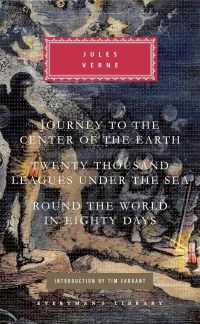
Get [3-novel omnibus] by Jules Verne
Journey to the Centre of the Earth (Anonymous Routledge), 20,000 Leagues Under The Sea (Frith), Round the World in Eighty Days (Frith).
Available as a hardcover (ISBN 9781841593517, 680 pages).
Get Jules Verne: Seven Novels by Jules Verne
Five Weeks in a Balloon, Around the World in Eighty Days, A Journey to the Center of the Earth, From the Earth to the Moon, Round the Moon, Twenty-Thousand Leagues Under the Sea and The Mysterious Island. Out of print. I'm not sure which translations these are, except that I expect they're all reprints of old public domain translations.
Available as a hardcover (ISBN 9781435122956, 1196 pages).

Get The Jules Verne Collection (7 volumes) by Jules Verne
Journey to the Center of the Earth (Malleson); Around the World in Eighty Days (Towle); In Search of the Castaways ("Charles Francis Horne"); Twenty Thousand Leagues Under the Sea ("Malleson" but actually Walter); The Mysterious Island (Kingston); From the Earth to the Moon and Around the Moon (Mercier and King); Off on a Comet (Frewer). Hardcover set also available (ISBN 9781665934398).
Available as a paperback box set (ISBN 9781665934381, 3520 pages).

Get The Best of Jules Verne (5 novels) by Jules Verne
Around the World in Eighty Days 9781853260902 (Desages), From the Earth to the Moon / Around the Moon 9781840226706 (Linklater), Journey to the Centre of the Earth 9781853262876 (Malleson), The Mysterious Island 9781840226249 (Kingston), Twenty Thousand Leagues Under the Sea 9781853260315 (Mercier).
Available as a paper back set (ISBN 9781848702226, 1824 pages).

Get Amazing Journeys (5 novels) by Jules Verne
Journey to the Center of the Earth, From the Earth to the Moon, Circling the Moon, 20,000 Leagues Under the Seas, Around the World in Eighty Days. All translated by Frederick Paul Walter. Ebook also available (ISBN 9781438432403).
Available as a paperback (ISBN 9781438432380, 678 pages).
Around the World in Eighty Days best translation?
As usual, there is no “best” translation, as different translators have different strengths and styles, and different readers have different preferences.
- If you want an American translation, get the Walter translation.
- If you want a cheap translation, look for a reprint of the 1926 Desages translation, which is in the public domain, though seemingly not yet (in 2025) available in any free online digital editions.
- If you want a scholarly British translation, get the Butcher translation, but be sure you’re okay with his interpretive angle.
- If you want a colloquial British translation, get the Glencross translation.
All four of these are in print and widely respected among Verne scholars.
Let us know in the comments which one(s) you’ve read or plan to read!
